Adobe Commerce vs Shopify vs Headless Commerce: Which Is Best for UAE Businesses?
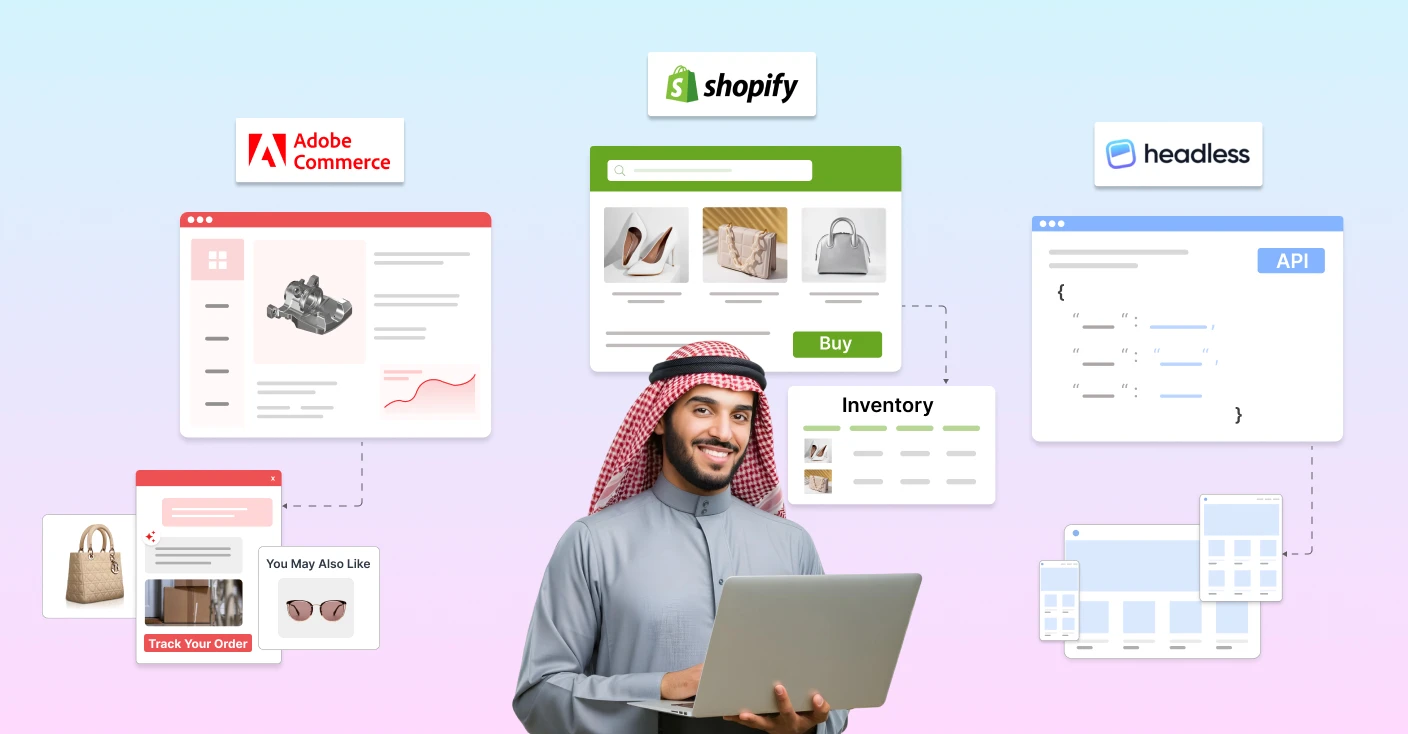
Table of Contents
Dubai’s eCommerce market is growing rapidly, creating new opportunities for businesses across retail, B2B, luxury, automotive, and distribution sectors.
However, growth alone is no longer enough to stay competitive. Today’s customers expect personalized experiences, seamless buying journeys, faster service, and consistent interactions across every digital touchpoint.
As businesses expand across the UAE and the GCC region, many are discovering that the platform that helped them launch successfully may not support their next stage of growth.
Increasing operational complexity, rising customer expectations, omnichannel demands, and the growing influence of AI-powered eCommerce are forcing organizations to rethink their digital commerce foundations.
This has led many businesses to evaluate three leading commerce approaches — Adobe Commerce, Shopify, and Headless Commerce. While each platform offers distinct advantages, the right choice depends on your business model, growth objectives, customer experience strategy, and long-term technology vision.
In this blog, we’ll compare Adobe Commerce, Shopify, and Headless Commerce to help Dubai-based businesses determine which platform best supports scalability, innovation, AI-driven experiences, and sustainable growth in an increasingly competitive digital landscape.
Why Platform Decisions Are Becoming Business Decisions
Many companies initially choose a commerce platform based on convenience. They want a quick launch, a manageable budget, and a straightforward setup.
However, as the business grows, new challenges begin to emerge. A growing catalog becomes difficult to manage. Personalization capabilities become limited. Integrating new technologies becomes expensive. Performance issues start affecting customer experience.
Most importantly, businesses find it harder to adapt to changing customer expectations.
Common challenges include:
- Difficulty scaling across multiple countries
- Limited customization options
- Poor integration with ERP and CRM systems
- Fragmented customer data
- Slow adoption of AI-powered experiences
- Increasing operational costs
At this stage, platform selection stops being a technical decision and becomes a growth decision.
Understanding the Three Commerce Approaches
Before comparing features, it’s important to understand that Shopify, Adobe Commerce, and Headless Commerce solve different business challenges.
Shopify: Built for Simplicity and Speed
Shopify has become one of the world’s most popular commerce platforms because it removes much of the complexity associated with launching an online store.
Businesses can quickly set up storefronts, manage products, process orders, and launch campaigns without requiring extensive technical expertise.
For startups and growing brands, this simplicity creates tremendous value. However, businesses with more complex requirements can use Shopify development services to customise their stores, integrate essential tools, and create experiences that better support their growth.
The platform is particularly attractive for businesses that want to launch quickly and focus on selling rather than managing technology.
However, simplicity can sometimes become a limitation as business requirements become more sophisticated.
Adobe Commerce: Built for Scale and Flexibility
Adobe Commerce takes a very different approach. Instead of prioritizing simplicity, it prioritizes flexibility and control.
Businesses gain the ability to create highly customized commerce experiences while managing complex catalogs, multiple storefronts, customer-specific pricing structures, and sophisticated business workflows.
For many enterprise organizations in the UAE, this level of control becomes essential as operations grow.
Adobe Commerce development is especially popular among businesses managing multiple brands, serving both B2B and B2C customers, or operating across different regions.
Headless Commerce: Built for Innovation
Headless Commerce isn’t simply another platform. It’s an architectural approach that separates the frontend customer experience from the backend commerce engine.
This allows businesses to create completely customized digital experiences without being restricted by traditional platform limitations.
More importantly, Headless Commerce enables organizations to adopt emerging technologies faster, making it increasingly attractive in an AI-driven commerce landscape.
The AI Factor: Why This Comparison Looks Different in 2026
A few years ago, businesses primarily evaluated commerce platforms based on features. Today, they’re evaluating platforms based on future readiness.
AI is rapidly changing how customers discover products, interact with brands, and make purchasing decisions.
Customers increasingly expect:
- Personalized recommendations
- Intelligent product search
- Conversational shopping experiences
- Real-time assistance
- Tailored promotions
Businesses that cannot deliver these experiences risk falling behind competitors.
This is why AI readiness has become one of the most important factors when selecting a commerce platform.
Shopify vs Adobe Commerce vs Headless: AI Capabilities Compared
Shopify and AI
Shopify has invested heavily in making AI accessible to merchants. The platform offers tools that help automate content creation, streamline operations, and improve customer engagement.
For many growing brands, these capabilities provide meaningful efficiency gains without requiring major technology investments.
However, businesses remain largely dependent on the capabilities available within Shopify’s ecosystem. For brands navigating the challenges in automotive ecommerce, Shopify Plus can provide the flexibility needed to build a more scalable online store.
Adobe Commerce and AI
Adobe Commerce offers a more enterprise-focused AI strategy. Organizations can leverage advanced personalization, predictive analytics, intelligent merchandising, and customer journey optimization through integrations with Adobe’s broader ecosystem.
This creates significant opportunities for businesses looking to build highly personalized experiences at scale.
Headless Commerce and AI
Headless Commerce gives businesses more flexibility to use AI. Since the frontend and backend work separately, businesses can easily add AI tools and solutions across different customer touchpoints.
This includes:
- AI-powered product discovery
- Conversational commerce
- Recommendation engines
- Generative AI experiences
- Predictive customer engagement
For organizations viewing AI as a long-term competitive advantage, Headless Commerce often provides the most flexibility.
Customer Experience: Where Brands Win or Lose
Customer experience has become one of the biggest differentiators in digital commerce. The platform you choose directly influences how effectively you can deliver personalized interactions, seamless buying journeys, and consistent experiences across every customer touchpoint.
Shopify enables businesses to launch polished customer experiences quickly, making it a strong choice for brands focused on speed and simplicity.
Adobe Commerce offers greater flexibility, allowing businesses to create highly customized experiences that align with complex operational and customer requirements.
Headless Commerce takes this a step further by providing complete freedom to design unique, omnichannel experiences without the limitations of traditional platforms.
Ultimately, the right choice depends on your growth ambitions and customer experience strategy. If your priority is rapid deployment and ease of management, Shopify may be the right fit.
However, businesses looking to differentiate through personalization, scalability, and innovative customer experiences often find greater long-term value in Adobe Commerce or Headless Commerce.
Which Platform Is Best for B2B Commerce?
For many UAE businesses, B2B ecommerce represents a significant growth opportunity as companies look to digitise complex buying processes and serve customers more efficiently.
Unlike traditional retail experiences, B2B environments often require:
- Customer-specific pricing
- Quote management
- Approval workflows
- Bulk ordering
- Company account structures
This is where platform differences become more noticeable.
Shopify can support B2B requirements but often requires additional applications.
Adobe Commerce includes powerful B2B capabilities out of the box.
Headless Commerce allows organizations to build highly customized B2B experiences tailored to unique operational requirements.
For manufacturers, distributors, and wholesalers, Adobe Commerce and Headless Commerce frequently emerge as stronger long-term options.
Which Commerce Platform Aligns with Your Business Goals?
The answer isn’t about choosing the most popular platform. It’s about choosing the platform that aligns with your business strategy.
- Choose Shopify if your priority is speed, simplicity, and faster time-to-market.
- Choose Adobe Commerce if your business requires flexibility, scalability, and advanced B2B capabilities.
- Choose Headless Commerce if customer experience, AI innovation, and long-term agility are central to your growth strategy.
The most successful businesses don’t select a platform based on current requirements alone. They choose a platform that supports where they want to be in three to five years.
How Magneto Helps UAE Businesses Make the Right Choice
Selecting the right commerce platform is only part of the journey.
Successful digital commerce transformation requires strategic planning, platform expertise, integration capabilities, and a clear understanding of future business goals.
At Magneto IT Solutions, we help UAE businesses evaluate commerce platforms, modernize digital experiences, implement AI-driven capabilities, and build scalable commerce ecosystems that support long-term growth.
Whether you’re considering Shopify, Adobe Commerce, or Headless Commerce, our team helps align technology investments with measurable business outcomes.
Conclusion
There is no universal winner between Shopify, Adobe Commerce, and Headless Commerce. Each platform serves a different purpose.
Shopify excels in simplicity and speed. Adobe Commerce delivers enterprise-level flexibility and scalability. Headless Commerce provides the agility and AI readiness needed for the future of digital commerce.
The real question is which platform is best for your business, your customers, and your growth ambitions.
As customer expectations continue to evolve across the UAE, businesses that invest in scalable, AI-ready commerce foundations today will be better positioned to lead tomorrow.
Ready to future-proof your commerce strategy? Talk to our ecommerce experts, Leverage our expertise in Adobe Commerce, Shopify, and Headless Commerce to build a scalable platform designed for growth in Dubai’s fast-evolving digital economy.
FAQs
 Is Adobe Commerce better than Shopify?
Adobe Commerce is generally better for enterprises requiring advanced customization, scalability, and B2B functionality. Shopify is often preferred for businesses seeking simplicity and faster deployment.
Why are UAE businesses adopting Headless Commerce?
Headless Commerce offers greater flexibility, stronger AI integration opportunities, and the ability to deliver personalized experiences across multiple customer touchpoints.
Which platform is best for AI-powered commerce?
Headless Commerce typically provides the most flexibility for AI integrations, while Adobe Commerce offers robust enterprise AI capabilities through its ecosystem.
When should a business consider replatforming?
Businesses should evaluate replatforming when platform limitations begin impacting customer experience, scalability, operational efficiency, or future growth initiatives.
Which commerce platform is best for UAE businesses?
There is no single best option. Shopify suits businesses focused on speed, Adobe Commerce suits complex enterprise needs, and Headless Commerce suits businesses prioritising flexibility and AI-driven experiences.
Is Shopify better than Adobe Commerce for Dubai businesses?
Shopify is often better for businesses that want faster deployment and simpler management, while Adobe Commerce is better suited to complex catalogues, B2B requirements and advanced customisation.
Which platform is best for B2B ecommerce in the UAE?
Adobe Commerce and Headless Commerce are strong choices for complex B2B requirements. Shopify can also support B2B commerce, particularly with additional applications.
How should a Dubai business choose an ecommerce platform?
Consider your business model, scalability, integrations, customer experience, AI requirements and long-term growth plans before choosing a platform.