ERP vs CRM: Understanding the Key Differences for Dubai Businesses
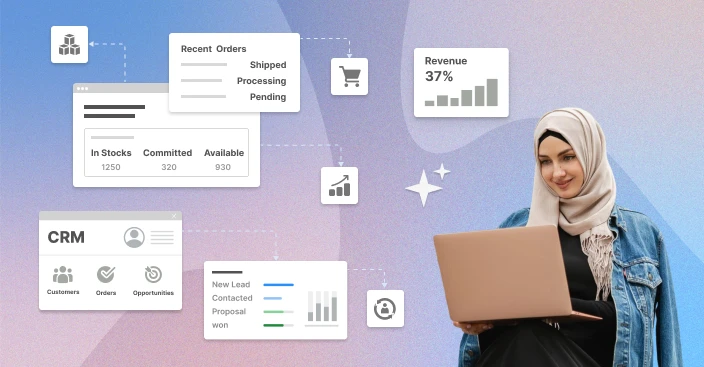
Table of Contents
In today’s digitally driven economy, businesses in Dubai are constantly looking for ways to improve efficiency, enhance customer relationships, and scale operations seamlessly. As organisations grow, managing internal processes and customer interactions through disconnected systems becomes increasingly challenging.
This is where ERP and CRM systems play a crucial role. While both are essential for business success, they serve different purposes and together create a powerful ecosystem that drives growth, efficiency, and customer satisfaction.
In fact, studies show that businesses implementing ERP systems can reduce operational costs by up to 23%, making ERP a strategic investment for companies aiming to scale efficiently in competitive markets like Dubai.
In this blog, we will explore the fundamentals of ERP and CRM, understand the key differences, and analyse how Dubai-based businesses can leverage these technologies to stay competitive.
What Is ERP? Understanding ERP Implementation for Business Efficiency
Enterprise Resource Planning (ERP) is a system designed to manage and automate core business processes, including finance, supply chain, inventory, procurement, and human resources.
An effective ERP implementation provides businesses with a unified platform for storing and managing operational data. This eliminates silos and enables real-time visibility across departments.
For growing businesses in Dubai, investing in ERP development services ensures streamlined operations, optimised resources, and more data-driven decision-making. Instead of relying on multiple tools, an ERP system brings everything together into one cohesive structure.
Think of ERP as the back office of your business, like the kitchen in a restaurant. Everything that keeps the operation running happens here, away from the customer’s view. At its core, ERP serves as a single source of truth, connecting your financial general ledger, accounts payable and receivable, payroll, inventory management, procurement, order fulfillment, and supply chain into one unified database.
For Dubai businesses operating across multiple departments or locations, this single source of data eliminates the need for separate spreadsheets and manual reconciliations. Teams across finance, operations, and logistics all work from the same accurate, real-time data — reducing errors and enabling faster decisions.
What Is CRM? The Role of CRM Development Services in Customer Management
Customer Relationship Management (CRM) focuses on managing interactions with current and potential customers. It helps businesses track leads, manage sales pipelines, and improve customer engagement.
By effectively CRM implemention, businesses can gain deeper insights into customer behaviour, preferences, and purchasing patterns. This allows for more personalised communication and improved customer experiences.
According to Salesforce, businesses using CRM systems experience an average 29% increase in sales and a 34% improvement in sales productivity, highlighting CRM’s direct impact on revenue growth.
With advanced CRM development services, Dubai businesses can automate sales processes, improve customer retention, and build long-term relationships that drive revenue growth.
A modern CRM does far more than store contact details. It tracks every interaction a customer has with your business, including phone calls, emails, website visits, social media engagement, support requests, and purchase history. This comprehensive view allows your sales and service teams to understand each customer’s preferences and history before every conversation, enabling truly personalised experiences.
For Dubai businesses that rely on high-value, relationship-driven sales — whether in retail, real estate, manufacturing, or professional services — this depth of customer intelligence is a significant competitive advantage. CRM also enables targeted marketing campaigns, automated follow-up workflows, and accurate sales forecasting based on real pipeline data.
ERP vs CRM: Understanding the Key Differences

When comparing ERP vs CRM, it is important to recognise that both systems serve distinct but complementary roles within an organisation.
ERP systems are primarily focused on internal operations. They help manage business processes, improve efficiency, and ensure that resources are used effectively. On the other hand, CRM systems are designed to enhance external interactions by managing customer relationships and improving sales performance.
While ERP ensures that the backend of the business runs smoothly, CRM ensures that the front-end customer experience is engaging and effective. Together, they create a balanced system that supports both operational excellence and customer satisfaction.
| Parameter | ERP | CRM |
| Primary Focus | Internal operations & processes | Customer relationships & sales |
| Data Managed | Financial, inventory, HR, supply chain | Customer interactions, leads, sales pipeline |
| Primary Users | Finance, operations, HR, procurement | Sales, marketing, customer service |
| Deployment Complexity | High — involves multiple departments | Moderate — typically faster to deploy |
| Cost & Timeline | Higher investment; months to years | Lower initial cost; quicker to implement |
| Core Goal | Operational efficiency & cost reduction | Revenue growth & customer retention |
Why Dubai Businesses Need ERP and CRM Integration
In a fast-paced market like Dubai, businesses cannot afford inefficiencies or fragmented systems. Integrating ERP and CRM allows organisations to create a seamless flow of information between departments.
When customer data from the CRM is linked to operational data from the ERP, businesses gain a complete view of their operations. This integration enables better forecasting, improved customer service, and more informed decision-making.
For example, sales teams can access real-time inventory data, while operations teams can better understand customer demand patterns. This level of alignment is critical to delivering consistent, efficient business performance.
Consider a real example relevant to Dubai’s market. A wholesale distribution company using ERP can track inventory levels in real time across its UAE warehouses. When integrated with a CRM, the sales team can check product availability instantly during a client call, promise accurate delivery dates, and automatically trigger an order in the ERP upon closing the deal. Finance is updated, inventory is adjusted, and the customer is informed all without manual intervention.
Similarly, a retail brand in Dubai can use CRM data on purchasing patterns to inform the demand forecasting module in their ERP, ensuring the right products are ordered ahead of peak seasons like Ramadan or Dubai Shopping Festival. This kind of cross-system intelligence is only possible when ERP and CRM are connected.
Benefits of ERP and CRM Implementation
Improved Operational Efficiency
A well-executed ERP implementation streamlines processes and reduces manual tasks, allowing teams to focus on strategic activities rather than routine operations.
Enhanced Customer Experience
By implementing CRM effectively, businesses can deliver personalised interactions, respond more quickly to customer needs, and build stronger relationships.
Better Decision-Making with Data Insights
By combining ERP and CRM data, businesses gain access to comprehensive insights that support smarter, data-driven decisions.
Scalability for Growing Businesses
As Dubai businesses expand, both ERP and CRM implementation systems provide the flexibility and scalability needed to support growth without operational disruptions.
CRM Implementation for Ecommerce Automation
Implementing CRM for eCommerce businesses automate lead management, customer follow-ups, and personalised marketing campaigns. When integrated with ERP systems, it improves operational efficiency, customer engagement, and overall business scalability in a competitive market.
Cost Efficiency and ROI
While ERP systems typically require a higher initial investment and longer implementation timelines, the long-term return is significant. CRM systems are generally faster and more affordable to deploy, delivering quicker wins in sales productivity. For Dubai businesses, the combination of both systems drives compounding returns — operational savings from ERP free up resources that can be reinvested in customer experience improvements enabled by CRM.
When Should Dubai Businesses Prioritise ERP, CRM or Both?
Start with ERP if: Your business is experiencing challenges with inventory management, financial reporting accuracy, procurement inefficiencies, or inter-departmental data silos. Manufacturing, distribution, and logistics businesses in the UAE typically benefit from ERP implementation first.
Start with CRM if: Your primary challenge is sales performance, lead management, customer retention, or marketing effectiveness. Businesses in retail, real estate, professional services, and hospitality in Dubai often see faster ROI from CRM first.
Invest in both if: You are a growing enterprise with both operational complexity and a large customer base. Companies scaling across the UAE and wider GCC region, or those preparing for rapid headcount and product growth, will need both systems to avoid hitting ceilings in either operations or customer experience.
The key insight is that ERP and CRM are not competing investments — they address different business challenges and work best in combination. As your business grows in Dubai’s competitive market, running both systems in an integrated architecture is not a luxury; it is a strategic necessity.
Choosing the Right ERP and CRM Development Services
Selecting the right technology partner is crucial for a successful ERP and CRM implementation. Businesses should prioritise providers who not only offer technical expertise but also understand their industry, operational challenges, and long-term vision.
When evaluating a partner, consider:
- Industry-specific experience and domain knowledge
- Ability to understand and align with your business goals
- Proven track record of successful ERP and CRM implementations
- Scalability and flexibility of solutions
- Strong post-deployment support and maintenance
At Magneto IT Solutions, we deliver customised ERP and CRM development services tailored to meet the evolving needs of businesses in Dubai.
Our approach includes:
- In-depth consultation to understand your business requirements
- Tailored solution design aligned with your workflows
- Seamless integration with existing systems
- Scalable architecture to support future growth
- End-to-end support from development to deployment
We ensure a smooth ERP and CRM implementation process, enabling businesses to streamline operations, enhance customer relationships, and achieve measurable growth.
Conclusion
Understanding ERP and CRM is essential for businesses aiming to thrive in Dubai’s competitive market. While ERP optimises internal processes, CRM enhances customer relationships; together, they form the backbone of a successful digital strategy.
By investing in the right systems and working with an experienced partner like Magneto IT Solutions, businesses can achieve greater efficiency, improved customer engagement, and long-term growth in the UAE.
FAQs
 What is the main difference between ERP and CRM?
ERP focuses on managing internal business processes, while CRM focuses on managing customer relationships and sales interactions.
Do businesses need both ERP and CRM?
Yes, using both systems together provides a complete solution for effectively managing operations and customer engagement.
How long does ERP and CRM implementation take?
The timeline depends on business complexity, but it typically ranges from a few weeks to several months.
Can ERP and CRM systems be integrated?
Yes, integration allows seamless data flow between systems, improving efficiency and decision-making.
Why are ERP and CRM important for Dubai businesses?
They help businesses streamline operations, enhance customer experience, and stay competitive in a fast-growing market.
Why choose Magneto IT Solutions?
Magneto IT Solutions offers customized, scalable, and efficient ERP and CRM solutions tailored to business needs.
What is the difference in cost between ERP and CRM implementation?
CRM systems are typically faster and less expensive to implement than ERP. CRM deployments can often be completed in weeks to a few months, while ERP implementations for mid-to-large businesses can take six months to over a year, depending on the complexity of your operations and the number of integrations required.
Which industries in Dubai benefit most from ERP and CRM?
ERP is particularly valuable for manufacturing, distribution, logistics, retail, and construction businesses. CRM delivers the strongest ROI in retail, real estate, financial services, hospitality, and any business with a large sales team or complex customer lifecycle.