Top E-Commerce Platforms For The Australian Market

Table of Contents
Understanding e-commerce solutions in Australia is crucial for businesses seeking to grow their online store in the evolving digital era. In this competitive era, an e-business company could only survive by focusing on consumer behaviour, as online is now not just a luxury but a necessity to rely on entirely.
According to Marketix 2026 analysis of ABS retail data, Australian online retail spending reached $82.6 billion in 2025 – roughly 24% of total retail spend with the ABS reporting $4.7 billion in online sales in June 2025 alone, a 13% year-on-year increase.
E-commerce is an online marketplace where customers and sellers can connect to make deals on sales of goods and services in a hassle-free environment. Advanced technologies like AI, mobile commerce, and personalisation fuel its growth and boost user engagement.
To maintain market growth and generate revenue, online store owners must choose a functional platform with payment integration, advanced Search Engine Optimi, and mobile responsiveness.
In this blog, we will explore the best e-commerce platforms and their capabilities to enhance engagement with the target audience and how they can be helpful for future trends.

Essential Features Of Ideal E-Commerce Platforms
The ideal e-commerce platform should be able to handle and fulfill the needs of online store owners. Though there are numerous website building and hosting platforms available in the market, the ones that have some specific features are helpful.
The e-commerce platform should monitor market competition and consumer behaviour in select regions. It should also define scalability, flexibility, personalisation, and payment integration and suggest marketing strategies.
These platforms should have some essential features to make them ideal. Let’s understand the valuable features that can help grow online business.
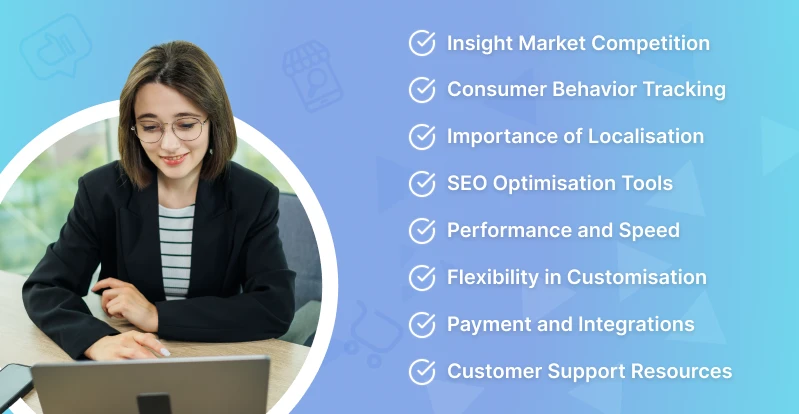
Insight Market Competition
An ideal e-commerce platform should be efficient in getting insights into the current market trends and their competitors to gain growth in the business.
Consumer Behavior Tracking
Identifying and analysing consumer behaviour and being able to offer them customised discounts and services are the signs of an ideal e-commerce platform.
According to Australian companies that excel at customer experience grow revenues 4–8% above their market, since a superior experience turns customers into repeat buyers and promoters.
Importance of Localisation
Localisation should be the essence of e-commerce platforms to achieve long-term relationships, gain regular consumers, and maintain high engagement levels. Supporting regional currencies, languages, and tax laws is essential, particularly for e-commerce platforms in the Australian market.
SEO Optimisation Tools
Provide a higher rank on search engines and draw organic traffic with built-in SEO tools or with dedicated SEO services layered on top of your platform for AU-specific keyword and technical optimisation, with a close eye on search engine optimisation performance.
Effective SEO strategies can also reduce cart abandonment rates, and 57% of consumers prefer brands using advanced technologies like SEO.
Performance and Speed
An optimised platform can provide faster page loading and optimise performance, improving user experience and conversion rates.
Flexibility in Customisation
Able to provide customised and unique branded designs without compromising the functionality of custom themes.
Payment and Integrations
Hassle-free integrations with international and local Australian payment gateways and shipping solutions, including locally focused providers such as Pin Payments and SecurePay, with support for multiple payment options. This also includes local payment methods such as Afterpay and Zip, plus key shipping integrations with Australia Post, the dominant carrier for 68% of domestic orders.
Customer Support Resources
Smooth and accessible customer support for the different regional zones for more prolonged consumer engagement.
Top 7 E-Commerce Platforms For The Australian Market
| Platform | Best for | Key strength |
| Shopify | Small to large retailers wanting speed to launch | Ease of use, 24/7 support |
| WooCommerce | Existing WordPress sites | Deep customisation, open-source |
| BigCommerce | Complex inventories, B2B | No extra transaction fees |
| Wix | Solopreneurs, small business | Visual editor, no coding needed |
| Adobe Commerce (Magento) | Large B2B/B2C enterprises | Scalability, deep customisation |
| Squarespace | Creatives, small business | Design-first, mobile responsive |
| Ecwid | Adding a store to an existing site | Easy integration, global reach |
Shopify Plus
Shopify is the most premium and popularly known e-commerce platform globally. It is recognised for its flexibility and robust features. Due to its user-friendly interface and budget-friendly and responsive design, it is a good-to-go e-business platform for several companies – our team offers Shopify Plus development for AU businesses needing custom builds on top of the platform, and you can hire Shopify experts directly if you already have a build in progress.
Advantages
- It is an easy-to-use e-commerce platform; even non-technical individuals can operate it.
- It is mobile-friendly. Thus, online store owners can get updates even on the mobiles.
- Shopify supports Afterpay and Zip Pay for Australian customers, helping merchants offer multiple payment options at checkout.
- Appreciating customer 24/7 customer support for hassle-free workflow.
Disadvantages
- Provides limited customisation in the respective package. Needs to get an upgraded subscription for better customisation themes.
- Charges additional transaction fees in addition to gateway fees, If you don’t use Shopify Payments, which can significantly increase costs for large transactions.
Features:
- Shopify has been globally recognised for its premium features, customer support, and built-in marketing tools that help merchants sell online more efficiently.
- It has more significant potential for responsiveness, which enhances the user experience and engagement, while support for customer accounts can improve conversion and retention.
Suitable for:
- Shopify is the preferred e-commerce platform for numerous small and large enterprises, and it suits businesses of different sizes, from small merchants to larger enterprises, including brick-and-mortar retailers building omnichannel sales.
WooCommerce
WooCommerce is an open-source, free plugin for WordPress users that turns a static website into a fully responsive online store, making it a flexible ecommerce platform for businesses that already rely on WordPress. This integration is quite beneficial for companies that currently use WordPress. WooCommerce powers approximately 36% of all online stores globally.
If you’re already running WooCommerce and want it customised further, our WooCommerce development and WordPress development teams handle both the plugin layer and the underlying site.
Advantages :
- WooCommerce provides WordPress integration, which is especially beneficial for businesses that already have a wordpress website.
- WooCommerce is an open-source and free plugin available to the public.
- It is mainly customisable, supports free themes as well as more advanced paid options, and is easy to customise as a preferred choice.
Disadvantages:
- WooCommerce is a self-hosted plugin, so high maintenance is required, such as regular updates and backups and implementing security measures to prevent loopholes in the online store, and many Australian businesses outgrow it as operational complexity increases.
- An open-source and freely available to the public plugin provides limited customer support.
Features:
- WooCommerce specialises in providing direct product management services.
- It can and is available for highly customisable themes and designs to gain user engagement.
- It requires separate web hosting to run reliably.
- It is a practical option for turning a current content site into an e commerce store.
Suitable for:
- WooCommerce is often the best fit for businesses with an existing WordPress site that want deeper customisation and more control, especially when they prefer not to start a new site.

Big Commerce
BigCommerce is a powerful e-commerce platform ideal for businesses with complex inventories. It offers advanced features to help scale operations.
Our BigCommerce development team specialises in exactly this kind of complex-catalogue build, and you can also hire BigCommerce developers directly for an existing project.
Advantages :
- It is user-friendly and beginner-friendly. It can help teams create, manage, and maintain e commerce sites more efficiently.
- Big-commerce has no transaction fees, so costs are more predictable with only gateway charges to consider rather than a percentage plus a fixed fee, unlike Shopify.
Disadvantages:
- It has fewer free themes than some alternatives, including Shopify.
- Big Commerce has a complex interface that may feel harder to manage for teams on the cheapest plan or an entry-level setup, which can affect user experience and engagement.
Features:
- It has excelled in multichannel selling, helping businesses drive growth across multiple channels and improve revenue visibility as they scale.
- Big Commerce has product management features that help manage and upload products, and it can support an e commerce website with larger catalogues and integrations.
Suitable for:
- Small, growing brands, B2B sellers, and businesses needing a scalable ecommerce platform
Wix
Wix is an easy-to-use website builder that is perfect for solopreneurs and small enterprises. It provides robust business features and an easy-to-use visual editor at an economical rate.
Advantages
- Wix is an e-commerce platform that is budget-friendly for beginners starting a small store.
- It mainly focuses on design, and its templates can help you launch quickly on a paid plan.
Disadvantages
- Customer service is not optimal, and you won’t be able to export your website if you switch to other platforms, which can limit flexibility if you later need to preserve customer data.
- Wix allows integration with Braintree and Stripe for payments.
- Wix’s Business plan starts at A$46 per month for e-commerce, while a premium plan may be needed as requirements grow.
- Wix cannot scale the website as the individual desires.
Features :
- Wix is simple to use and allows anyone to quickly build an attractive e commerce store. It doesn’t require coding expertise.
- Wix’s user-friendly design makes managing product listings easier for merchants, even those new to the platform, while built-in marketing tools help beginners handle promotions and storefront updates more easily.
Suitable for:
- It is mainly ideal for small businesses that want to sell online with minimal setup and technical overhead
Adobe Commerce (Magento)
Adobe Commerce offers scalable software business solutions. It includes a free Open Source version and a paid Commerce version for enterprises, allowing for customisation and growth, though technical expertise may be needed.
Our Adobe Commerce development teams help enterprises navigate exactly this trade-off between customisation depth and technical overhead.
Advantages :
- Adobe Commerce is capable of fast loading, user-friendliness, and provides the security needed for complex payment processing at scale.
- It has hassle-free and easy upgrades, along with the enterprise flexibility needed for evolving business requirements.
Disadvantages :
- It is way more expensive for start-ups and mid-size enterprises, with higher monthly costs to account for over time.
- Adobe Commerce requires web hosting sourced separately, as it doesn’t provide an in-built hosting feature.
Features :
- Scalability is ensured by Adobe Commerce, which offers dependable solutions for expanding business requirements.
- Adobe Commerce supports complex e commerce analytics and reporting for large catalogues and teams.
- Adobe Commerce, like many other systems, allows merchants to maintain their own product listings, but it also offers tools to help automate the process.
Suitable for:
- B2B and B2C, especially larger operations building a successful online store at scale
Squarespace
Squarespace is a simple SaaS platform that enables anyone to build a beautiful and effective online business.
Advantages :
- Squarespace is a complete e-commerce platform and can be a good fit for an e commerce website with strong visual presentation.
- One of the more effective interfaces for beginners, with support for custom domains.
Disadvantages :
- Squarespace is more expensive than competing commerce platforms across its commerce plans, and its Basic plan charges a 2% transaction fee on sales, despite its simple user experience.
- It doesn’t provide mobile support, so it can’t quickly get updates about the data everywhere.
Features :
- It is fully mobile responsive, which helps get the updated data anytime and anywhere.
- Squarespace integrates with Stripe, PayPal, and Afterpay for payment processing.
- It supports your own domain name, which helps strengthen store branding and professionalism.
- It has limited third-party integrations, which implies more security from outside sources and relief from data breaches.
Suitable for:
- Creatives, service businesses, and small business owners who want a polished e commerce website with minimal setup
Ecwid
Top digital store-holder platforms like Ecwid are ideal for business owners looking to integrate an online store with their current website. They provide cost-effectiveness, flexibility, and global accessibility to satisfy various online business targets.
Advantages :
- Ecwid helps merchants sell online across an existing website and other touchpoints, making it easier to reach a global audience.
- It doesn’t charge extra transaction fees, unlike Shopify, and its lower entry pricing can appeal to businesses comparing monthly fee commitments.
Disadvantages :
- It doesn’t allow for search engine optimisation customisation, which can directly degrade rankings.
- It has a significant dependency on host platforms, with limited features compared with more full-scale platforms.
Features:
- Ecwid provides easy integration with other platforms, supports multichannel selling, and helps adapt the outside features.
- It enhances mobile presence by making it easily accessible it and updating the data anywhere.
- It lets merchants connect to multiple channels from one backend.
Suitable for:
- Small and medium size; Ecwid suits businesses that want to extend an existing e commerce website rather than rebuild from scratch.
E-Commerce Platforms Adapting To Australian Future Trends
AI, Voice Search, And AR In E-Commerce
To improve the consumer experience and smoothen the business in this digital era, AI needs to take the step. The right ecommerce platform makes platform choice a strategic decision, especially when brands want to adopt AI, voice search, and augmented reality without limiting future customization or control. The emerging technologies AI, voice search, and augmented reality in online purchasing help retailers think outside the box. Online retailers are able to forecast trends, provide automated customer service, and make customised suggestions with the help of artificial intelligence.
Moreover, voice search makes it simpler for customers to find and buy products with just their voice using devices like Alexa and Google Assistant. AR improves the interactivity of online shopping by allowing customers to try on clothing or see products in their homes before making a purchase. These trends have led to 57% of consumers increasing their chances of spending money on a brand’s use of the latest technologies, such as AR.
E-commerce Platforms Shape Australia’s Future
As technology evolves and consumer behaviour changes over time, e-commerce platforms are becoming more attentive and trying to meet their customer’s needs, especially for Australian businesses adapting to local customer expectations. With the growing Australian online shopping market, the expectation of using AI for personalisation and machine learning for specific recommendations and dynamic pricing has been the top expectation, and the best platform often depends on growth stage, local integrations, and data needs.
With the expectations of getting updates anywhere and anytime, mobile commerce has become a prominent part of the digital purchasing era; thus, platforms will prioritise mobile-first designs to provide quick loading times and accessible user experiences, with smoother transitions between online journeys and brick-and-mortar store experiences. With the increasing features of voice and AI search capabilities, it will also be easier to find products and shop hands-free. Thus, the combination of online and offline buying will enable seamless transitions between digital and physical companies for customers, with clear shipping costs visibility helping meet omnichannel customer expectations.

Steps To Implement An E-Commerce Market
Starting your journey in the exploding online market requires following a few beginner-friendly steps for successful execution. Here are 6 easy steps to implement in an online marketplace.
Planning :
Set clear goals, allocate resources, develop a business plan, identify your niche and market trends, and establish a customer service strategy.
Choose The E-Commerce Platform :
Establish your digital store by selecting a commerce platform based on your business model, budget, and integration needs rather than naming tools only. The right platform choice also depends on factors like AI integration, support for features such as voice search or augmented reality, and the level of customization and control you need. The best platform is the one that fits your own e commerce business and long-term growth plans.
Understanding The Target Market :
To stay competitive in the market and attract consistent consumers, you should understand the target market and monitor consumer behaviour.
Marketing Strategies :
In this digital era, consumers can only be drawn to your site through marketing, so platform evaluation and execution should also consider built-in marketing tools that support lead generation, campaigns, and third-party integrations. To stay ahead in terms of quality, online shop owners first need to get ahead in marketing strategies, and many successful sellers use multiple channels to reach customers more effectively.
Use Analytics :
Various strategies and tactics are useless until the gap between the consumers and the owner is closed. Thus, after fulfilling the consumer expectations, use e commerce analytics as the basis for closing that gap and take the necessary steps based on the given feedback, while using customer data responsibly to improve decisions.
SEO Optimisation :
SEO is essential in digital marketing to increase visibility and generate leads. Consistent feedback and skilled SEO help maintain higher SEO rankings, and pairing this with ongoing conversion rate optimisation ensures the extra traffic actually converts.
Conclusion
The growing Australian market has set a huge bar for e-commerce entrepreneurs. Choosing the right ecommerce platform for Australian businesses depends on your business needs, local integrations, and long-term growth plans. Selecting a platform that meets your business needs with capabilities like AI, mobile-friendly designs, and customisation is critical, alongside factors like payment processing, SEO, and analytics.
Each platform has unique benefits to support your growth, regardless of the size of your organisation. Our experts provide mentorship, technical support, and platform recommendations to help your e-commerce business succeed in Australia’s competitive market.
Not sure which platform is right for your business? Book a free consultation with our eCommerce strategists, and choose the right platform to grow your business like never before.
FAQs
 What's the best eCommerce platform for a small business in Australia?
Shopify or Wix, generally both are beginner-friendly with low technical overhead. Shopify tends to win for businesses planning to scale, since it has stronger app/integration support and 24/7 customer support.
Is Shopify or WooCommerce better for an Australian business?
It depends on your starting point: choose WooCommerce if you already run WordPress and want deep customisation with full control over hosting and plugins. Choose Shopify if you want a faster launch with less ongoing technical maintenance, at the cost of some customisation flexibility.
Which platform is best for a large or complex product catalogue?
BigCommerce or Adobe Commerce (Magento). BigCommerce handles complex inventories well without extra transaction fees; Adobe Commerce offers deeper customisation and scalability but needs more technical expertise and budget (its enterprise pricing runs into the tens of thousands per year).
Do these platforms support Australian-specific payment methods like Afterpay and Zip?
Most major platforms – Shopify, BigCommerce, Squarespace, Wix — support these through built-in or app-based integrations, since Buy Now Pay Later options are now a standard expectation for Australian online shoppers. WooCommerce can support them too, but typically needs a plugin since it relies on your own hosting setup rather than built-in support.
What role does AI and voice search play in choosing an eCommerce platform?
A growing one – AI powers personalised product recommendations and demand forecasting, while voice search and AR let customers shop hands-free or preview products before buying. Around 57% of consumers say a brand’s use of technologies like AR increases their likelihood of spending with that brand, so platform choice increasingly depends on how well it supports these features natively or via apps.
How much does it cost to set up an eCommerce store in Australia?
It ranges widely by platform: Wix and Shopify start in the $17–29/month range for small stores, BigCommerce and Squarespace sit similarly, while Adobe Commerce (Magento) enterprise licensing runs from roughly $22,000 to $125,000 per year. Always verify current pricing directly with the provider, since plans change often.
What should I check before committing to an eCommerce platform?
Beyond price, check payment gateway support (including local ones like Pin Payments/SecurePay), mobile responsiveness, SEO customisation options, and how easily the platform scales — some platforms that are great at launch (like Wix) become limiting once you need advanced customisation or higher transaction volume.