How to Build a D2C Furniture Brand That Customers Trust
Table of Contents
Building a direct-to-consumer furniture brand that customers trust starts with reducing the risk of buying a high-ticket item online: give shoppers a seamless ecommerce experience with high-quality visuals, room visualization or AR tools, transparent delivery and return policies, responsive support, and logistics they can rely on. In furniture, you’re asking someone to buy a $1,000+ product they have never sat on, touched, or seen in person and to pay before it ships. That’s the entire challenge in one sentence. Solve it, and you’re competing with Wayfair, Article, and Joybird on equal footing. Ignore it, and no amount of ad spend will save your conversion rate.
The global furniture market is worth roughly $691 billion in 2025 and is projected to reach USD 866.59 billion by 2030, according to Mordor Intelligence, and online sales are the fastest-growing slice of it. For founders, ecommerce teams, and furniture businesses launching or scaling a D2C brand, that creates a real opportunity—but also a harder trust problem than most product categories, because expensive items, long delivery windows, and costly returns make every weak point in the customer journey more visible. This guide breaks down the D2C furniture market, the challenges unique to selling furniture online, the website features and trust signals that improve conversion, how to handle logistics and customer experience, what growth tactics and budgets matter, and what separates a thriving brand from one that burns cash on returns and rebuys.
What Is a D2C Furniture Brand?
A D2C (direct-to-consumer) furniture brand designs, manufactures or sources, and sells furniture straight to shoppers through its own website – skipping department stores, big-box retailers, and third-party marketplaces. The brand has direct control over the customer relationship, pricing, and the entire customer journey, from product discovery and photography to delivery and post-purchase support.
This model gives furniture companies more margin and more brand control than wholesale, and D2C brands retain a larger portion of revenue than traditional retail, but it also means they absorb every logistics and trust problem that a traditional retailer would normally handle in-store. With furniture web development solutions, businesses can create seamless digital experiences that address these challenges and strengthen customer trust.

The D2C Furniture Industry Market in 2027: Why Now
Three shifts are pulling furniture shopping online faster than most other retail categories. In 2018, D2C sales accounted for 30% of the market, and they jumped 67% from 2019 to 2020.
North America alone generated 135 billion USD from digitally-only D2C brands in 2023.
- consumers are comfortable spending big online. Many check reviews before purchasing, and Millennial and Gen Z shoppers routinely make high-ticket purchases when they can see detailed specs, high-resolution photos, and real customer photos or unboxing videos.
- Visualization technology closed the “can’t touch it” gap. Augmented reality (AR) and 3D configurators now let shoppers place a virtual sofa in their actual living room before buying.
- Customization went mainstream. Brands that let customers pick fabric, finish, size, and modular configuration create a sense of ownership before the order even ships — and that emotional investment helps align with customer expectations and reduces returns.
Suggested chart: “Global Furniture Market Growth, 2025–2030” – a line or bar chart plotting market value at $691B (2025) → $902B (2030), sourced from Mordor Intelligence, with a second series showing online/D2C channel share if your analytics or a licensed report can supply it.
Why Furniture Is the Hardest D2C Category to Get Right
Furniture doesn’t behave like apparel or home decor in a cart. Three structural differences make it harder to sell online:
- High average order value. A single mistake (wrong color, wrong scale, damaged in transit) is expensive to fix; in Q2 2023, the average order value of home products was $421.
- Complex logistics. Freight shipping, assembly, and white-glove delivery are nothing like a poly mailer.
- No physical trial. Shoppers can’t sit on it, feel the fabric, or check the finish in person before buying, which makes it harder to feel confident about quality, comfort, and fit.
A clear and generous return policy, along with transparent in-home trial periods, reduces purchase anxiety and purchase risk for furniture buyers. Realistic delivery expectations are also part of building trust.
Return rates reflect this: industry estimates put furniture and home goods returns at roughly 5–10% under normal conditions, and as high as 30–40% when sizing or visualization tools are missing or poor. That gap is exactly where the strategies below pay off.
The Competitive Landscape: Taking On Wayfair, Article, and Joybird
Wayfair, Article, and Joybird dominate D2C furniture through scale and ad budgets that most new brands can’t match. New entrants win by competing on dimensions where they can stand apart in ways incumbents can’t easily copy.
| Differentiation Strategy | What It Looks Like | Why It Works |
|---|---|---|
| Sustainable materials | Reclaimed wood, recycled fabrics, non-toxic finishes, carbon-neutral shipping | Appeals to environmentally conscious buyers willing to pay a premium |
| Modular design | Sofas, storage, and tables that reconfigure as space needs change | Matches shrinking urban living spaces and renter flexibility |
| White-glove customer experience | In-home delivery, assembly included, generous returns, transparent pricing | Removes the two biggest furniture-buying fears: fit and hassle |
| Niche positioning | A single category done exceptionally well (e.g., only sofas, only nursery furniture), with market research to identify a specific gap in the furniture market | Lets a small brand focus and out-execute generalists in one area |
| AI-assisted shopping | Chatbots and virtual design consultations from the customer’s perspective | Replicates the in-store sales associate experience online |
7 E-Commerce Website Features Every D2C Furniture Brand Needs
Your website is doing the job a showroom floor and a sales associate used to do, starting with product discovery well before a shopper is ready to buy. Miss any of these, and you’re leaving conversions and trust on the table.
| # | Feature | What It Solves |
|---|---|---|
| 1 | Intuitive navigation & filtering | Lets shoppers filter by material, size, color, and price without frustration |
| 2 | High-resolution visuals, 360° views & AR placement | Replaces the ability to touch and see the product in person |
| 3 | Mobile-first, fast-loading design | Captures the roughly three-quarters of e-commerce traffic that now comes from mobile devices |
| 4 | Detailed specs, dimensions & size comparisons | Cuts returns caused by scale misjudgment and gives shoppers the knowledge they need to buy with confidence |
| 5 | Transparent returns & refund policy | Reduces purchase hesitation on high-ticket items and helps brands communicate openly |
| 6 | Multi-channel customer support | Resolves questions about customization, assembly, and delivery before they become abandoned carts, while strengthening customer relationships |
| 7 | Flexible payment & BNPL options | Makes large purchases feel affordable by spreading out the cost |
A well-optimized website doesn’t just convert better – it also supports brand reputation. Fast, clutter-free pages with clear product data lower bounce rates and give search engines and AI answer engines cleaner content to cite.
High-Quality Visuals and AR Are Non-Negotiable for Customer Experience
This is worth its own callout because the data is unusually strong. IKEA and Wayfair were early adopters of AR placement tools, and the results across the industry are consistent:
- Shopify has reported that merchants using AR or 3D product visualization see up to 40% fewer returns.
- Macy’s cut return rates on VR/AR-assisted furniture purchases to under 2%, compared with a typical 5–10% baseline.
- Independent research from Magna Media Trials found shoppers were 64% less likely to return a product they had previewed in AR.
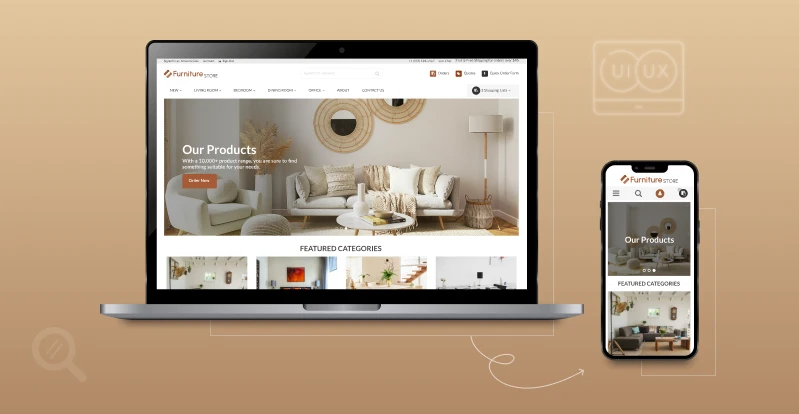
The mechanism is simple: AR improves how customers perceive products before delivery, closing the gap between what they expect and what actually arrives. Better visualization also helps create more relevant experiences on mobile and desktop, while tools like configurators can personalize experiences around shopper preferences.
Suggested chart: “How AR Changes Furniture Return Rates” – a before/after bar chart comparing a typical furniture return rate (5–10%, citing industry estimates) against AR-assisted return rates (under 2%, citing Macy’s/Shopify data above).
Suggested chart: “Mobile vs. Desktop Share of Furniture Shopping Traffic” – a simple pie or stacked bar chart at roughly 75% mobile / 25% desktop, sourced from current mobile commerce data, to justify a mobile-first design budget.
The 4 Biggest Challenges in Building Customer Loyalty for a D2C Furniture Brand
| Challenge | Root Cause | How to Solve It |
|---|---|---|
| Earning trust | Furniture is a considered, long-term purchase; shoppers fear quality or fit mismatches | Detailed photography, video demos, verified reviews with photos from other customers, generous warranties |
| Supply chain & manufacturing | High material costs, long lead times, complex logistics | Vet manufacturers rigorously, run strict QC checks, specify the provenance of materials in quality standards, and work with ethical manufacturing partners that meet quality and environmental standards |
| Logistics & fulfillment | Furniture is bulky, heavy, and expensive to ship or return | Partner with furniture-specialized 3PLs, offer white-glove delivery for high-value items, use damage-resistant packaging |
| Retention & repeat purchase | Furniture is a low-frequency category by nature | AR-driven engagement, personalized recommendations, loyalty and referral programs, plus loyalty programs for repeat buyers |
Initial customer feedback is critical for building customer trust and refining the offer.
An iterative feedback process helps improve pricing, service, and customer engagement over time.
5 Growth Strategies That Actually Work
- Brand storytelling built on a real value. Craftsmanship, sustainability, or design philosophy – pick one, prioritize authenticity, and make it visible in every product page and social post, not just an About page.
- SEO and content marketing. Publish buying guides, room-styling content, and care tutorials that target the searches your customers are already making and are informed by customer behavior. This lowers acquisition costs over time compared with paid ads alone.
- Social and visual discovery. Pinterest and Instagram drive furniture discovery through inspiration boards and lifestyle imagery; TikTok and YouTube work well for behind-the-scenes and assembly content, and social media helps amplify that trust through real customer interaction.
- Reviews and referral programs. Photo and video reviews on product pages directly address the “will it look like the picture” hesitation that drives furniture cart abandonment, while referrals help strengthen customer loyalty.
- Verified sustainability credentials. FSC or GREENGUARD certification, published supply chain details, and take-back or recycling programs build credibility with environmentally motivated buyers who don’t just claim “eco-friendly,” prove it, and these signals can attract more customers over time.
D2C vs. Traditional Retail Furniture: Which Model Fits Your Brand?
| Factor | D2C Furniture Brand | Traditional Retail |
|---|---|---|
| Margins | Higher – no wholesale markup or retailer cut | Lower – retailer takes a margin |
| Customer relationship | Owned directly (email, reviews, customer data) | Owned by the retailer, limiting direct customer relationships |
| Upfront cost | Lower barrier to entry, but marketing-heavy | High cost of retail placement and inventory |
| Trust-building | Must be built entirely online (photos, reviews, AR) | Built in-store through physical inspection and physical stores |
| Speed to market | Faster – no retailer buy-in cycles needed | Slower – dependent on retail buying seasons |
| Returns handling | Brand owns the full logistics burden | Retailer often absorbs in-store returns |
| Best suited for | Brands with a strong niche, design story, or price advantage in a modern furniture business | Brands prioritizing broad, immediate reach |
What to Budget For When Launching a D2C Furniture Brand
Exact costs vary enormously by product category, materials, and market, and with 30% of D2C startups failing in their first year, treat any single dollar figure you see online with caution. What’s consistent is the budget categories every founder needs to plan for, even if cost structures differ from traditional furniture retailers:
- Product development & sourcing — sampling, tooling, manufacturer vetting, quality control
- eCommerce platform & website build — including AR/3D visualization tooling, which pays for itself in reduced returns
- Photography & content — high-resolution, 360°, and lifestyle imagery for every SKU and variant
- Logistics infrastructure — freight partnerships, white-glove delivery, packaging engineered to survive freight handling
- Customer acquisition — a mix of SEO/content (lower cost, slower to compound), paid social, and advertising (faster, higher cost per acquisition)
- Returns and warranty reserve — budget for this as an obvious cost of doing business, not an edge case

Conclusion
A successful D2C eCommerce website is built on the same core promise as a good showroom: help the customer see themselves owning the piece, then remove every friction point between “I like this” and “it’s in my home.” That means investing in visualization technology, being honest about sizing and materials, owning your logistics rather than treating them as an afterthought, and building a brand story customers actually believe—one that creates lasting relationships and strengthens your customer base over time.
The furniture brands that will lead the next five years of this market are the ones solving the trust problem better than Wayfair, Article, and Joybird, not the ones simply outspending them on ads in the furniture industry.
Ready to build the eCommerce infrastructure your furniture brand needs? Talk to our eCommerce development team about AR-ready product pages, mobile-first UX, and platform builds designed specifically for high-ticket, high-consideration categories like furniture.
FAQs
 What is a D2C furniture brand?
A D2C furniture brand designs, sources, or manufactures furniture and sells it directly to consumers through its own website, without going through department stores or third-party retailers.
Why do furniture brands have higher return rates than other e-commerce categories?
Furniture return rates run higher because shoppers can’t physically test fit, scale, or fabric before buying. Industry estimates put furniture returns at 5–10% under normal conditions and as high as 30–40% without adequate sizing or visualization tools.
Does augmented reality actually reduce furniture returns?
Yes. Retailers using AR product placement have reported return-rate reductions ranging from roughly 25% to 64%, depending on the study, with Macy’s reporting under 2% returns on AR-assisted furniture purchases.
Should a D2C furniture brand offer Buy Now, Pay Later?
Offering BNPL options like Klarna, Affirm, or Afterpay is worth it for most furniture brands because it lowers the perceived cost of high-ticket items and can measurably improve conversion rates on big-cart purchases.
What's the biggest challenge in launching a D2C furniture brand?
Earning trust without a physical showroom is the biggest challenge. Brands overcome it with detailed product visuals, AR previews, verified reviews, and transparent return policies.
Is white-glove delivery necessary for a D2C furniture brand?
White-glove delivery isn’t mandatory for every price point, but it’s strongly recommended for high-ticket or bulky items, since it directly reduces damage-related returns and improves the unboxing experience that drives reviews.