AI-Powered Hyper-Personalisation and Beyond in Australia’s Future of eCommerce

Table of Contents
AI hyper-personalisation in Australian eCommerce means using real-time behavioural data and machine learning to tailor what each shopper sees, from product recommendations and search results to emails, offers and support replies. It has moved from “nice to have” to baseline: McKinsey’s global research found that 71% of consumers expect personalised interactions and 76% get frustrated when they don’t receive them, while personalisation most often lifts revenue by 10–15%.
The fastest returns come from a short list of use cases: recommendations, smart search, AI assistants, demand forecasting and fraud screening. One rule change also matters for every retailer: under the Privacy Act’s automated decision-making rules, Australian businesses that use automated decisions affecting people must explain it in their privacy policy. This guide covers what to build first, what Australian retailers like Woolworths are already doing, how to stay compliant, and how to measure ROI.
What Is AI Hyper-Personalisation?
Hyper-personalisation uses live data (browsing, purchases, location, device and timing) and machine learning to build an experience for one customer rather than a segment. Traditional segmentation sends the same email to “women 25–34 who bought shoes.” Hyper-personalisation decides, per person and per moment, which product, message, price band or channel is most relevant.
- Segmentation: targets groups using demographics and past purchases. The marketer decides. Example: a seasonal email blast.
- Personalisation: targets a named customer using purchase history and preferences. A rules engine decides. Example: “Hi Sam, you left this in your cart.”
- Hyper-personalisation: targets the individual in real time using live behaviour, context and predicted intent. An AI model that keeps learning decides. Example: homepage, search and offers reshuffled per visit.

Why It Matters for Australian Retailers
- 71% of consumers expect personalised interactions, and 76% feel frustrated when it’s missing (McKinsey, global).
- 10–15% is the typical revenue lift from personalisation, with company results ranging from 5–25% (McKinsey, global).
- 97.1% of Australians are online (DataReportal, Digital Australia report).
- 45.2% of Australian eCommerce spend is made on mobile (DataReportal, Digital Australia report).
- About 39% of Australians use generative AI for product research and selection.
- Woolworths has upgraded its AI assistant Olive into an agentic shopper (Woolworths Group).
Australian shoppers are online, mobile-first and increasingly guided by changing consumer preferences shaped by AI-assisted discovery. For most retailers the gap isn’t awareness. It is choosing the two or three use cases that pay back first. Your platform shapes how easy that is, and our comparison of the best eCommerce platforms is a good starting point.
7 AI Use Cases Australian eCommerce Brands Are Using
These AI-driven use cases help improve customer experience while strengthening operational performance.
- Product recommendations: rank products per shopper from behaviour and history. Moves conversion rate and average order value.
- Smart and visual search: understands natural language and image uploads. Moves search-to-purchase rate.
- AI shopping assistants: answer questions, plan baskets and track orders. Moves support cost and basket size.
- Predictive analytics: forecasts demand and customer lifetime value. Moves stock-outs, overstock and retention.
- Dynamic pricing: adjusts prices on demand, competition and stock. Moves margin and sell-through.
- Logistics optimisation: plans routes and warehouse picking, with gains for supply chain management through lower delivery costs and faster fulfilment. Moves delivery cost and time.
- Fraud detection: scores transactions and flags unusual behaviour. Moves chargebacks and false declines.
1. Personalised Product Recommendations
Machine learning algorithms use browsing history and purchase patterns to identify patterns in consumer behavior, helping rank what each visitor sees. This is usually the best first project because it works on data you already collect and supports tailored recommendations with more personalised shopping experiences. Our AI personalisation services cover recommendation engines, on-site content and triggered offers, including personalised discounts as a common retention and conversion use case, while AI smart merchandising decides which products to feature and in what order. The major platforms support this well. See our Shopify Plus development, Magento development and BigCommerce development services for how recommendation and search tools plug into each.
2. Smart Search and Visual Recognition
AI-powered search improves online shopping by helping shoppers find the right product faster. It handles typos, slang and descriptive queries such as “black boots for wide feet,” and visual search lets someone upload a photo to find similar items, with virtual try ons and augmented reality supporting discovery and fit confidence. Good search is also an accessibility win, and our guide to improving UX through accessibility covers the overlap.
3. AI Assistants and Agentic Shopping
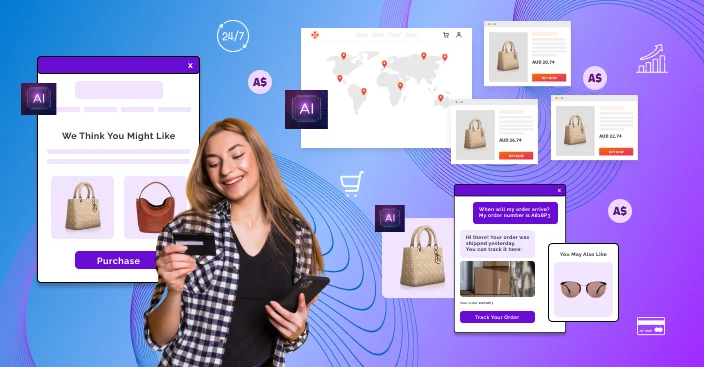
The big shift in AI shopping is from AI-powered chatbots that answer to assistants that act, with virtual assistants becoming the next step toward more agentic support. Woolworths has rebuilt Olive on Google’s Gemini platform so it can plan meals, apply loyalty discounts and add items to a basket, although customers still approve and pay. Woolworths can also surface loyalty programs and personalised discounts through assistants to improve engagement. Coles has taken a different path. It signed a multi-year Microsoft partnership and so far uses generative AI mainly for staff.
For smaller retailers, the lesson is to start with order tracking, product questions and returns, then widen the assistant’s role once it proves accurate. An AI chatbot is the usual first step, and guide to agentic AI vs rule-based automation explains when to move beyond fixed rules, while a hybrid model helps preserve human interaction, human touch, and customer satisfaction.
4. Predictive Analytics and Demand Forecasting
Predictive models use advanced analytics on sales history, seasonality and promotions to forecast demand per product and location, which is the core of our AI demand forecasting service. This reduces both overstock and empty shelves, while also supporting more efficient supply planning in the retail sector, and predicted customer lifetime value (CLV) shows which customers deserve the most retention spend.
5. Dynamic Pricing
AI dynamic pricing adjusts prices as demand, stock and competitor pricing change. It can lift margin, but it is also the use case most likely to feel unfair, and it may count as an automated decision under the new privacy rules (see below). Keep price rules explainable, set floors and ceilings, and get legal advice on Australian Consumer Law before switching it on.
6. AI in Logistics and Fulfilment
Australia’s distances make delivery costly, and AI in logistics supports broader supply chain management goals by reducing costs and enabling faster deliveries, enhancing customer experiences through more reliable fulfilment. AI route planning cuts kilometres and failed deliveries, while warehouse automation speeds up picking and packing. Drone delivery is being trialled in parts of the country, but for most retailers route optimisation and accurate delivery estimates deliver value sooner.
7. Fraud Detection
Machine-learning models, like those behind our AI fraud detection service, score each transaction against normal behaviour. They catch suspicious patterns in real time and reduce false declines of good customers. Published reduction figures vary widely by vendor and merchant, so test on your own chargeback data before promising a number. Frictionless checkout still matters, so see Magento checkout extensions for balancing security and conversion.
Which Platform Path Fits Your Personalisation Goals?
Personalisation is only as good as the platform and data underneath it, and many Australian retailers find fragmented back-end systems block real-time data unification. Use this table to match your business model to the right starting point.
| Platform Path | Best Fit | Personalisation Strengths | Watch-Outs |
|---|---|---|---|
| Shopify Plus | Retailers moving from offline to online, fast-launch brands | Large app ecosystem for recommendations, search and email; quick to test | App sprawl and disconnected systems can slow ai integration |
| Adobe Commerce (Magento) | Enterprise and B2B sellers with complex catalogues | Deep customisation, account-specific catalogues and pricing, flexible integrations | Higher build and maintenance effort; needs clear ownership |
| BigCommerce | Mid-market brands wanting an open, API-first SaaS | Strong APIs, multi-storefront options, easy third-party tool connections | Tool selection and integration are on you |
| Composable / headless | Multi-brand or multi-channel retailers | Plug in best-of-breed AI search, CDP and recommendation tools | Needs strong integration planning and data governance |
If you are weighing a move, our Shopify Plus migration service and Adobe Commerce migration guides explain what changes for your customer data and AI integration readiness.
Personalisation Beyond the Website
Personalisation breaks down when the app, store, email and website each hold a different picture of the customer. Unified commerce helps create a single customer view across e commerce touchpoints through one customer profile. Four practical building blocks:
- Mobile apps and in-app recommendations: mobile apps are a natural home for eCommerce personalisation, and our mobile commerce development team builds these experiences.
- Headless and composable architecture: separating the storefront from the back end lets you add AI tools without rebuilding everything, and it gives brands room to deliver bespoke solutions across channels. See our headless commerce and Commercetools services.
- Content at scale: personalised product copy, emails and landing pages need a lot of content. AI content automation helps produce it consistently, with human review.
- Lifecycle messaging: triggered and predictive emails are one of the lowest-cost places to apply personalisation. See our email automation services.
Direct-to-consumer brands have the most to gain, since they own customer data end to end. B2B sellers can personalise too, with account-specific catalogues, pricing and reorder prompts through our B2B eCommerce solutions. For a wider channel view, read overview of digital commerce channels and technologies.
The Privacy Rule Every Australian Retailer Should Know
Australian Privacy Principles 1.7–1.9 require organisations covered by the Privacy Act to explain in their privacy policies when they use automated decision-making, including AI, to make or substantially assist decisions that significantly affect individuals’ rights or interests. The OAIC has published final guidance to help organisations assess this.
Whether a use case is in scope depends on a three-part test. Recommendations will often fall outside it, while pricing, credit-style decisions and automated account blocks may fall inside.
Does Your Use Case Trigger the Disclosure?
| Use Case | Example Automated Decision | Likely in Scope? | What to Do |
| Product recommendations | Ranking which products a shopper sees | Often out of scope | Document the logic; review if it starts to restrict choice |
| Email and offer personalisation | Choosing message content or send time | Usually out of scope | Keep opt-outs and consent records clean |
| Dynamic pricing | Showing different prices to different shoppers | Check closely | Disclose if price materially affects the individual; get legal review |
| Fraud screening | Auto-declining or flagging a transaction | Check closely | Keep a human review path for contested declines |
| Account blocks or suspensions | Automatically locking a customer account | Likely in scope | Disclose and provide a clear appeal route |
| Credit-style decisions (e.g. buy-now-pay-later eligibility) | Approving or refusing finance at checkout | Likely in scope | Disclose, and confirm what your finance partner’s model does |
| AI assistant decisions | Approving or refusing returns or refunds | Check closely | Disclose if the bot decides, not just advises |
Use this five-step plan to get ready before the deadline:
- Inventory: list every AI or automated system that touches customer data, including vendor tools.
- Classify: check each against the OAIC’s test for “significant effect.”
- Update: add plain-English disclosures to your privacy policy.
- Govern: assign an owner and keep a human review path for contested decisions.
- Review vendors: confirm what data third-party AI tools collect and where it goes.
Treat this as a trust opportunity rather than a chore. After the Optus and Medibank breaches, customers are watching how brands handle their data.
Challenges of Using AI in Australian eCommerce
- Privacy and compliance: personalisation needs data, and the Privacy Act limits how it’s used. Collect only what you need, be transparent and update your policies.
- Skills gap: data science and ML talent is scarce. Start with platform-native tools, upskill existing staff and partner with specialists, while leveraging AI responsibly in the competitive landscape.
- Integration complexity: legacy platforms, fragmented systems and siloed data slow everything down. Move to a modern or composable stack and connect data before adding models.
- Cost and unclear ROI: spend comes before benefits. Pilot one use case, set baseline metrics and scale what works; forecasts suggest generative AI could replace 100,000 frontline agent roles by 2025, so human oversight still matters.
What’s Next for AI in eCommerce
- Market trends shaping the future of AI in eCommerce: assistants that plan, compare and fill baskets on the shopper’s behalf, with consent. Expect more Australian retail businesses to follow Woolworths as technological advancements accelerate adoption. To be recommended by these assistants, product data and content must be structured for AI search, which is the focus of our generative engine optimisation and answer engine optimisation services.
- AR and AI together: virtual try-on and room-visualisation tools powered by artificial intelligence that react to the shopper’s own photos.
- Transparent, ethical AI: shoppers and regulators will expect plain explanations of why they saw a price or product, and preserving the human touch will still matter as automation expands.
- Emotion AI: detecting mood from voice or expression is technically possible but raises serious privacy questions. Treat it with caution.
Your 90-Day Starter Plan
- Days 1–15: audit data and set baseline conversion, AOV, abandonment and retention. Success check: baseline dashboard live.
- Days 16–45: launch recommendations and smart search on key pages. Success check: lift versus control group.
- Days 46–75: add AI-assisted support and triggered emails. Success check: faster response times and more recovered carts.
- Days 76–90: review privacy disclosures, report ROI and choose the next use case. Success check: board-ready results summary.

How to Measure AI Personalisation ROI
- Conversion rates: shows whether relevance is turning visits into orders.
- Average order value: shows whether recommendations lift basket size.
- Cart abandonment rate: shows whether triggers and assistance recover sales.
- Customer retention and CLV: shows whether personalised journeys build loyalty, and whether loyalty programs are measurable within the retention strategy.
- Support cost per order: shows whether AI assistants reduce workload.
Always compare against a control group that doesn’t see the personalised experience. Otherwise, seasonality can masquerade as lift. Use data analytics to build the dashboard and conversion rate optimisation testing to run the control comparisons.
Conclusion
AI moves an online store from reacting to customers to anticipating them, but the winners won’t be those who adopt every tool. They’ll pick two or three use cases, measure them against a control group, and be open about how customer data is used, especially under the Privacy Act’s automated decision-making rules.
Ready to plan your first AI personalisation project? Talk to our AI personalisation team about which platform and use cases will pay back fastest for your store.
FAQs
 What is hyper-personalisation in eCommerce?
Hyper-personalisation uses real-time data and machine learning to tailor product recommendations, search results, emails and offers to each individual shopper rather than to broad segments.
Is AI personalisation only for large Australian retailers?
No. Many platforms include built-in recommendation, search and email tools priced for small and mid-sized merchants, so smaller retailers can start with one use case and scale as results arrive.
How do eCommerce businesses measure AI ROI?
By comparing conversion rate, average order value, cart abandonment, retention and support cost against a control group that doesn’t receive the personalised experience.
How much revenue can personalisation add?
McKinsey’s global research found personalisation most often lifts revenue by 10–15%, with company results ranging from 5% to 25% depending on sector and execution.
What do the Privacy Act’s automated decision-making rules mean for AI personalisation?
Organisations must disclose in their privacy policy when automated decision-making significantly affects individuals’ rights or interests. Simple recommendations may be out of scope, but pricing and account decisions need checking.
Can small retailers use AI for fraud detection?
Yes. Payment providers and eCommerce platforms offer built-in AI fraud screening, so most small merchants can switch on a basic layer without building their own models.
How does AI support sustainable eCommerce?
Better demand forecasting reduces overstock and waste, and route optimisation cuts delivery kilometres, so AI can lower both inventory and emissions when applied well.