10 Powerful Ways a PIM System Can Transform Your eCommerce Business

Table of Contents
Managing products manually gets messy fast. One inconsistent price on a marketplace listing, one missing spec on a product page, one outdated description synced to the wrong channel – and you’ve got a customer complaint before you’ve even noticed the error.
A Product Information Management (PIM) system fixes this by giving every product a single source of truth – one centralised platform where product data is created, enriched, and pushed out consistently to your website, marketplaces, and social channels. As catalogues grow, this shifts from “nice to have” to essential: the global PIM market is projected to grow from $4.47 billion in 2024 to $20.66 billion by 2032, a compound annual growth rate of 21.1%, which tells you how fast eCommerce businesses are moving away from manual product data management.
This guide covers the ten ways a PIM system transforms an eCommerce business, the leading PIM platforms on the market, and two real-world examples of what the switch actually delivers.
10 PIM Features That Transform eCommerce
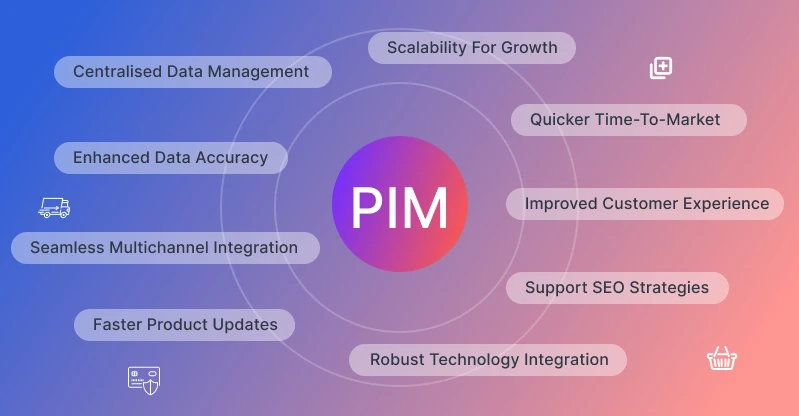
1. Centralised Data Management
A PIM system centralises product attributes, product catalogs, and digital assets in one managed source instead of leaving them scattered across spreadsheets, platform back-ends, and team inboxes. That single source of truth cuts duplication, speeds up how quickly teams can find and update information, reduces data silos, supports stronger catalog management as assortments grow, and builds far more confidence in the data everyone’s working from.
2. Enhanced Data Accuracy
Manual data entry is where most product errors originate incorrect pricing, missing descriptions, mismatched images. A PIM system automates checks and updates, closing the gap where human error typically creeps in and ensuring data accuracy before changes are published across every channel it feeds. These validation processes improve data quality through data validation, helping teams maintain accurate product data at scale.
3. Seamless Multichannel Integration
A PIM system synchronises product data from a single source across various sales channels, distribution channels, and mobile apps, including your website, marketplaces like Amazon and eBay, social commerce, and internal databases. That consistency ensures accurate product details across multiple platforms and your online store, which removes confusion and builds trust at every touchpoint.
For fast-scaling stores, this alone can be the difference between a smooth multichannel expansion and a support inbox full of “which listing is correct?” complaints. If you’re weighing how PIM and DAM work together to support this kind of omnichannel strategy, it’s worth a closer look at how the two systems complement each other.
Also Read: How PIM & DAM Improve Omnichannel Commerce for Australian Brands
4. Faster Product Updates
Customers expect to see new offers, discounts, and launches reflected everywhere, immediately. PIM systems automate updates when product specs or promotions change and reduce repetitive tasks across every sales channel, replacing a slow, error-prone process that does not scale. Real-time synchronisation means your team can react to market changes, launch campaigns, and release new products faster, which translates directly into competitive advantage, accelerates time-to-market, and helps avoid lost sales caused by outdated listings.
5. Robust AI and Technology Integration
Modern PIM platforms increasingly integrate with AI to analyse customer behaviour, forecast demand, and power personalised product recommendations – 92% of businesses have already adopted AI-driven personalisation to support growth. On the operational side, AI within a PIM system can automate product classification, suggest missing attributes, help enrich product data, and create detailed product descriptions for different markets, while handling translation for international markets and cutting the manual workload significantly. It also supports multi-language content and regional compliance for global expansion.
6. Stronger SEO Performance
Search visibility depends on consistent, optimised product titles, detailed descriptions, technical specifications, meta tags, and keywords – exactly the SEO-critical fields a PIM system centralises and standardises. Businesses that manage this data through a PIM system typically see stronger product page rankings, because search engines are being fed clean, consistent, keyword-optimised content instead of the fragmented versions manual updates tend to produce.

7. Improved Customer Experience
Accurate, complete product information isn’t a nice-to-have – it’s often the deciding factor in whether a customer trusts you enough to buy. Businesses lose 15-20% of potential revenue due to inaccurate data. Zendesk research found that roughly 50% of customers will switch to a competitor after just one bad experience, and 88% of users never return after a bad user experience, which makes consistency a retention issue, not just a data-hygiene one.
A PIM system helps you maintain up to date information and accurate information across every platform – blogs, social media, catalogues, and marketplaces – reducing the confusion that leads to returns, complaints, and lost repeat business while strengthening customer trust.
8. Quicker Time-to-Market
Manually managing and updating listings eats time your team could spend on higher-value work. Businesses using PIM solutions reduce time-to-market by an average of 23%. A PIM system streamlines data collection as the starting point and helps teams move from raw inputs to launch-ready listings faster, so new products go live with fewer bottlenecks. That speed compounds – the faster you can launch, the faster you can respond to trends ahead of competitors still working through manual processes.
9. Scalability for Growth
As a catalogue grows from hundreds to thousands of SKUs, manual product data management stops being merely inefficient and starts actively limiting growth. A PIM system is built to handle that scale, with sku data and high quality product data forming the foundation for expansion into new markets and larger assortments, while keeping information accurate across channels and supporting better supply chain coordination as the catalogue expands.
10. Reduced Operational Costs
Lower operational costs free up budget to reinvest in growth – new markets, better customer experience, product development. By automating product upkeep, a PIM system lowers costs by reducing manual tasks, routine tasks, and other internal processes tied to managing product data at scale. It also helps teams spend less time on maintenance work so they can focus on strategic initiatives, while reducing costly errors like overstocking or stockouts.
Research from Harvard Business Review found that of 201 companies studied over three years, 62% achieved below-market growth by focusing narrowly on either cost-cutting or revenue growth alone – a reminder that operational efficiency and growth investment need to happen together, not as a trade-off.
Top PIM Systems For eCommerce Transformation
| Platform | Best For | Architecture | Notable Strength |
| Akeneo | Retail, consumer goods, construction | Headless, cloud-native | 150+ API connectors, strong Product Experience Management (PXM) |
| Salsify | Brands selling on major marketplaces | Cloud-based | GDSN-compliant data syndication, strong for Amazon/reseller sync |
| Pimcore | Businesses with complex, custom data needs | Open-source, highly customisable | Flexible data modelling; steeper integration learning curve |
| Acquia | Enterprises needing PIM + DAM + CDP together | Headless | Strong compliance and digital experience management fit |
| Plytix | Small to medium businesses | Cloud-based | Low-cost entry point; fewer customisation options |
Akeneo PIM
Akeneo launched in 2013 as open-source PIM software and has since evolved into a cloud-native, headless platform with basic features for structured product enrichment and syndication. It’s particularly strong in retail, consumer goods, and construction, thanks to Product Experience Management (PXM) capabilities that let businesses tailor product experiences across channels.
With over 150 API connectors, Akeneo Implementation supports PIM integration with ecommerce websites, DAM tools, and analytics stacks, and its headless architecture is generally expected to keep gaining ground as more businesses prioritise API-first, flexible tech stacks.
Salsify ProductXM
Salsify started in 2012 helping eCommerce businesses manage sales, later expanding into full PIM, DAM, and PXM functionality. It’s built to consolidate product data from multiple sources – including major resellers like Amazon – into a single point of control, with strong publication and syndication tools. Strong data governance is essential in this kind of setup, and clear governance policies also help marketing teams keep product content consistent across channels.
Salsify’s compliance with the Global Data Synchronisation Network standard makes it a particularly good fit for larger retailers, manufacturers, and packaged goods companies that need to exchange data reliably with big-box partners.
Pimcore
Pimcore is an open-source, highly flexible PIM platform well suited to businesses whose business processes require flexible data modelling and complex or non-standard data structures. As an experienced Pimcore Development Partner, businesses can seamlessly connect Pimcore with their existing ERP, CRM, eCommerce, and third-party systems while supporting real-time updates for stock changes, product descriptions, and new categories through a centralized, unified platform, including complex onboarding from CSV files and marketplace formatting through attribute mapping.
For successful implementation, implementing PIM software requires a clear roadmap and defined requirements from the start. The trade-off is integration complexity: some users report difficulty fitting Pimcore into existing workflows, and limited visibility into certain departments can create friction for cross-team collaboration. However, for organizations with genuinely complex data modelling needs, Pimcore’s customization depth is hard to match.
Don’t Miss This Article –Pimcore vs Akeneo: Which One Empowers Australian Retailers the Most?
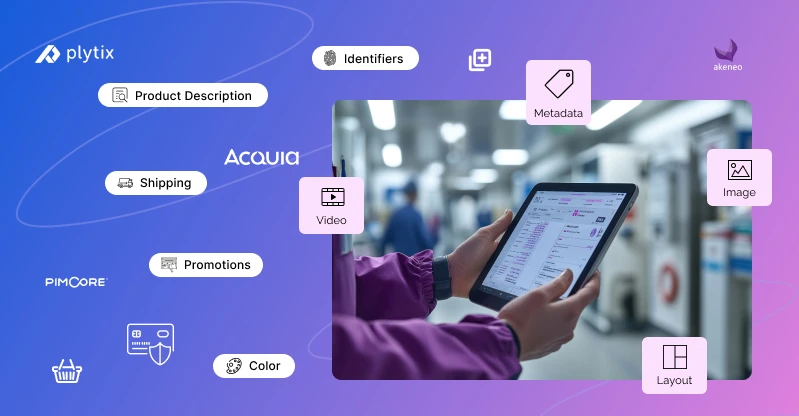
Acquia
Acquia began as a content management company and expanded into digital experience management, acquiring PIM and DAM capabilities in 2021. It offers PIM, PXM, and customer data management under strong compliance standards, with headless architecture that makes integration across both Acquia’s own tools and third-party providers straightforward a good fit for enterprises that need a broader product information management solution with governance, compliance, and connected ecommerce software. Inaccurate enterprise data can cost businesses 15–20% of revenue, which makes controlled PIM solutions more valuable.
Plytix
Plytix is built specifically for small to medium-sized businesses, giving ecommerce clients a user-friendly interface and affordable product information management software for managing product descriptions across multiple channels without enterprise-level cost or complexity. It has fewer customisation options than platforms like Pimcore or Akeneo, but that simplicity is exactly what makes it a practical, low-cost entry point for smaller catalogues, especially when teams need simpler PIM solutions without heavy system upgrades.
Success Stories
Philips
Philips, founded in 1891, has built decades of trust across health technology, consumer electronics, and lighting. As the company pushed further into innovation across personal health devices and home entertainment, manual product data management became a genuine bottleneck.
Adopting a PIM system (Plytix) helped digitise internal workflows, improve data accuracy, and support sales growth, reducing the time, budget, and staff previously tied up in data entry. That shift let the business redirect effort toward innovation and new marketing strategies instead of maintaining spreadsheets, a meaningful factor in sustaining Philips’ global recognition.

Reebok
Reebok used PIM-driven product data management as part of a broader repositioning shifting its brand identity from cricket-focused marketing to a fitness-first strategy. Cleaner, better-organised product data supported more effective marketing execution across its ecommerce platform and other sales channels, and the improved consistency contributed to Reebok posting a profit for the first time since 2014. Following its acquisition by Adidas, Reebok continued leaning into the fitness positioning, showing how better data management can support not just follow a broader strategic pivot.
Final Words
A Product Information Management system isn’t just a data-hygiene tool — it’s infrastructure for growth. A well-implemented PIM system reduces manual errors, unifies multichannel selling, and directly improves customer satisfaction, all of which compound as your catalogue and channel footprint expand.
Making this shift without the right guidance is harder than it needs to be. Connect with Magneto IT Solutions’ PIM development partner for tailored support bringing your Australian eCommerce business’s product data management up to scale and set your team up for long-term, sustainable growth.
FAQs
 What is a PIM system used for?
A PIM (Product Information Management) system centralises product data, descriptions, pricing, images, specifications in one platform, then syncs that data consistently across a business’s website, marketplaces, and social channels.
How is a PIM system different from a DAM system?
A PIM system manages structured product data (titles, prices, specs, descriptions), while a DAM (Digital Asset Management) system manages the actual media files, images, videos, PDFs. Many platforms, like Akeneo and Salsify, offer both PIM and DAM capabilities together.
Do small eCommerce businesses need a PIM system?
It depends on catalogue size and channel complexity. A business selling a handful of products on one channel may not need one yet, but once you’re managing dozens of SKUs across multiple channels, a PIM system
Can a PIM system improve SEO?
Yes. Because a PIM system centralises and standardises product titles, descriptions, and metadata, it makes it far easier to keep SEO-optimised, keyword-relevant content consistent across every product page and channel – which search engines reward with better rankings.
How long does it take to implement a PIM system?
Implementation timelines vary by catalogue size and integration complexity, typically ranging from a few weeks for a small catalogue on a platform like Plytix to several months for an enterprise rollout involving multiple systems and markets.