Boost Your Shopify Store Visibility and Sales with the Right Marketing Strategies
Table of Contents
Building a Shopify store is the easy part. Getting it seen, trusted, and bought from is where most Australian merchants get stuck and the gap is almost always marketing strategy, not product quality.
The short answer: growing a Shopify store takes a combination of audience understanding, consistent content and social presence, SEO, paid advertising, and conversion optimisation working together not any single tactic in isolation. Shopify remains the fastest-growing eCommerce platform in Australia, with Shopify’s own Q2 2024 GMV grew 20% YoY to $67.2B, which means the opportunity is real, but so is the competition.
This guide walks through the marketing strategies that actually move the needle for Shopify stores, the optimisation tactics that turn visitors into buyers, and two real case studies showing what’s possible when you get the mix right.
In this blog, Magneto IT Solutions‘ experts share essential marketing strategies and practical tips to help grow your Shopify store’s visibility and drive more sales.
Best Marketing Strategies To Boost Your Shopify Store Visibility
Understand The Target Audience
Every effective marketing strategy starts with knowing exactly who you’re talking to, including identifying your target market. You can’t meet a customer’s needs you haven’t taken the time to understand, and that understanding only comes from direct or indirect research – surveys, on-site quizzes, and behavioural data all work.
Nike’s shift from marketing almost exclusively to male athletes to actively targeting female athletes is a well-known example of what happens when a brand identifies and serves an overlooked audience segment: sales and market share both grew rapidly. The lesson for Shopify merchants is the same at any scale – narrowing in on who your best customers actually are, rather than marketing to “everyone,” leads to better-fit messaging and more sales, consistently outperforming generic targeting.
Use Social Media Strategically
Social media remains one of the most effective social media platforms for building brand awareness and driving traffic to a Shopify store. In fact, 51% of shoppers discover products on social media platforms. 90% of marketers report a direct revenue increase from social media marketing, which makes it hard to ignore as a channel.
Run campaigns across the places where your audience actually spends time – Facebook, Instagram, and Pinterest are strong performers for product-based businesses and combine organic content with paid ads to showcase products and drive engagement. TikTok also deserves attention: TikTok Shop sales reached $15.82 billion in 2025, showing how quickly commerce is expanding there. For store owners looking to increase brand awareness, consistent social media posts can support both discovery and retention. Consistency matters more than volume: a steady posting cadence outperforms sporadic bursts of activity. Reposting customer content also helps signal engagement with buyers.
Invest in Email Marketing
Email should sit inside a broader digital marketing strategy because email and SMS marketing deliver high ROI while giving you direct ownership of customer data. Choosing the right platform for email campaigns matters. Look for one that supports segmentation and automation, not just broadcast sending, so you can move beyond generic brand updates to targeted flows and promotional campaigns (abandoned cart, post-purchase, win-back).
Building a newsletter list is a long-term asset for customer retention and repeat customers. To track performance, monitor open rates, click-through rates, and conversion rates after every campaign; email marketing averages a 1.69% click rate, while top-performing sends can reach 3.38%, giving you a benchmark for re-engaging existing customers instead of guessing at what’s actually working.

Try SMS Marketing
sms marketing campaigns are still underused by most Australian Shopify stores, which makes them a genuine opportunity. They work best alongside email across multiple channels, and owning customer data across these marketing channels can improve ROI. Open rates routinely outperform email, and this approach is particularly effective for time-sensitive messages – flash sales, restock alerts, and abandoned cart reminders. Keep the volume low and the value high; SMS lists churn fast when merchants over-message.
Uplift Conversions with Optimisation
Driving traffic is only valuable if that traffic converts. Conversion rate optimisation (CRO) means refining every part of the buying journey checkout, product pages, calls to action so a larger share of visitors becomes customers. In practice, that means a simplified checkout process, high-quality product photography, and clear, unambiguous calls to action throughout your Shopify store.
Technical SEO Optimisation
With more merchants entering eCommerce every year, ranking on Google’s first page has only gotten harder, which makes solid search engine optimization and SEO fundamentals more valuable, not less. Focus on relevant keyword targeting, keyword research, a clean and logical site structure, and strong on-page SEO (title tags, meta descriptions, meta tags, header structure, internal linking) to improve visibility in search results by optimizing web pages for Google Search and other search engines to build sustainable organic traffic. Collection pages often rank better on Google than standalone product pages, and backlinks from high-quality sites improve your site’s authority.
Google accounts for 90% of the online search engine market globally, which is why consistent seo efforts matter for visibility.
The average SEO-driven conversion rate across page categories is softened to “2–3% range” per WordStream benchmark data, covering actions like email sign-ups, form completions, or content downloads, a useful benchmark for judging whether your organic traffic is actually working for you.
Implement a Loyalty Programme
Discount tiers, points-based rewards, and coupon codes distributed through email or social media are proven ways to increase repeat purchases, while loyalty incentives encourage customers to buy again and improve customer engagement. Over 70% of customers consider loyalty programs when purchasing, and more than 50% of loyal customers spend more per transaction. A well-run loyalty programme does double duty: it increases customer lifetime value and generates word-of-mouth referrals as members share codes and rewards with friends, and loyal members recommend brands 50% more often than non-loyal customers, which strengthens brand loyalty. Referral mechanics can also help attract new customers and lower acquisition costs; for example, Everlane’s referral program offers $25 for both the referrer and referee.
Use Influencer Marketing
Trust is one of the biggest barriers to a first purchase from an unfamiliar brand, and influencer marketing is one of the fastest ways to borrow it while helping engage customers and reach potential customers who have not bought yet. Partnering with influencers who genuinely align with your brand values, and who produce authentic content rather than obviously scripted promotion, extends your reach while adding credibility that paid ads alone can’t buy. Micro-influencers often deliver higher engagement rates than celebrities, and influencer marketing can also drive traffic through affiliate links.
Pay-Per-Click Advertising
PPC advertising remains one of the most reliable ways to drive sales and generate website traffic for a Shopify store quickly, often within hours of launch. Google Ads and Facebook ads let you target specific demographics precisely, while Google Shopping ads improve search visibility by placing products directly in results. Retargeting ads help bring back visitors who previously left your site and can recover lost sales.
PPC visitors are 50% more likely to convert than organic visitors, which is why four in ten marketers report plans to increase their PPC budgets rather than cut them as part of broader marketing efforts.

Tips for Optimising your Shopify Store With Excellence
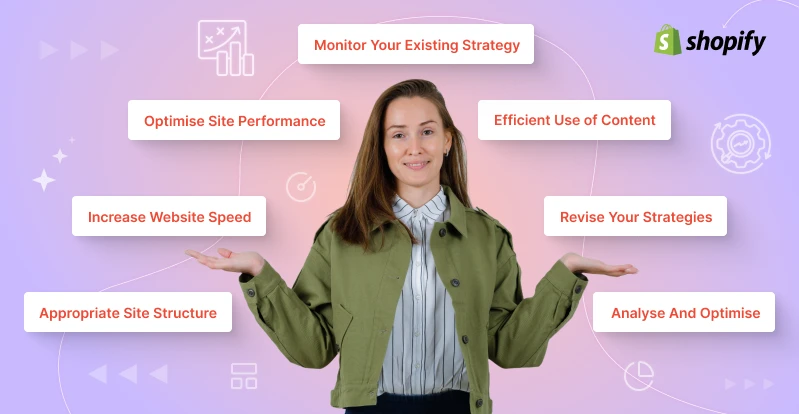
Build the Right Site Structure
A well-structured site is one where every page has a clear place in the hierarchy, and pages link to each other logically. Categories and subcategories should be obvious and easy to navigate — shoppers shouldn’t have to guess where a product might live. Strong collection-page structure also helps online shoppers and improves search visibility for an ecommerce store.
Australian fashion brand Princess Polly is a strong example: after re-platforming to Shopify Plus website design and overhauling its user experience, the brand saw a marked improvement in both sales performance, including stronger shopify sales, and overall shopping experience.
Increase Website Speed
Load time has an outsized effect on whether visitors stay or leave, especially for shoppers on mobile devices. According to Google’s own mobile research, the probability of a visitor bouncing increases by 32% as page load time goes from one second to three seconds, and by 90% at five seconds – meaning every extra second genuinely costs you traffic before a visitor ever sees your products. Mobile-first design is crucial for user experience and conversion rates, and it helps boost sales by reducing friction on smaller screens.
Faster load times improve both user experience and search rankings, since Google factors speed directly into how it ranks pages. Compress images, use a content delivery network (CDN), and trim unnecessary code to keep your store fast.
Optimise Site Performance Continuously
Speed is only one part of performance. Regularly test load times, keep your store and its apps updated, and resolve issues as they surface rather than letting them accumulate. Ongoing performance maintenance protects the gains from any redesign or speed optimisation you’ve already made.
Use Content Effectively
Ranking in search is valuable, but content marketing built on high quality content is what keeps visitors engaged once they arrive. Research your audience’s actual questions, target relevant keywords, and write with a global as well as local audience in mind if you’re planning to scale. Many store owners now use AI tools to support these workflows, with 75% of store owners using AI tools for content marketing. This is one of the most effective marketing strategies because high-quality content is essential for attracting organic traffic and engaging customers effectively.
Beyond blog posts, tutorials and video content meaningfully increase engagement, and podcasts can deepen brand engagement as well, with 55% of Americans regularly listening to them. Quizzes and polls relevant to your niche add another layer of interaction, keeping visitors on-site longer and giving you first-party data on their preferences.
Monitor Your Existing Strategy
Building a presence isn’t a one-time task – it needs ongoing attention to stay effective. Track performance of your current marketing tactics continuously so underperforming tactics get identified and corrected before they quietly drain the budget.
A marketing strategy is only working if you can point to what’s succeeding and what isn’t. Monitoring customer behavior helps refine decisions. Use audience feedback to refine decisions in a way that protects budget and stays aligned with both business goals and customer expectations. A/B testing can improve conversion rates over time.
Revise Your Strategies Regularly
Digital marketing shifts constantly, and proven strategies that worked six months ago may already be underperforming. Make adjustments based on monthly performance reviews and revise campaigns to keep boosting sales as competition changes, while staying aware of emerging trends in your category rather than waiting for a strategy to visibly fail before changing it.
Analyse and Optimise With Data
For Shopify store owners, decisions made without data are guesses, and guesses are expensive at scale. Use tools like Google Analytics to track customer behavior, website traffic, and campaign attribution so you can see what’s actually working and what isn’t, and let that data not assumptions guide where you invest next.
In fact, 75% of Shopify store owners use AI tools for marketing analysis, but measurement still matters. This same discipline of testing, measuring, and reallocating budget month over month is exactly what we cover in more depth in our guide to building a digital strategy for Australian businesses – worth a read if you’re trying to make every marketing dollar work harder, not just spend more of it.
Success Stories
Paper Shoot Camera
A unique brand with its innovative moves and products that are eco-friendly and sustainable for the environment. They were facing issues with their logistics and shipping approach. In search of better solutions, they switched to Shopify’s managed market. This tool helps them manage taxes, handling duties, and other required things so that they can provide a hassle-free shopping experience to the consumers.
Switching to being Shopify’s managed market was a huge transformation for them; they observed ;
- a 12% increase in global conversions,
- a 69% increase in global revenues, and
- recognised expansion in important markets like Mexico (48%) and Italy (105%).
By spending on local content and advertising, with campaigns aligned to the target market in each region, the company was able to increase its international sales through these efficiencies. Apart from that, they worked on social media influence and Instagram advertisements, which generated a lot of visitors and traffic to their site and helped drive sales.
Dermalogica
A skill-based training provider to professionals, it has become one of the leading skincare brands. They switched to Shopify Plus because of their issues with boosting the customer experience, sales, and site performance, which was majorly missing in their store earlier.
With the help of Shopify Plus, they able to get insightful information on consumer behaviour, which Dermalogica uses to provide tailored recommendations that increase engagement. Furthermore, Shopify made it easier to run promotions across additional platforms without requiring any developer, improving customer engagement across multiple channels for the ecommerce business.
After switching to Shopify Plus, Dermalogica experienced significant benefits in just six weeks:
- 119% increase in sales
- 45% increase in conversion rate
- 44% faster site speed
- 43% increase in unique visitors
By implementing Shopify Plus, Dermalogica has been able to enhance and optimise its online presence, which leads to global recognition.
Conclusion
Improving your Shopify store’s performance starts with choosing the right platform, and continues with consistently investing in the marketing mix of search engine optimization, content marketing, social media, email, and paid advertising that builds visibility and trust. Email marketing, social media, SEO, quality content, and paid advertising all play a role — the strongest results come from running them together across multiple channels to increase sales and customer retention, not picking one and ignoring the rest.
Getting this mix right takes ongoing expertise and testing. Connect with Magneto IT Solutions’ Shopify experts to build a marketing strategy that grows your store’s visibility, conversions, and revenue with excellence.
FAQs
 What is the best marketing strategy for a Shopify store?
There’s no single best strategy — the highest-performing Shopify stores combine SEO, social media, email and SMS marketing, and paid advertising, then double down on whichever channels their own data shows converting best.
How can I increase my Shopify store's visibility on Google?
Focus on on-page SEO fundamentals: relevant keyword targeting, a clear site structure, fast load times, and consistent, high-quality content. These are the same factors that influence both traditional search rankings and how AI-powered search tools evaluate your site.
How much does website speed affect Shopify sales?
Significantly. Pages that load in over three seconds see bounce rates around 32%, compared to roughly 9% for pages loading in one to two seconds — meaning slow load times directly cost you traffic before a visitor ever sees your products.
Is influencer marketing worth it for a small Shopify store?
Yes, when the influencer’s audience genuinely matches your target customer. Smaller, niche-relevant influencers often deliver better ROI than broad-reach ones because their audience trusts their recommendations more.
How often should I review my Shopify marketing strategy?
At minimum, monthly. Digital marketing channels and algorithms change quickly, and a strategy that performed well six months ago can quietly stop working without regular review.