What Saudi Retailers Lose Due to Slow Magento Luma Storefronts
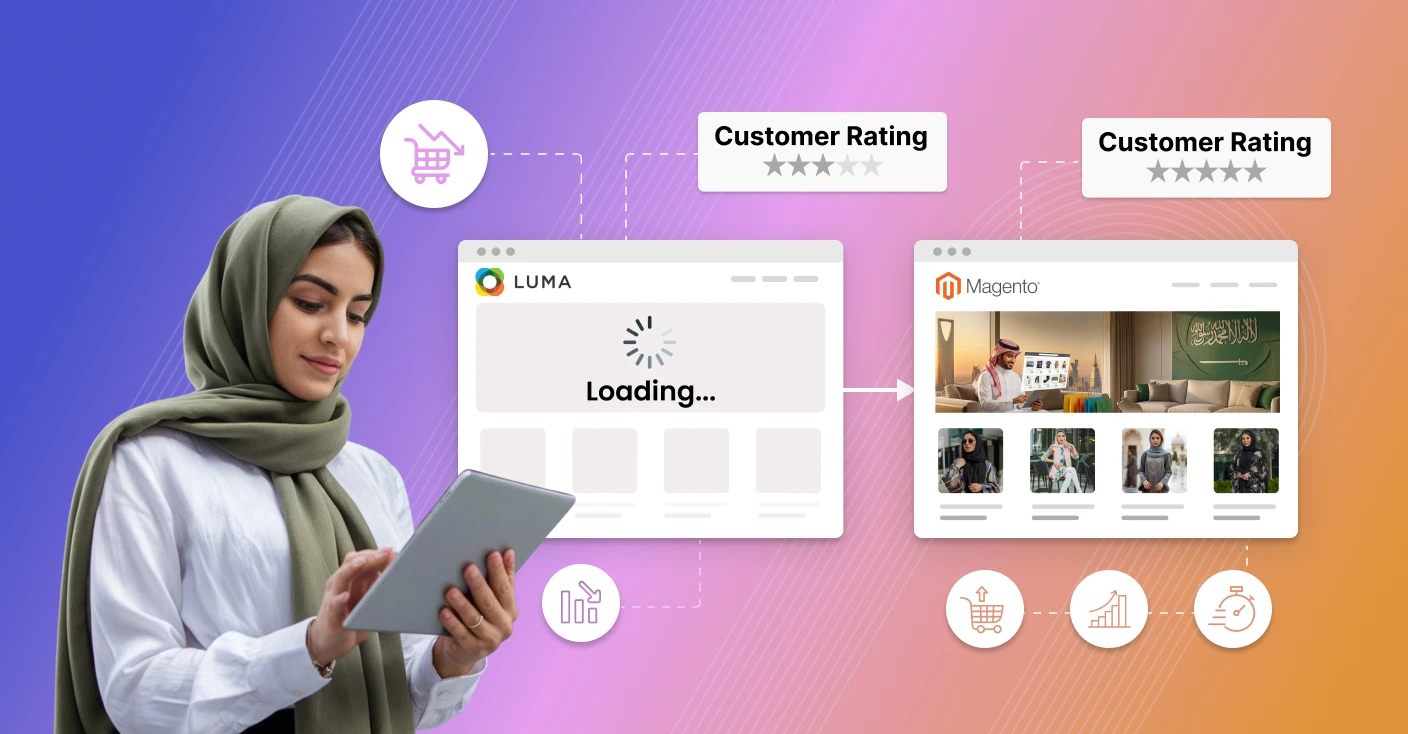
Table of Contents
A customer clicks on your Google Ad, lands on your website, and waits a few extra seconds for the homepage to load. Nothing appears broken.
The products eventually load, the navigation works, and the checkout is available. Yet, within moments, the customer leaves without viewing another page.
For many retailers, this happens every day without raising any immediate concerns. Marketing teams focus on improving campaigns, merchandising teams refine product catalogs, and sales teams look for ways to increase conversions.
Meanwhile, the storefront itself quietly becomes the weakest link in the customer journey. As Saudi Arabia’s ecommerce market continues to mature, customers have become far less tolerant of slow or inconsistent digital experiences.
They expect websites to load quickly, respond instantly, and provide seamless browsing across every device. If a store cannot meet those expectations, shoppers rarely wait; they simply move to another retailer.
Magento’s Luma storefront has been a reliable foundation for ecommerce businesses for years.
However, as online stores grow with larger catalogs, multiple third-party integrations, personalized shopping experiences, and increasing mobile traffic, many retailers are exploring the Magento 2 Hyvä Theme to deliver faster page loads, smoother navigation, and a more responsive shopping experience without replacing their core ecommerce platform.
The question is no longer whether your website works.
The real question is whether your storefront is costing you customers before they even reach the checkout.
Why Website Speed Has Become a Competitive Advantage in Saudi Arabia
Saudi Arabia has emerged as one of the Middle East’s most dynamic ecommerce markets, driven by digital transformation, widespread smartphone adoption, and changing consumer expectations.
Today’s shoppers compare multiple brands before making a purchase, often switching between websites in seconds. In such a competitive environment, every interaction contributes to the buying decision.
A fast storefront creates confidence from the very first click. Pages load without delay, products appear instantly, filters respond quickly, and checkout feels effortless.
These small moments combine to create an experience that encourages customers to continue shopping rather than abandoning their journey midway.
The opposite is equally true. Even if your pricing is competitive and your products are excellent, a sluggish storefront introduces friction that customers immediately notice.
Delayed page rendering, slow category navigation, or unresponsive search results can make the shopping experience feel unreliable.
For retailers investing heavily in digital marketing, this means attracting visitors successfully but failing to convert them because the website does not keep pace with customer expectations.
Performance has therefore become more than a technical benchmark. It is now a critical factor influencing customer satisfaction, brand perception, and long-term profitability.
The business impact of website speed is proven; a recent analysis by Deloitte stated that improving mobile site speed increases retail conversions by 8.4% and average order value by 9.2%.

Why Magento Luma Begins to Struggle as Stores Grow
Magento Luma was designed to provide flexibility and customization, making it a practical choice for businesses launching or expanding their ecommerce presence.
For businesses considering Magento Luma for your Saudi store, it can offer a solid foundation for creating a customised shopping experience while supporting different business requirements.
However, the demands placed on modern online stores have changed significantly over the years.
Retailers now operate with extensive product catalogs, personalized recommendations, multiple payment gateways, ERP integrations, loyalty programs, multilingual experiences, and advanced promotional campaigns.
Every additional feature adds complexity to the storefront, increasing the amount of code that browsers must process before a customer can interact with the page.
Over time, this complexity often affects loading speed, responsiveness, and overall user experience. While optimization can improve performance to an extent, many businesses eventually find that the underlying frontend architecture limits further improvements.
This isn’t a reflection of poor development. Rather, it reflects the evolution of ecommerce itself. Customer expectations continue to rise, and storefront technology must evolve alongside them.
The Revenue Losses Most Retailers Never Measure
When businesses evaluate ecommerce performance, they often focus on completed orders, average order value, or marketing spend. What frequently goes unnoticed is the revenue lost before customers even begin shopping.
A slow storefront creates several hidden costs that gradually reduce profitability.
Customers Leave Before They Discover Your Products
Every marketing campaign aims to bring qualified visitors to your website. Whether traffic comes from organic search, paid advertising, social media, or email marketing, each click represents an investment.
However, that investment loses value if visitors leave because the website feels slow or difficult to navigate. Customers rarely explain why they exit. They simply return to search results or explore a competitor offering a smoother experience.
This means businesses often spend more acquiring traffic while unknowingly reducing the return on every marketing pound invested.
Slower Experiences Reduce Purchase Confidence
Online shopping depends heavily on trust. Customers expect pages to respond immediately when they search for products, apply filters, or add items to the basket.
Delays during these interactions may seem minor from a technical perspective, but they influence how shoppers perceive the reliability of the entire business.
A slow website can create unnecessary hesitation, particularly for first-time customers who have not yet developed confidence in the brand. Even if the checkout functions perfectly, uncertainty introduced earlier in the journey may already have influenced the purchasing decision.
Improving frontend performance helps remove that friction, allowing customers to focus on products rather than the website itself.
Mobile Shoppers Have Less Patience Than Ever
Saudi Arabia’s ecommerce growth has been largely driven by mobile commerce. Consumers browse products while commuting, compare prices during store visits, and complete purchases from their smartphones throughout the day.
Mobile users also tend to have the lowest tolerance for slow websites. Large images, heavy JavaScript files, and delayed page rendering create interruptions that often lead to abandoned sessions.
Since mobile traffic represents a significant share of ecommerce visits, even modest improvements in website performance can translate into better engagement and higher conversion rates.
Google’s research found that 53% of mobile users abandon a website if it takes longer than three seconds to load.
In a competitive ecommerce landscape like Saudi Arabia, reducing loading times is no longer just a technical priority; it is a business strategy that helps retailers retain customers and maximize every sales opportunity.
Search Visibility Can Gradually Decline
Google’s focus on user experience has made website performance increasingly important alongside relevant content and technical SEO.
Metrics such as loading speed, responsiveness, and visual stability contribute to how users interact with a website and can influence long-term search performance.
While improving speed alone will not guarantee higher rankings, a faster storefront supports better user engagement, lower bounce rates, and stronger browsing experiences, all of which contribute to sustainable organic growth.
For retailers relying on search traffic, frontend performance supports both customer experience and digital visibility.
Why More Retailers Are Choosing Modern Frontend Architecture
Many retailers assume improving website performance requires rebuilding their entire ecommerce platform. In reality, the storefront is often where the greatest opportunity exists.
Modern frontend solutions are designed to minimize unnecessary code, reduce browser processing, and improve how quickly pages become interactive.
Rather than forcing customers to wait while multiple resources load in the background, these architectures prioritize speed and responsiveness from the moment a visitor arrives.
Businesses are increasingly moving towards modern frontend architectures because they deliver faster page loading, improved responsiveness, and a smoother shopping experience without replacing the core Magento platform.
Beyond performance gains, they also provide the flexibility to create storefronts that reflect a brand’s identity and support unique customer journeys.
Partnering with experts in Magento theme development helps retailers identify performance bottlenecks, simplify frontend complexity, and build scalable storefronts that are easier to maintain while meeting evolving customer expectations.
How to Know When Your Store Has Outgrown Luma
Not every business needs to replace its storefront immediately. However, certain indicators suggest it may be time to review whether your frontend continues to support your commercial objectives.
Your store may have outgrown Luma if you consistently experience declining conversion rates despite increasing traffic, lower mobile sales compared to desktop, difficulty improving Core Web Vitals, slower page performance after adding new features, or customer feedback highlighting navigation and loading issues.
Similarly, if your marketing investment continues to grow while revenue remains relatively flat, the problem may not lie in attracting visitors but in providing an experience that encourages them to stay and purchase.
A professional performance assessment can identify whether your storefront has become a limiting factor and reveal where your broader Magento 2 development strategy can improve performance, scalability, and the overall customer experience.
For businesses with unique design, functionality, or branding requirements, custom Hyvä theme development can provide a tailored solution that supports both current needs and future growth.
Final Words
A slow storefront does more than affect website performance; it can reduce customer trust, lower conversions, and limit the return on your marketing efforts.
As ecommerce competition grows across Saudi Arabia, delivering a fast and seamless shopping experience has become a business advantage.
If your Magento store is attracting traffic but not generating the results you expect, it may be time to evaluate your storefront.
At Magneto IT Solutions, we help Saudi retailers identify performance bottlenecks and build faster, scalable storefronts that improve customer experience and drive sustainable growth. Get in touch with our Magento experts to discover the right frontend strategy for your business.
FAQs
 Is Magento Luma still suitable for ecommerce businesses?
Yes. Magento Luma remains a functional frontend for many businesses. However, retailers experiencing performance challenges or planning significant growth often evaluate modern frontend alternatives that better support current customer expectations.
Does a slow storefront really affect sales?
Yes. Website performance influences how customers browse, interact with products, and complete purchases. Even small delays can increase bounce rates, reduce engagement, and negatively impact conversion rates.
Why is frontend performance especially important for Saudi retailers?
Saudi consumers expect fast, mobile-friendly shopping experiences. As competition grows across the ecommerce development sector, delivering a responsive storefront helps businesses improve customer satisfaction, encourage repeat purchases, and remain competitive.
Should businesses replace Luma or optimize it?
The right decision depends on your store’s complexity, performance challenges, and long-term business goals. A technical assessment can determine whether optimization is sufficient or whether a modern frontend offers greater long-term value.
Can a faster storefront improve SEO?
A faster storefront supports better user experience, improved Core Web Vitals, and stronger customer engagement. While speed alone does not determine rankings, it contributes positively to an overall SEO strategy.