PIM and DAM: Streamlining Product Content for Speed and Scale
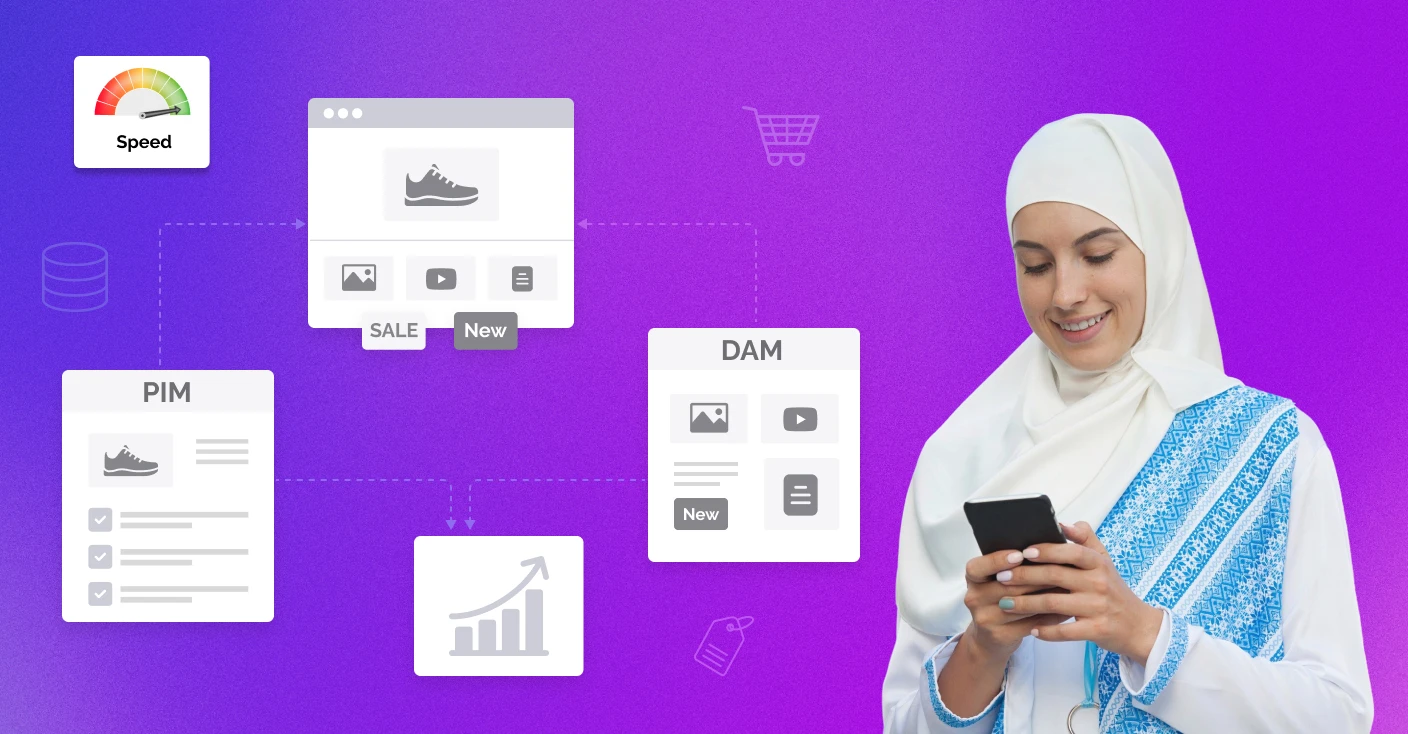
Table of Contents
Shopping online is becoming increasingly popular in Saudi Arabia very fast. But there is one thing that has become very obvious: It is not enough to have the cheapest prices only if you want to win over customers nowadays.
Customers demand to find complete, accurate, and pretty product content that is even free of any errors and they want it everywhere they shop. When brands cannot provide this all the time, it is trust, conversions and the customers’ loyalty that get affected.
This is exactly why Product Information Management (PIM) and Digital Asset Management (DAM) have become essential tools for modern eCommerce teams. Many businesses also partner with a reliable Digital Asset Management Solution company to better organize, store, and distribute their growing library of product images, videos, and marketing assets.
On their own, each solves a different problem. But when combined, especially through a well-planned PIM and DAM strategy they can dramatically improve how quickly and accurately product content flows across every digital channel.
PIM and DAM: The Basics
What Is PIM?
A PIM solution is essentially the hub where all the data concerning products is stored. One can gather everything related to products in a single system, such as product titles, descriptions, attributes, specs, SKUs, pricing, packaging info, etc.
In the absence of PIM, teams often find themselves pulling data from spreadsheets, emails, and various software that aren’t connected to each other. Apart from delaying product launches, this also results in mistakes that mislead customers and harm the trust factor.
What Is DAM?
Digital Asset Management does for media what PIM does for data. With proper tagging and version control, teams no longer waste time searching for the “correct” photo or accidentally using outdated visuals on their website or marketplace listings.
Why Integrating PIM and DAM Matters
Think of PIM as the “what” and DAM as the “show me.” Customers need both. When the two systems operate separately, teams still struggle with mismatched content, extra manual work, and inconsistent product pages. A smooth PIM–DAM integration eliminates these issues by:
- keeping all product info and visuals connected
- automating how content flows to websites and marketplaces
- ensuring every channel shows up-to-date, accurate content
- improving launch speed and reducing dependency on manual uploads
And in a fast-growing market like Saudi Arabia, where competition and customer expectations are rising, this integration is becoming a necessity.
Advantages of Putting PIM and DAM Together
1. Cleaner Workflows and Better Efficiency
When product data and assets reside in one connected platform, teams do not have to rework their tasks. Change a product only once and, as a result, all the related stuff images included will be automatically updated throughout the entire ecosystem. It releases product, eCommerce and marketing teams from monotonous work and so they have more time to concentrate on strategy and creativity.
2. Consistency Across Every Channel
No matter where consumers discover your products – Amazon.sa, Noon, TikTok Shop, your website, or your mobile app – they should get the same high-quality content. PIM and DAM systems ensure consistency.
3. Speedier Release of Products and Rollout of Marketing Campaigns
Three is when you launch new SKUs, seasonal product lines, or promotional campaigns, you are comparatively fast. Interconnected data and assets are effortlessly transformed into publish-ready versions for each sales channel. Speed is a significant factor of competition in the rapidly changing world of eCommerce.
4. More Rich and Complete Product Experiences
Studies show that consumers refer to many pieces of product information prior to making a purchase. Product pages get a great upgrade in terms of excitement and informativeness, which will be a direct result of higher conversions and lower returns, with PIM and DAM integration.
5. Fewer Errors and Stronger Data Quality
Inconsistency between systems means errors are inevitable: wrong images, outdated specs, and wrong variations. With integration, all these problems are eliminated because there is one source of truth. All changes are reflected everywhere, automatically.
6. Scalability as the Business Grows
As catalogue sizes and asset volumes expand, manual processes become unsustainable. A PIM–DAM backbone allows businesses to scale confidently without drowning in operational work.
7. Cost Savings and Better Use of Resources
By consolidating systems and removing redundant effort, brands reduce operating costs. Teams also spend less time fixing mistakes or digging through folders to improve productivity.
8. Stronger Security and Compliance
Centralising product data and media assets ensures tighter access controls, auditability, and compliance, especially important in regulated markets.

How PIM–DAM Integration Actually Works
Basically, your PIM solution holds structured product info while the DAM solution is the place for media files. Basically, an integration refers to the way two systems connect and work together through APIs or a system. In such a case, if you change a product in the PIM, the DAM will immediately select the appropriate images, videos, and docs without the need for you to do it manually; therefore, it will give you the complete package to populate your eCommerce channels.
Hence, it gets rid of manual coordination, limits mistakes and allows the whole content-related workflows to be carried out much faster.
Choosing the Right Implementation Partner
Deploying PIM and DAM — and connecting them properly, requires experience in:
- Information architecture
- Taxonomy and attribute modelling
- Metadata design
- API and channel integrations
- Asset workflows and governance
This is where Pimcore development services, DAM specialists, and experienced implementation partners become essential. They help you build a scalable, future-ready content foundation tailored to your business.
With a unified PIM–DAM setup, brands in the region can:
- Publish consistent product info across marketplaces
- Support multilingual content
- Scale catalogues faster
- Strengthen their mobile and social commerce presence
- Reduce operational complexity while improving accuracy
In a market moving as quickly as KSA’s, this level of agility is a major competitive advantage.
The Growing Complexity of Product Content in Saudi eCommerce. As the digital economy in the region grows, product content requirements are also evolving to be more complex. Just getting the product name and price in front of the consumer is no longer enough.
They are looking for high-quality images in great detail, zooming capability, main features, comparison tables, product descriptions in both Arabic and English, warranty terms, product certifications, and even demonstration videos. To manage such a complex level of information manually is extremely difficult.
This is where a strategic PIM and DAM strategy, combined with pim ecommerce integration, becomes critical. When product data and digital assets are unified, brands can manage complexity without slowing down operations. Instead of reacting to content demands, businesses can proactively structure, enrich, and distribute product information at scale.
For retailers in Riyadh, Jeddah, Dammam, and across KSA, this capability is no longer a luxury; it is a requirement to compete effectively across marketplaces and direct-to-consumer channels.
Breaking Down Content Silos
One of the biggest hidden challenges in growing eCommerce organisations is content silos. Product teams manage specifications in spreadsheets. Marketing teams store campaign images on shared drives. Designers use separate creative tools. Marketplace managers manually upload content per channel.
When businesses truly integrate strong Digital Asset Management Solutions with a centralised PIM system, they basically stop fragmentation. They used to have scattered data and files, but now, everything is not only searchable but also structured and governed.
In addition to this, a single unified ecosystem is created, which in turn lowers the need for manual coordination and makes sure that each department is working from the same source of truth.
Eventually, this well-organised base will greatly help in the development of operations and making of decisions.
The Role of Pimcore in Unified Commerce
Many Saudi enterprises are turning to flexible platforms that support both PIM and DAM capabilities under one ecosystem.
This is where pimcore development services play an important role. Pimcore offers a powerful open-source framework that combines product information management, digital asset management, and experience management into one scalable architecture.
For businesses planning long-term growth, Pimcore enables:
- centralised master data management
- advanced taxonomy structures
- seamless pim ecommerce integration
- API-based connections with ERP, CRM, and marketplaces
- flexible customisation for regional requirements
Delivering Localised Product Experiences for the Saudi Market
Saudi Arabia is a culturally distinct and fast-changing market. Brands have to create localised product experiences that match the tastes of the region. This includes:
- Arabic-first product descriptions
- culturally relevant lifestyle imagery
- localised measurement units
- compliance with Saudi regulatory standards
- region-specific promotions and bundles
Without the integration of systems, managing local variations can become a nightmare. For instance, one product can have several language variations, and a DAM connects the corresponding images for each region.
When content is distributed to various storefronts, each receives personalised and compliant information automatically. Such localisation helps increase the trust of customers and conversion rates in KSA.
Enabling Omnichannel Commerce and Marketplace Expansion
Consumers in Saudi Arabia are engaging with brands via different brand touchpoints such as brand websites, mobile apps, marketplaces, and social commerce platforms. Each of the channels requires a different set of formatting, image specifications, and attribute structures.
Without PIM e-commerce integration, teams must manually adjust content for every platform, increasing errors and launch times. An integrated PIM–DAM ecosystem transforms this process. Structured product data is automatically mapped to each channel’s requirements. Approved images and videos from the DAM are resized and formatted accordingly.
Updates sync in real time. This streamlined process enables brands to expand confidently into:
- Major Regional Marketplaces
- Social Commerce Platforms
- B2b Portals
- International Cross-Border Channels
As expansion accelerates, having experienced Digital Asset Management Developers ensures that integrations remain stable, scalable, and secure.
Strengthening Data Governance and Brand Control
Nowadays, PIM software helps enterprises to set mandatory attributes, validation rules, completeness scores, and approval workflows. On the other hand, DAM systems add to this by providing asset version control, usage rights tracking, and permission-based access.
Together, they create a controlled environment where:
- Incomplete products cannot be published
- Outdated visuals are automatically archived
- Brand guidelines are enforced
- Compliance documentation is stored and accessible
Accelerating Product Launches for Seasonal Campaigns
The Saudi retail industry is actually dependent on seasonal occasions such as Ramadan, Eid, National Day, White Friday, and the major Shopping festivals to develop.
These occasions bring about changes inproduct offerings, promotion packages, new images, and messages. With the Vision 2030 underway, online shopping is bound to increase significantly. Companies should prepare themselves for the following:
- larger product catalogues
- AI-powered personalisation
- headless commerce architectures
- cross-border expansion
- advanced analytics and automation
A disconnected content ecosystem will not support this future.
Measuring Performance and Optimisation
Once the product data and assets have been consolidated in one place, analytics are significantly empowered. Businesses can track:
- which images drive higher conversions
- which product descriptions reduce returns
- which attributes improve search visibility
- which channels generate the best engagement
This data-driven approach enables continuous optimisation. Instead of Guessing what works, teams refine content strategically.
Building a Long-Term Competitive Advantage
In the end, the integration of PIM and DAM is more than just a matter of operational convenience. It is the essence of strategic differentiation.

Brands that master product content management:
- launch faster
- maintain consistency
- scale effortlessly
- adapt to market trends
- reduce operational waste
- improve customer satisfaction
In the relatively competitive e-commerce landscape in Saudi Arabia, such benefits can quickly add up. By highlighting strong PIM e-commerce integration, leveraging expertise in favour of Pimcore development, and partnering with experienced Digital Asset Management Developers, you can build a strong content foundation.
As product listings continue to expand and consumers demand more, it’s companies that invest in comprehensive Digital Asset Management Solutions and PIM infrastructure today that will be the ones playing the game of Saudi eCommerce tomorrow.
In a region of the world where innovation and digital transformation happen at breakneck speed, efficient product content management is more than just an operations improvement – it’s a key to staying ahead of the pace.
Final thoughts
Bringing PIM and DAM together is not only an improvement but also a paradigm change in how brands handle product content and customer experience. The benefits for companies that have business in Saudi Arabia are obvious; it offers smoother workflows, consistent, accurate information, better customer experiences, faster time-to-market, improved collaboration and scalable growth.
By investing in the integration of PIM, reducing dependency on Pimcore developers, and teaming up with experienced DAM professionals, brands can unlock the real growth potential of their product content. If you’re looking to implement or optimize such solutions, connect with our expert team to explore the right PIM and DAM strategy tailored to your business needs.
An integrated PIM and DAM solution is not a matter of debate but the very basis of a successful eCommerce strategy.
FAQs
 How to differentiate PIM and DAM?
PIM is used to manage product information, such as details about the products. It keeps this information organised. On the other hand, DAM is used to manage digital assets solutions, such as pictures and videos, and it keeps all these assets in one place.
Why is it important for Saudi eCommerce to have PIM and DAM working together?
When PIM and DAM work together, it makes sure that the information about products is correct and the same everywhere, whether it is on the website or on media.
How does integrating PIM with eCommerce make things more efficient?
It helps to update product information across all platforms, which reduces the amount of work that needs to be done manually and also reduces mistakes.
How do Digital Asset Management Solutions help businesses grow?
These solutions help to keep all the media assets, like pictures and videos, organised and in one place, which makes it easier for businesses to grow and expand in a controlled way.
Why should businesses consider using PIM development services and Digital Asset Management Developers?
These services and developers can help businesses create a system that is tailored to their needs and can grow with them over time, which is very important, for long-term success.