Why ERP & CRM Integration Is Critical for Scalable B2B Commerce in Saudi Arabia
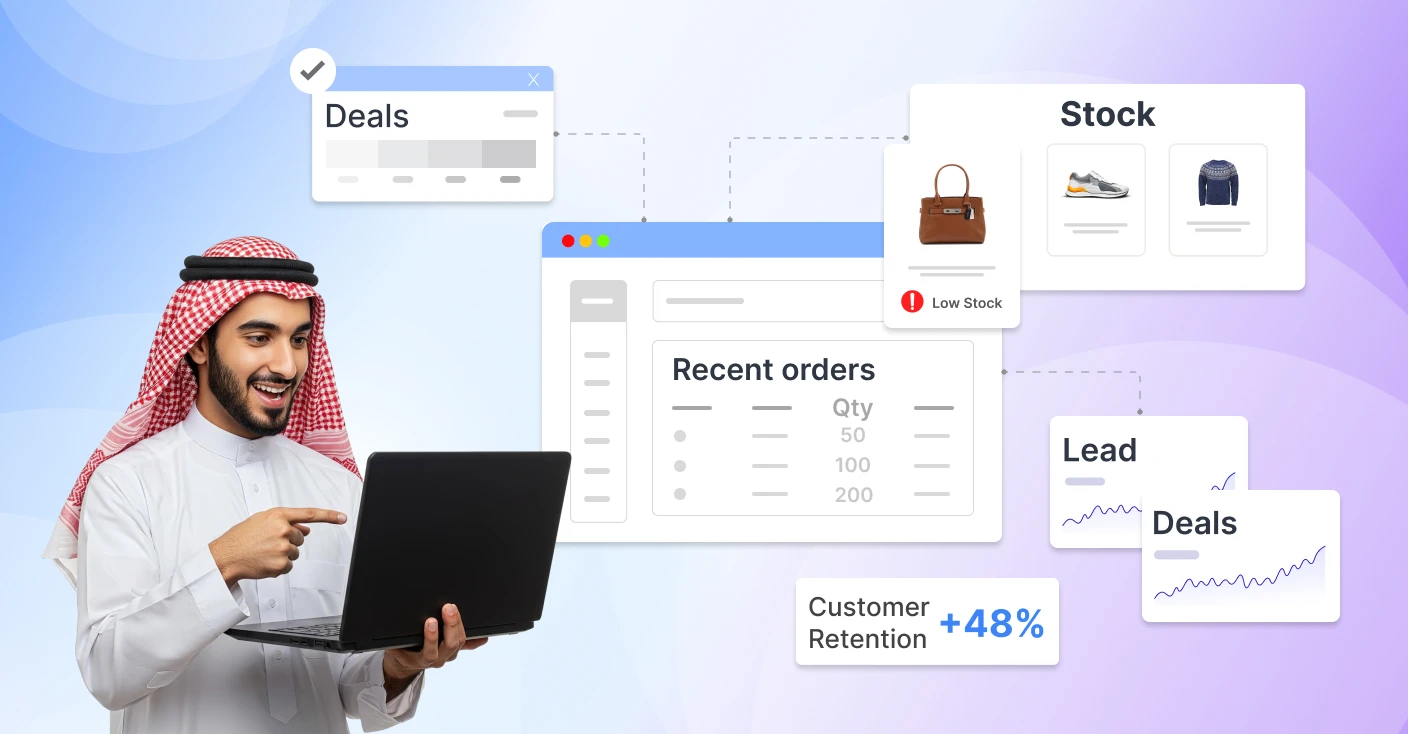
Table of Contents
Saudi Arabia’s B2B landscape is evolving rapidly. Driven by Vision 2030, digital transformation, and rising customer expectations, businesses are under increasing pressure to deliver faster, smarter, and more connected buying experiences.
Despite investing in CRM and ERP platforms, many organizations still struggle with disconnected systems that slow operations, reduce visibility, and impact customer satisfaction.
The challenge isn’t the technology itself. Without the right implementation strategy and experienced ERP implementation services, ERP and CRM systems often operate in silos, leading to data inconsistencies, manual processes, delayed order fulfillment, and missed revenue opportunities.
As B2B buyers expect real-time inventory, accurate pricing, and seamless purchasing experiences, connected systems have become a business necessity.
ERP and CRM integration bridges the gap between customer-facing and backend operations, helping businesses improve efficiency, enhance customer experiences, and scale with confidence.
In this blog, we’ll explore how ERP and CRM integration helps Saudi B2B businesses streamline operations and achieve scalable growth.

The Hidden Cost of Disconnected Systems
Many organizations underestimate the impact disconnected systems have on day-to-day operations. On the surface, manual processes may seem manageable.
Consider a typical B2B sales cycle. A sales representative receives a customer inquiry and prepares a quote. To confirm product availability, they contact the operations team.
The operations team checks inventory through the ERP system and sends an update. Finance verifies pricing and payment terms separately. By the time the customer receives a final response, valuable time has been lost.
Multiply this process across hundreds or thousands of transactions, and the impact becomes substantial.
Disconnected systems often result in:
- Delayed order processing
- Inventory inaccuracies
- Duplicate data entry
- Slower sales cycles
- Limited customer visibility
- Reduced employee productivity
- Higher operational costs
More importantly, these inefficiencies directly affect customer satisfaction. In an era where buyers expect instant access to information, delays and inaccuracies can quickly drive customers toward competitors.
Questions Every Business Leader Should Ask
- Are disconnected ERP and CRM systems slowing down your sales and order fulfillment processes?
- How many revenue opportunities are being lost because teams don’t have access to real-time customer and inventory data?
- Are manual workflows creating delays, errors, and unnecessary operational costs?
- Can your business continue to scale if critical information remains trapped in separate systems?
- Are customers receiving the seamless buying experience they expect from modern B2B brands?
- Is your digital commerce platform driving growth, or are disconnected systems holding it back?
If these questions sound familiar, it’s time to rethink how your ERP, CRM, and commerce platforms work together. The businesses that connect their systems today are often the ones best positioned to grow tomorrow.
Why ERP & CRM Integration in B2B Has Become Essential
B2B commerce is no longer driven solely by relationships and traditional sales channels. Buyers now conduct extensive research online, compare suppliers, expect personalized experiences, and increasingly prefer digital self-service options.
To meet these expectations, businesses need systems that communicate seamlessly.
ERP CRM integration in B2B enables customer data, inventory information, order details, pricing structures, and financial records to flow automatically between departments. Instead of working with fragmented information, teams gain access to a single source of truth.
This connectivity creates significant advantages. Sales teams can view real-time inventory levels before making commitments. Customer service representatives can access complete order histories during support interactions. Finance teams receive accurate transaction data without manual intervention. Leadership teams gain comprehensive visibility into business performance.
The result is a more agile organization capable of responding quickly to customer needs while operating more efficiently.
What Does Integrating ERP with CRM Actually Look Like?
Imagine a customer visiting your B2B commerce portal to place a bulk order.
The order is automatically captured through your commerce platform and synchronized with the CRM. Sales teams instantly gain visibility into customer activity and can track opportunities.
Simultaneously, the ERP system validates inventory availability, confirms pricing rules, initiates fulfillment workflows, and generates financial records.
As the order progresses, updates are shared across all connected systems. Customer service teams can monitor order status in real time, while management gains access to accurate reporting and forecasting data.
This level of automation eliminates manual intervention, reduces errors, and accelerates the entire order-to-cash process.
For organizations focused on growth, integrating ERP with CRM creates the operational foundation required to support increasing transaction volumes and evolving customer expectations.
Key Business Benefits of ERP and CRM Integration
Enhanced Customer Visibility
One of the most significant benefits of ERP and CRM integration is the creation of a comprehensive customer view. Instead of maintaining customer information across multiple platforms, businesses gain centralized access to purchase history, account activity, payment records, support interactions, and sales opportunities.
This visibility enables more personalized engagement and helps teams identify opportunities for upselling, cross-selling, and customer retention. Rather than reacting to customer needs, businesses can proactively deliver relevant recommendations and support.
Faster Order Processing
Manual order processing often introduces delays that impact both operational efficiency and customer satisfaction. Integrated systems automate the flow of information between sales, inventory, finance, and fulfillment teams, ensuring that orders move through the organization quickly and accurately.
By reducing administrative tasks, employees can focus on higher-value activities such as customer engagement and business development.
Improved Inventory Accuracy
Inventory discrepancies are among the most common challenges in B2B operations. Without integration, inventory information may become outdated across different systems, leading to overselling, backorders, and customer frustration.
ERP and CRM integration ensures inventory data remains synchronized, enabling businesses to provide accurate availability information and improve order fulfillment performance.
Better Decision-Making
Data-driven decision-making requires accurate and timely information. Integrated systems eliminate reporting inconsistencies and provide leadership teams with real-time insights into sales performance, inventory trends, customer behavior, and financial health.
This enables organizations to make informed strategic decisions with greater confidence.
Why ERPNext Is Gaining Popularity Among Saudi Businesses
As businesses explore modern integration strategies, many are turning to ERPNext as a flexible and scalable solution.
It’s a cloud based ERP solution, and offers comprehensive functionality that supports accounting, inventory management, procurement, manufacturing, CRM, project management, and human resources within a single platform.
The modular architecture and customization capabilities of ERPNext solutions make it particularly attractive for growing organizations seeking a balance between functionality, flexibility, and cost efficiency.
However, successful implementation requires expertise. Working with an erpnext partner ensures the platform is configured to align with business processes while supporting future growth objectives.
ERP and CRM Integration and B2B Commerce: A Powerful Combination
Businesses investing in B2B eCommerce development services often focus on creating exceptional customer-facing experiences, from intuitive storefronts to streamlined purchasing journeys.
While these elements play a critical role in attracting and engaging buyers, the success of a B2B commerce platform ultimately depends on the systems operating behind the scenes.
A modern B2B commerce platform is only as effective as the ERP and CRM systems that support it. Today’s buyers expect personalized pricing, real-time inventory visibility, accurate order tracking, and a seamless purchasing experience across every touchpoint.
When backend systems are disconnected, consistently meeting these expectations becomes a significant challenge.
This is one of the primary reasons many B2B organizations invest heavily in digital commerce initiatives, yet struggle to achieve the expected return on investment.
Despite having a powerful storefront, disconnected business systems often lead to inventory discrepancies, delayed order processing, inconsistent customer information, and operational inefficiencies that impact both customer satisfaction and profitability.
By integrating ERP and CRM systems, businesses can create a connected digital ecosystem where customer data, inventory information, pricing structures, and order workflows are synchronized in real time.
This not only enhances operational efficiency but also enables organizations to deliver the seamless, personalized experiences that modern B2B buyers expect.
The result is a stronger foundation in commerce that supports sustainable growth, improves customer loyalty, and drives better business outcomes.

Why Choosing The Right ERPNext Implementation Partner Matters?
Implementing a Custom ERPNext Solution is not just about deploying software. The real goal is to create a connected ecosystem in which your ERP, CRM, and commerce platforms work together to drive growth, improve efficiency, and deliver better customer experiences.
As an experienced ERPNext implementation partner, Magneto helps businesses:
- Align ERP implementation with long-term business goals
- Integrate ERP, CRM, and B2B commerce platforms seamlessly
- Eliminate data silos across sales, finance, inventory, and operations
- Ensure smooth data migration and system configuration
- Deliver real-time visibility across business functions
- Build scalable solutions that support future growth
- Provide ongoing support, optimization, and strategic guidance
With extensive experience in digital commerce, ERP implementation, and system integration, Magneto helps businesses create a connected technology ecosystem that drives measurable business outcomes.
Whether you’re looking to streamline operations, improve customer experiences, or accelerate digital transformation, Magneto’s team of ERP and commerce experts can help you maximize the value of your ERPNext investment while reducing implementation risks.
The right technology matters, but the right implementation partner can make the difference between a successful transformation and an expensive software deployment.
Final Thoughts
As Saudi businesses continue to scale, disconnected ERP, CRM, and commerce systems can quickly become barriers to growth. By integrating these critical platforms, organizations can eliminate data silos, improve operational efficiency, and deliver the seamless experiences modern B2B buyers expect.
Ready to Turn Disconnected Systems into a Growth Engine?
Connect with our experts to discover how ERP and CRM integration can streamline operations, improve customer experiences, and create a scalable foundation for long-term business growth.
FAQs
 Why is ERP and CRM integration important for Saudi B2B businesses?
It helps eliminate data silos, improve operational efficiency, and deliver the seamless buying experiences modern B2B customers expect.
What challenges can ERP and CRM integration solve?
It reduces manual processes, inventory inaccuracies, order delays, and disconnected customer data across departments.
How does ERP and CRM integration improve B2B commerce?
It enables real-time pricing, inventory visibility, faster order processing, and a more connected customer experience.
Is ERPNext a good choice for growing businesses in Saudi Arabia?
Yes. ERPNext offers a flexible and scalable cloud-based ERP solution that supports finance, inventory, CRM, procurement, and operations.
Why work with an ERPNext implementation partner?
An experienced partner helps ensure smooth implementation, seamless integrations, optimized workflows, and faster ROI.
How can ERP and CRM integration support business growth?
It improves visibility, automates workflows, enhances customer experiences, and helps businesses scale more efficiently.
How long does ERP and CRM integration typically take?
The timeline depends on business complexity, existing systems, and integration requirements, but proper planning helps accelerate implementation.
How can Magneto help with ERP and CRM integration?
Magneto helps businesses integrate ERP, CRM, and commerce platforms to streamline operations, improve customer experiences, and support long-term growth.