How AI in DXM Personalises Every Saudi Shopper’s Experience
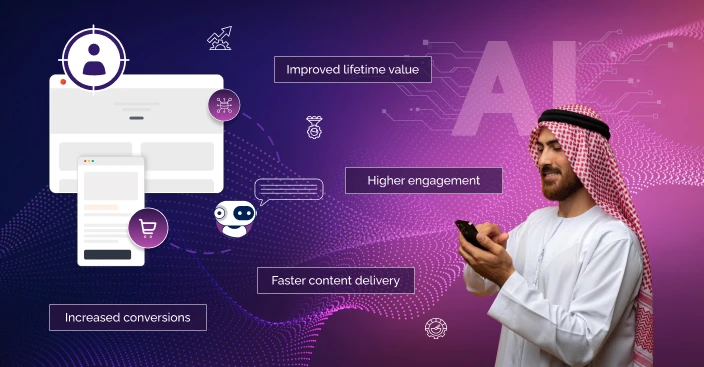
Table of Contents
Saudi Arabia is becoming one of the most progressive digitally enabled markets in the Middle East.
With the growing tech use, due to the Vision 2030 has accelerated across so many industries, businesses all around them now need to rethink how they engage customers in a digital-first economy.
Digital Experience Management is at the heart of that evolution, and Artificial Intelligence is behind a defining role as experiences go through new ways of delivery, management, and improvement.
Today, the Saudi shopper needs more than a pretty website or an app that works well. Relevance, personalisation, pace, and cultural affinity must be felt through every single touchpoint.
Every touch-from the e-commerce site of choice down to banks or government services-should be intuitive and tailored.
AI-powered DXM really lets organisations break out from generic journeys into orchestrating purposeful, personalised experiences that foster confidence and long-term loyalty.
The following blog post looks at how AI in DXM drives personalised journeys for Saudi shoppers, why personalisation proved essential, and how an organisation can ensure it has the right solution in place by leveraging expert Digital Experience Management Services.

Understanding DXM in the Saudi Digital Landscape
DXM in its broader sense refers to a collection of ways, platforms, and technologies by which one can design, manage, and optimise customer experiences at each digital touchpoint-from the website to mobile applications, e-commerce, and even social media.
Hence, it has become a strategic priority in Saudi Arabia and is known as the front-runner in digital adoption.
With highly widespread mobile-first behaviours and ever-rising customer expectations, Saudi consumers have grown accustomed to frictionless digital interactions.
In such a setup, the role of the digital experience manager has changed radically, from operating siloed platforms to orchestrating continuous and personalised journeys across touchpoints.
AI is the intelligence layer that lets DXM platforms understand customer behaviour in real time and drives experiences based on that knowledge.
Why AI is now central to digital experience management
Traditional systems of DXM have static rules and segmentations; this is done manually. These would work in the very initial phases of digital maturity.
Such ways cannot keep pace with modern expectations of customers. AI brings the ability to analyse large volumes of data, learn from user behaviour, and then make decisions in real time.
By integrating AI into the DXM, an organisation can predict the intent of users, personalise content dynamically, and optimise journeys with no human interference.
This will make the timing of the responses faster for customers, while interactions will be more meaningful.
Put differently, AI-driven DXM is not a maybe but an absolute must-have for Saudi businesses operating these competitive digital markets in terms of driving scalability, agility, and deeper customer insight as constituents of sustainable growth.
Personalisation as a Core Expectation of Saudi Shoppers
In other words, personalisation has emerged as a basic expectation of Saudi shoppers. Personalisation is becoming the new normal for customers in Saudi Arabia.
Their high usage of smartphones and inherent digital literacy demands that platforms must know their preferences and personalise accordingly.
They want experiences representative of the local culture, language, and context. In fact, Arabic-first content offers good for the region in which a customer resides, and relevant messaging are all levers that drive trust.
AI gives these businesses the ability to provide that level of personalisation at scale while remaining consistent across channels.
In an ecosystem where literally everything related to eCommerce and services increasingly has digital competitors, personalisation seems to bring about the line of division between engagement and abandonment.
Not doing so in this equation would only undermine the relevance of the brands within the ever-crowding digital space.
How AI powers personalised DXM journeys?
It makes customer experience more effective by analysing user behaviour continuously and adapting to digital experiences in real time. Also, AI-powered DXM understands the intent of the customers by making use of machine learning and predictive analytics.
The implication of such intelligence is that it allows brands to serve up personalised content, product recommendations, and offers matched for the pattern of browsing, purchase history, and engagement signals.
Relevance to the Saudi shopper means products, language preferences, and promotions matched for their needs and expectations.
AI also enables dynamic personalisation across devices and channels: a customer who engages the brand on mobile gets the same degree of personalisation as on desktop or when visiting a location that has digital touchpoints. This kind of continuity engenders trust and develops brand relationships.
AI-driven Product Discovery and Personalised Content
Product discovery holds the secret to customer experience in eCommerce and retail. AI-powered DXM enhances keyword-based search and navigation by improving search, navigation, and recommendations with an understanding of user intent.
The Saudi shopper would therefore see relevance in the results, product suggestions, and curated content that would be very close to his preferences.
For peak seasons, like Ramadan or Eid, or even for other national campaigns, AI helps the brand adjust experiences according to local demand and behaviour.
And this goes beyond products alone. AI carves out matching banners, landing pages, messaging, and imagery that match user profiles for a more engaging, intuitive experience.
AI-driven omnichannel experiences
Omnichannel with AI allows Saudi customers to engage with the brands across each and every digital touch point. Websites, mobile apps, social platforms, and physical sites constitute one single customer journey.
AI-driven DXM works to make the interactions connected and consistent. AI ties customer data and behaviour insight together into frictionless omnichannel experiences.
Relevant messages, offers, and content are then pushed to customers on whatever channel they choose to engage with.
Continuity reduces friction and improves overall satisfaction. Omnichannel DXM focuses on curating a single view of the customer for better decision-making and strategy within organisations.
The Role of Digital Experience Solutions in Saudi Arabia
But the adoption of AI-driven DXM does call for the right technology backbone. Modern digital experience solutions integrate content management, commerce integration, personalisation analytics, and AI on a single platform.
For Saudi organisations, the right solution means high Arabic language support, scalability, security, and compliance with local regulations. Other major concerns would be flexibility for different integration capabilities to sustain future growth.
Professional services around Digital Experience Management help organisations in the selection, implementation, and optimisation of such solutions to meet business objectives and customer expectations.
Security, Privacy, and Compliance Considerations
Data security and privacy are believed to be the most integral concerns for every business in Saudi Arabia. AI-driven DXM platforms need to adhere to Saudi data protection regulations in addition to best practices laid down for secure data handling.
Thus, modern AI strengthens trust because it can offer secure, transparent, and ethical personalisation when applied within a responsible fashion in robust security frameworks featuring access control and encryption to ensure secure data processing across modern DXM platforms.
The rationale is to instil long-term confidence in customers to use digital experiences, rather than purely being a technical need.
Why Local Expertise Matters in the Implementation of DXM
Saudi Arabia has unique cultural, regulatory, and business dynamics. Any implementation of DXM without local context may lead to misalignment, which reduces the impact.
Valuable market insight brought in by the local partners and agencies ensures that digital experiences represent Saudi culture, language preferences, and customer behaviour.
They also help organisations wade through the regulatory environment and quicken implementation. Through partnerships with experienced providers of these Digital Experience Management Services, companies in the Kingdom of Saudi Arabia secure the maximum value creation with AI-powered DXM and minimise risk.
Business Benefits of AI-Powered DXM for Saudi Brands
Organisations that have come to realise AI-driven DXM actually see real business benefits. The personalised experiences drive more engagement, better conversion rates, and deeper customer loyalty.
AI also saves operational effort through automating personalisation, testing, and optimisation.
This frees the teams from manual execution to strategy and innovation. AI-powered DXM supports sustainable growth, better ROI, and long-term digital maturity across industries.

Future of AI in DXM in Saudi Arabia
AI in experience management holds great promise under Vision 2030. Future DXM platforms will hyper-personalise journeys and predict engagement to intelligently automate it at scale.
Early investment in AI-powered digital experience solutions can give these organisations a leading edge and position them to meet the rise in customer expectations and stay ahead in an increasingly competitive digital environment. Connect with our experts for a better implementation.
FAQs
 How is AI transforming DXM for modern eCommerce and retail brands?
AI empowers real-time personalisation, predictive insights, and continuous optimisation to make the digital experiences relevant and engaging.
Why is personalisation becoming important for Saudi shoppers?
The Saudi customer is demanding culturally relevant language-specific, seamless digital experiences reflective of their preferences and behaviour.
Is AI-driven DXM secure and compliant with Saudi data protection standards?
Yes, most of the modern DXM platforms support robust security controls if implemented correctly and hence are compliant with Saudi data privacy regulations.