What is Shopping Cart Abandonment? Key Cart Abandonment Statistics You Must Know in 2026
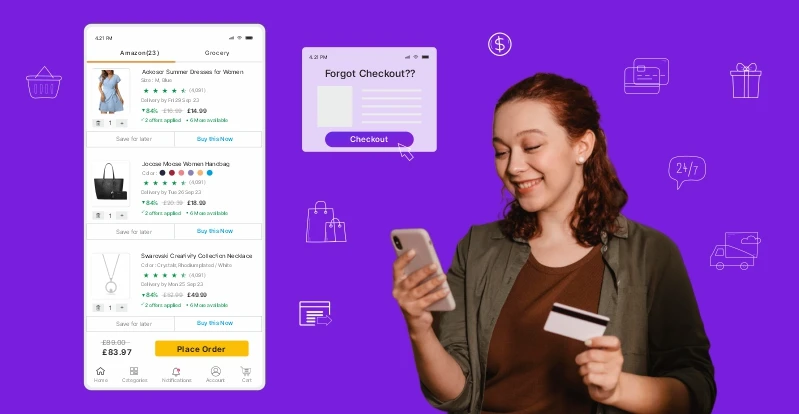
Table of Contents
Global ecommerce has crossed the $6 trillion mark, yet a persistent problem continues to undermine growth for brands of every size: shopping cart abandonment. Despite advances in UX, payment technology, and personalization, the average cart abandonment rate stubbornly hovers around 70%-and climbs even higher on mobile devices.
Shopping cart abandonment occurs when a customer adds products to their online shopping cart but leaves the site without completing the purchase. Every abandoned cart represents lost revenue, wasted acquisition spend, and a missed opportunity to build customer loyalty. Ecommerce brands lose $18 billion annually to this single issue. High cart abandonment rates signal checkout experience issues that, if left unaddressed, silently erode profitability quarter after quarter.
This article breaks down what cart abandonment is, walks through the most critical cart abandonment statistics for 2026, and outlines the practical optimization levers that Magneto IT Solutions implements for B2B and B2C brands to recover revenue and strengthen conversion rates. Let’s start with the definition.
What Is Shopping Cart Abandonment (Cart Abandonment Rate)?
Shopping cart abandonment refers to the moment an online shopper adds one or more items to their shopping cart but exits before the payment process is finalized-never reaching the “order confirmed” screen. It can happen at any point after a product is added: on the cart page itself, during shipping information entry, or even seconds before clicking “Pay Now.” The core issue is the same: intent was expressed, but the purchase journey was never completed.
The cart abandonment rate quantifies this gap. The standard formula to calculate cart abandonment rate is straightforward:
Cart Abandonment Rate = (1 − Completed Purchases ÷ Shopping Carts Created) × 100%
For example, if your online store generates 1,000 carts in a month and only 300 result in complete purchases, your cart abandonment rate is 70%. Think of it as your missed conversion rate at checkout.
It is worth distinguishing between cart abandonment and checkout abandonment. Cart abandonment covers anyone who adds items and leaves-whether they never opened the checkout page or dropped off mid-flow. Checkout abandonment is a narrower subset: users who actively entered the checkout flow (typed shipping info, selected payment) but still did not finish.
A shopper who adds sneakers to their cart, browses two more product pages, then closes the tab is a cart abandoner. A shopper who fills in their address, sees a $14.99 shipping fee they did not expect, and exits at the payment step is a checkout abandoner.
Average cart abandonment is not a universal benchmark. Your store’s ideal rate depends on industry, device mix, and whether you serve B2B buyers with purchase orders or D2C consumers expecting one-click checkout.
Global Cart Abandonment Statistics You Must Know in 2026
In 2026, the global shopping cart abandonment rate continues to sit in a range that should concern every ecommerce leader. The global average shopping cart abandonment rate is approximately 70% to 85%, depending on methodology, industry, and data source. The average cart abandonment rate across large-scale studies is 69.57%, according to Baymard Institute’s meta-analysis of 49 major studies.
Here are the abandonment statistics that matter most right now:
-
The global average cart abandonment sits between 70–78% across ecommerce sites, with some seasonal peaks near 77–78% during high-traffic holiday periods.
-
Mobile abandonment is dramatically higher, averaging around 85% for mobile users-a critical figure given that mobile now accounts for 70–80% of ecommerce traffic.
-
Desktop abandonment rates fall in the mid-60% range (~66%), making desktop the most conversion-friendly device.
-
Tablet abandonment lands between the two, typically around 70–71%.
-
Some data sources report global peaks near 83% when factoring in high-abandonment regions like Mexico (93%) and South Korea (88%), per Statista’s Q1 2026 data.
What does this mean in practice? Only about 22–30 out of every 100 online shoppers who create a cart actually complete purchases. For a mid-market brand processing 10,000 carts per month at a $120 average order value, a 70% abandonment rate translates to roughly $840,000 in potential monthly revenue left on the table.
Not all abandonment is pure friction. About 43% of shoppers abandon carts because they are just browsing-treating online shopping carts as wish lists or comparison tools. But the majority of abandonment points to preventable problems in the purchase journey: unexpected costs, poor UX, and limited payment options.

Cart Abandonment by Device: Why Mobile Users Abandon More Often
Device type is now one of the strongest predictors of cart abandonment. Mobile users consistently abandon at significantly higher rates than desktop shoppers, and this gap has real revenue consequences for every ecommerce brand.
Here are the 2026 device benchmarks:
-
Mobile abandonment: approximately 85%, with some datasets showing mobile checkout abandonment at 62%+ even among users who begin the checkout process.
-
Desktop abandonment: mid-60s, roughly 66%.
-
Tablet abandonment: approximately 70–71%, falling between mobile and desktop.
Why do mobile users abandon more? The reasons are structural and behavioral:
-
Form entry friction: 54% of shoppers abandon due to difficulties in entering personal information on mobile devices. Small touch targets, poor autofill support, and repetitive data entry create fatigue.
-
Mandatory account creation: Requiring registration on a small screen amplifies frustration and drives mobile abandonment even higher than on desktop.
-
Slow mobile performance: Website performance issues during checkout frustrate users and may lead to abandonment-especially on cellular networks where latency spikes are common.
-
Interruptions and context switching: Mobile sessions are frequently disrupted by notifications, calls, and app switching, reducing the chance a shopper completes the checkout process.
For many ecommerce brands, over 70% of traffic now arrives via mobile. When that traffic faces an 85% abandonment rate, overall conversion rates collapse-regardless of how well your desktop experience performs. This is why mobile-first checkout design, single-page flows, and digital wallets are no longer optional for B2C or B2B portals. They are baseline requirements.
Cart Abandonment by Industry and Region in 2026
Quoting an “average cart abandonment” figure without industry and regional context is misleading. Abandonment rates vary dramatically based on what is being sold and where the buyer is located.
Industry benchmarks for 2026:
-
Grocery: ~50–56% (lowest abandonment-necessity and recurring purchases drive completion)
-
General retail: ~71–76%
-
Travel: the travel industry has a cart abandonment rate of 82%, driven by comparison shopping and high price points
-
Automotive: the automotive industry experiences a cart abandonment rate of 85.97%, reflecting long decision cycles and complex configuration
-
Fashion: the fashion industry sees a cart abandonment rate of 87.79%, fueled by window shopping and sizing uncertainty
-
Cruise and ferry: the cruise and ferry sector has the highest cart abandonment rate at 98%, where booking complexity and price create extreme hesitancy
-
Industry variations exist in cart abandonment rates, with the beauty industry experiencing some of the highest rates due to product comparison behavior and sensitivity to shipping fees
Regional benchmarks (Q1 2026):
-
Global composite: ~70–78%
-
Asia: ~84%, with sustainability concerns and delivery logistics driving drop-off
-
Europe: ~80–85%, where high shipping costs and limited payment options create friction for international customers
-
North America: ~79–83%, where unexpected shipping costs dominate as the primary abandonment trigger
-
Latin America, Africa, and Australia: 83–88% range, with specific triggers including limited local payment methods, long delivery times, and high shipping fees
B2B sectors mirror these patterns when complex checkout processes-RFQ workflows, unclear tax or VAT calculations, and login walls-block quick ordering. When B2B ecommerce stores adopt guest checkout, saved carts, and integrated PO flows, abandonment drops meaningfully.

The Real Cost of Abandoned Carts: Lost Revenue and Customer Lifetime Value
The financial impact of abandoned shopping carts extends far beyond a single missed transaction. Globally, $4 trillion in sales is projected to be lost annually due to cart abandonment. In the US and EU alone, checkout optimization studies estimate roughly $260 billion in recoverable revenue.
A simple calculation illustrates the scale for an individual brand:
1,000 carts/month × 70% abandonment × $150 average cart value = $105,000 in potential monthly lost revenue. Recovering just 10% of those abandoned carts adds $10,500/month-or $126,000/year.
For a shopify plus partner or Magento-powered DTC brand doing $30M in annual GMV, a 70% abandonment rate means roughly $70M in initiated-but-uncompleted demand. Even modest recovery improvements unlock six- or seven-figure gains.
Cart abandonment increases customer acquisition costs significantly. Every ad click, email, and social impression that drives a visitor to add items-only to see them leave-represents wasted spend. You are effectively paying for non-converting touchpoints, inflating CAC without proportional revenue return.
The downstream effects compound. Cart abandonment can damage customer relationships and trust: a frustrating checkout experience makes first-time buyers less likely to return, reducing customer lifetime value. In B2B, where repeat ordering and account-based purchasing drive revenue, a friction-heavy first order can permanently suppress replenishment. Conversely, improving checkout so more first-time buyers successfully convert can dramatically lift CLV across subscription, repeat-purchase, and B2B models.
Cart abandonment rates can also misrepresent sales performance metrics. If marketing reports show strong traffic and high add-to-cart rates but low order volume, leadership may misattribute the gap to product-market issues rather than checkout friction-leading to misallocated investment.
Top Reasons Customers Abandon Carts in 2026
While some abandoned carts represent harmless window shopping (43% of shoppers are simply browsing), a far larger share is caused by preventable UX and business-policy issues. Factors influencing cart abandonment include unexpected extra costs and complex checkout processes-both of which are within a brand’s control to fix.
Here are the top reasons customers abandon their carts in 2026, with supporting data:
-
Unexpected shipping costs and extra fees: 48% of shoppers abandon carts due to unexpected costs, and 55% of shoppers abandon carts due to extra costs appearing too late in the checkout flow. When shipping fees, taxes, or duties surface only at the final step, potential customers leave immediately.
-
Mandatory account creation: 34% of shoppers abandon carts because of mandatory account creation. Forcing registration before payment introduces unnecessary friction-especially for first-time buyers.
-
Complicated checkout process: Approximately 26% cite a checkout process that is too long or too confusing, with too many form fields creating fatigue. Complex checkout processes deter customers who expect speed.
-
Slow site speed: 57% of shoppers abandon if a page takes over three seconds to load. Slow checkout pages are conversion killers, and 30% of these shoppers switch to a competitor entirely.
-
Limited payment options: 40% of shoppers abandon purchases without multiple payment options. When online shoppers do not see their preferred payment method-whether credit card, digital wallets, or BNPL-they leave.
-
Re-entering credit card details: 55% of shoppers abandon carts due to re-entering credit card details, and roughly 25% abandon when asked to re-enter shipping addresses. Repetitive data entry signals a poorly designed checkout.
-
Discount code failures and pricing doubts: 46% of shoppers abandon carts when discount codes fail to work or pricing feels unclear at the final step. Coupon-related frustration is one of the most underestimated exit triggers.
-
Ambiguous return policies and long delivery times: 22% of shoppers abandon due to long delivery times, and 10–18% leave when return or refund policies feel risky or unclear.
-
Payment security concerns: 18% of consumers abandon carts due to payment security concerns. Outdated design, missing trust badges, or an unfamiliar payment gateway make shoppers reluctant to enter credit card details.
-
Mobile-specific friction: Small form fields, missing autofill, and poor keyboard handling cause over 39% of mobile users to quit mid-checkout. Cart abandonment occurs disproportionately at the shipping information step on mobile (roughly 41% of mobile drop-offs happen there).
Key 2026 Cart Abandonment Optimization Levers (What Actually Moves Conversion Rates)
Reducing shopping cart abandonment is not about a single fix. It requires systematically removing friction and uncertainty at every stage of the purchase journey. The good news: a streamlined checkout can increase conversions by 35.62%, according to Baymard’s checkout optimization research.
Here are the levers with the highest proven impact:
-
Checkout UX simplification: The average checkout flow has 23.48 form elements. Top ecommerce sites have about 12 form elements in optimized checkouts. Cutting unnecessary fields can lift conversion rates by 30–35%.
-
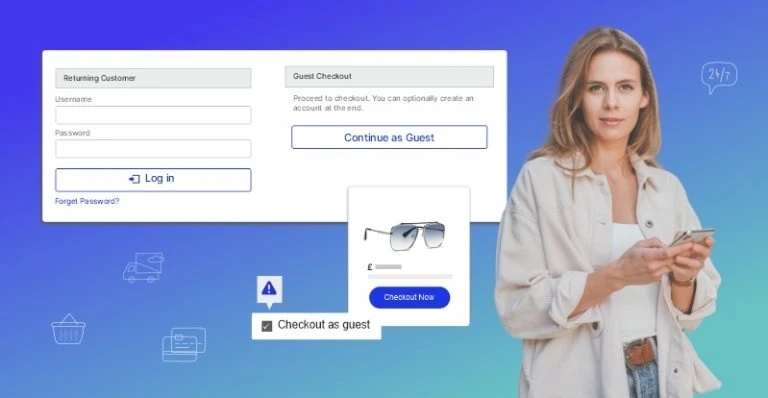
Guest checkout option: Offering guest checkout can reduce abandonment by 20%, directly eliminating the friction of account creation for first-time buyers.
-
Transparent pricing and shipping: Surfacing shipping costs, taxes, and duties on product pages and the cart page-not just the checkout page-prevents surprise-fee drop-offs. Shoppers who expect free shipping should know upfront if that is not available.
-
Faster experiences: Optimizing site speed to under 2–3 seconds across cart and checkout materially lowers bounce and abandonment rates.
-
Diverse payment options: Adding local payment methods, digital wallets like Apple Pay and Google Pay, and BNPL options reduces payment-related abandonment by double digits. Customers expect familiar payment options to complete purchases.
-
Trust-building elements: Visible SSL, PCI compliance badges, social proof, and clear return policies directly reassure customers and influence perceived safety during online transactions.
-
Retargeting and remarketing: Structured recovery workflows via email, SMS, and retargeted ads can recover 10–26% of abandoned carts, especially when personalized with abandoned product data.
-
Mobile-first design: One-page checkout, autofill, and wallet payments are non-negotiable when mobile traffic dominates.
-
Intelligent incentives: Smartly timed discounts or free shipping thresholds lift conversion without eroding margin-particularly effective for cart abandoners who dropped off at the shipping fee step.
-
Predictive AI and behavior analytics: Predictive AI can reduce cart abandonment by 18% through pre-abandonment triggers, exit-intent overlays, and personalized interventions. Continuous A/B testing of CTAs, layout, and flows compounds into long-term conversion gains.
Recovery Channels and Their Performance: Email, SMS, and Retargeting
Abandoned carts are not always permanently lost sales. Structured recovery workflows can bring a significant share of cart abandoners back to complete their orders-if the outreach is timely, relevant, and multi-channel.
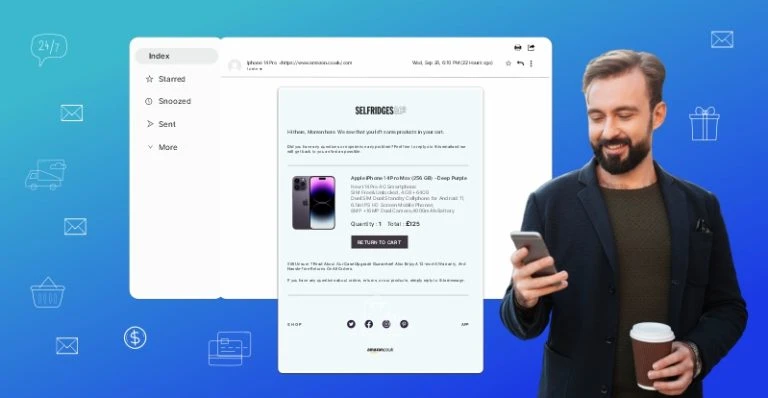
Email recovery: A single abandoned cart email typically recovers 3–5% of abandoned carts. A well-sequenced multi-email flow (sent at 30 minutes, 24 hours, and 72 hours post-abandonment) can recover 5–8% on average, with top-performing ecommerce stores reaching 10–15%. Email works best for rich product reminders, cross-sell recommendations, and communicating return policies or incentives. Open rates for abandoned cart emails hover around 45–50%.
SMS recovery: SMS conversion rates per message are higher-approximately 10–15% recovery among opt-in recipients-because open rates approach 98% and response times are faster. SMS is most effective as a second or third touch, sent 1–2 hours after abandonment, particularly for high-AOV carts. Reach is limited to those who opt in (typically 15–35% of abandoners), but cost per recovered cart often favors SMS when targeting is disciplined.
Retargeted ads: Performance benchmarks show that 26% of abandoners return to purchase when retargeted, versus roughly 8% without retargeting. Showing the exact abandoned items with dynamic pricing or shipping offers increases effectiveness. Personalized retargeting campaigns can achieve ROIs above 1,300% when powered by strong segmentation.
The highest-performing brands combine all three channels into multi-touch recovery workflows. Email casts a wide net, SMS adds urgency for high-intent segments, and retargeting maintains visibility across the web. Together, these channels can recover 25–40% of abandoned carts.
Designing a Frictionless Checkout Flow for 2026
Checkout is not just a technical step-it is a product that demands intentional design. This is especially true in B2B scenarios with configurable products, purchase orders, or approval workflows. An ideal checkout flow minimizes cognitive load and makes the path to payment feel effortless.
Key UX principles for cart and checkout performance in 2026:
-
Prioritize mobile-first, single-page checkout with a persistent order summary and clear total cost visible at all times. Mobile abandonment drops measurably when shoppers never lose sight of what they are paying.
-
Show progress indicators so existing customers and new buyers know exactly how many steps remain, reducing perceived effort and anxiety.
-
Pre-fill fields wherever possible: billing equals shipping by default, stored addresses for logged-in users, and full browser autofill support. Every keystroke you eliminate reduces the chance shoppers abandon carts.
-
Keep only essential form fields and clearly justify any additional data requests (VAT ID, PO numbers in B2B ecommerce flows). If a field is not necessary for order fulfillment, remove it.
-
Make CTAs visually prominent and unambiguous. “Continue,” “Review Order,” and “Pay Now” should be impossible to miss-and should never create confusion about what happens next.
-
Keep product thumbnails, details, and edit options visible throughout checkout. Shoppers who cannot verify what they are buying feel uncertain-and uncertainty triggers exits.
-
Deploy live chat or chatbot widgets near payment and shipping steps to answer last-minute questions about delivery, returns, or pricing.
-
Minimize distractions and outbound links once the shopper enters the checkout funnel. Navigation menus, promotional banners, and social links should be suppressed or removed on the checkout page.
A seamless checkout process is not achieved through a single redesign-it requires ongoing measurement and iteration based on funnel analytics, heatmaps, and session replays.
Payment Experience in 2026: From Digital Wallets to BNPL
Lack of preferred payment options is now one of the fastest-growing reasons shoppers abandon carts. 40% of shoppers abandon purchases without multiple payment options-a figure that has risen steadily as customer expectations around flexible payment options have evolved.
A modern payment mix for 2026 should include:
-
Traditional cards plus major digital wallets: Apple Pay, Google Pay, and PayPal reduce form entry friction and speed checkout. For mobile users, wallet-based payments can cut checkout time by 50% or more.
-
Buy Now, Pay Later (BNPL): Offering Buy Now, Pay Later increases order size by 18% while reducing sticker shock on high-AOV items. Klarna, Afterpay, and local BNPL providers are now table stakes for many D2C and retail brands.
-
Local payment methods and currencies: In cross-border selling, international customers abandon when they encounter unfamiliar currencies or foreign transaction warnings. Surfacing region-appropriate payment gateways prevents this friction entirely.
-
Visible payment security signals: 3D Secure where appropriate, recognizable gateway logos, and clear messaging about data protection reassure customers entering sensitive information. 18% of consumers abandon carts due to payment security concerns-trust signals directly address this.
Payment failures directly lead to cart abandonment. Falsely declined transactions, expired authorization tokens, and gateway timeouts inflate abandonment silently. Monitoring authorization rates and working with processors to optimize approval rates is a critical but often overlooked lever for checkout performance.
How Magneto IT Solutions Helps Brands Reduce Cart Abandonment
At Magneto IT Solutions, we approach cart abandonment as a measurable growth lever-not a vanity metric. As a global B2B and B2C ecommerce engineering and growth partner, our focus is on conversion outcomes, not just storefront launches. We help brands reduce shopping cart abandonment through data-driven strategy and scalable commerce solutions.
Here is how we address the problem across the stack:
-
Custom checkout UX and UI design for Magento, Shopify Plus, and headless commerce builds-tailored to device behavior, audience type, and industry benchmarks.
-
Performance optimization across cart and checkout to hit sub-2-second load times on web and mobile, directly limiting abandonment from slow pages.
-
Deep integrations with PIM, DAM, CRM, OMS, and marketing automation tools that support consistent pricing, real-time inventory, and personalized recovery flows for cart abandoners.
-
Modern payment stack implementation: digital wallets, BNPL, regional payment methods, and secure gateways with high authorization rates-so customer behavior is never blocked by limited payment options.
-
Data and behavior analytics setup: funnels, heatmaps, and session replay to identify exactly where customers abandon and how to prioritize fixes through our conversion rate optimization services.
-
Automated abandoned cart workflows across email, SMS, and paid retargeting, aligned with brand voice and margin constraints.
-
Replatforming and modernization that replaces legacy, high-friction checkout flows with scalable, omnichannel experiences designed for customer experience excellence.
We encourage our clients to view cart abandonment as an ongoing optimization program. The brands that compound small improvements across UX, payments, and recovery over time are the ones that see sustained revenue growth. If you are ready to design, build, and continuously refine your digital commerce ecosystem, we would welcome the conversation.
Conclusion: Turning Abandoned Carts into a Growth Lever
A cart abandonment rate around 70% is not a fixed law of ecommerce. It is a diagnostic signal pointing directly to solvable friction and trust gaps across your checkout flow, payment process, and customer experience. Every percentage point recovered translates to measurable revenue.
Even modest improvements-cutting form fields, adding a guest checkout option, surfacing shipping costs earlier, or supporting diverse payment options-can unlock six- or seven-figure annual revenue gains while strengthening customer lifetime value. The math is straightforward and the solutions are proven.
Abandonment carts are something that can lead to some serious issues for the eCommerce business; therefore, this issue needs to be solved quickly. The problem can be solved using structured strategies and refined technology by choosing digital solutions. To get rid of this problem, it’s important to connect with a professional and choose the right technique to improve the abandonment issue of the cart to ensure higher conversion.
FAQs
 What is a normal cart abandonment rate in 2026?
The global average sits between 70–78%, with some studies reporting 69.57% as the baseline. However, “normal” depends on your industry. Grocery brands may see 50–56%, while fashion or travel brands commonly exceed 82–88%. Benchmarking against your specific vertical and device mix is essential.
Why do mobile users abandon more often than desktop shoppers?
Mobile users face smaller screens, harder form entry, more interruptions, and slower network connections. 54% of shoppers cite difficulty entering personal information on mobile as a reason for leaving. Poor autofill support and mandatory account creation amplify the problem.
What is the number one reason customers abandon?
Unexpected shipping costs and extra costs are the top trigger. 48% of shoppers abandon carts due to unexpected costs, and 55% abandon when extra fees appear late in the flow. Transparent pricing from the product pages through checkout is the most effective countermeasure.
Is it realistic to reduce cart abandonment by 10–20%?
Yes. Checkout optimization can increase conversions by 35.62% when form elements are reduced, guest checkout is offered, and payment options are expanded. A 10–20% reduction in abandonment rates is well within reach for most ecommerce brands willing to invest in structured testing and UX improvements.