Why Agentic Commerce Matters for UK Brands and How Adobe Is Leading the Shift
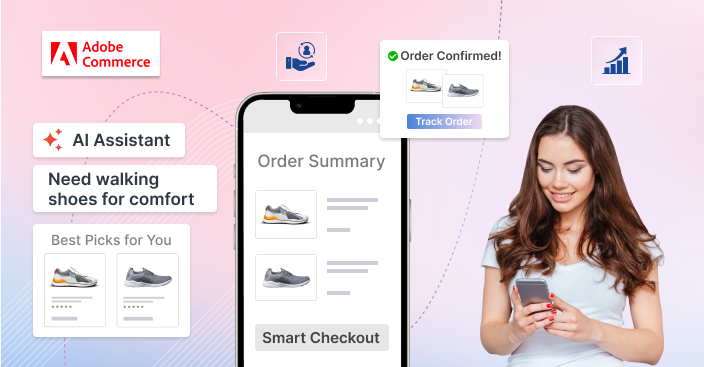
Table of Contents
What happens when customers no longer need to browse your website to make a purchase? That’s the direction online shopping is moving in.
AI is becoming more capable of helping people make buying decisions, from finding the right product to completing a purchase.
As a result, businesses need to start thinking about how shopping experiences will change in the years ahead.
This shift is often referred to as agentic commerce, and it has the potential to change how brands connect with customers.
In this blog, we’ll look at what agentic commerce is and how Adobe is helping UK businesses prepare for this change.
What Is Agentic Commerce?
Agentic commerce refers to a commerce environment where AI agents can make decisions and perform tasks on behalf of customers or businesses.
Unlike traditional AI tools that provide suggestions, AI agents can:
- Research products independently
- Compare pricing and specifications
- Recommend personalised options
- Manage purchasing workflows
- Execute transactions
- Coordinate with other systems and agents
Industry analysts predict that AI-assisted transactions will become a meaningful share of digital commerce over the next decade.
Why UK Businesses Should Pay Attention Now
Many UK businesses are investing in AI, but most are still building on disconnected systems, fragmented customer data, and commerce platforms that weren’t designed for AI-driven buying experiences.
While these limitations may seem manageable today, they could become significant barriers as AI plays a larger role in how customers discover and purchase products.
The shift is happening faster than many organisations expect. Salesforce reports that 39% of consumers are already comfortable with AI agents making purchases on their behalf, signalling growing trust in AI-assisted buying.
As customer behaviour evolves, businesses that fail to adapt risk losing visibility, relevance, and potential revenue opportunities to competitors that are better prepared.
The question is no longer whether AI will influence commerce. The real question is whether your business is ready for a future where buying decisions are increasingly shaped by intelligent agents.
This shift creates two important implications for businesses:
|
Today’s Ecommerce Experience |
Emerging Agentic Commerce Experience |
|
Customers actively search for products |
AI agents identify relevant products based on intent and preferences |
|
Buyers manually compare products and suppliers |
AI evaluates options, pricing, and availability in real time |
|
Purchasing decisions rely on individual research |
Decisions are supported by data, context, and predictive insights |
|
Checkout requires multiple customer actions |
Purchases can be assisted or automated by AI agents |
|
Personalisation is based on historical behaviour |
Experiences adapt dynamically to real-time intent and context |
|
Customer journeys follow predefined paths |
AI continuously optimises journeys based on goals and behaviour |
|
Business teams manage workflows manually |
AI automates repetitive tasks and decision-making processes |
While human decision-making will remain important, AI is expected to play a much larger role in how products are discovered, evaluated, and purchased. Businesses that begin preparing for this shift today will be better positioned to meet changing customer expectations tomorrow.
Why Adobe Is Well Positioned for Agentic Commerce
For many businesses, the challenge isn’t adopting AI, it’s giving AI access to accurate customer data, product information, content, and real-time business insights.
This is where Adobe stands out. By bringing together Adobe Experience Platform, Real-Time CDP, Customer Journey Analytics, and Adobe Commerce, businesses can build the connected foundation needed for intelligent buying experiences.
To support this shift, Adobe introduced Experience Platform Agent Orchestrator, enabling organisations to build and manage AI agents that can access data, automate workflows, and deliver more relevant customer experiences while maintaining governance and human oversight.
- Customer Data Integration: Creates a unified view of customers, interactions, and preferences across channels.
- AI-Powered Decisioning: Delivers faster, more relevant recommendations based on real-time data and context.
- Multi-Agent Coordination: Automates workflows and enables seamless collaboration across systems and teams.
- Conversational Experiences: Supports more natural and personalised interactions for both customers and employees.
- Governance Controls: Maintains compliance, transparency, and human oversight of AI-driven decisions.
The result is a more connected commerce ecosystem that can adapt to changing customer expectations and support AI’s growing role in the buying journey.

Practical Use Cases for UK Brands
1. Intelligent Product Discovery
Imagine a UK automotive distributor managing thousands of SKUs. Instead of manually searching through catalogues, an AI agent can identify compatible parts, compare inventory availability, recommend alternatives, and help buyers complete purchases faster.
To deliver more relevant recommendations, AI agents can analyse:
- Previous purchases and order history
- Customer preferences and buying patterns
- Real-time inventory availability
- Pricing rules and product alternatives
This helps buyers find the right products faster while reducing friction throughout the purchasing journey.
2. Automated B2B Procurement
UK manufacturers and distributors often manage thousands of SKUs across suppliers, making procurement a strong use case for AI-assisted decision-making.
AI agents can:
- Create replenishment orders
- Compare suppliers
- Verify inventory levels
- Recommend purchasing decisions
This creates significant efficiency gains for procurement teams.
3. Dynamic Customer Journey Optimisation
Adobe’s ecosystem allows AI agents to analyse customer interactions across channels and adjust experiences in real time.
Examples include:
- Personalised promotions
- Dynamic content recommendations
- Journey optimisation
- Automated campaign execution
4. Customer Service at Scale
Instead of scripted chatbot responses, AI agents can:
- Access customer histories
- Understand context
- Resolve complex issues
- Escalate appropriately
This creates more meaningful interactions while reducing operational costs.
What Businesses Stand to Gain?
Beyond improving efficiency, agentic commerce has the potential to reshape how businesses engage customers, streamline operations, and create competitive advantages.
|
Opportunity |
Potential Impact |
|
Faster product discovery |
Improved conversions |
|
Better personalisation |
Higher engagement |
|
Connected customer data |
Better decision-making |
|
Automated workflows |
Increased efficiency |
|
AI-assisted buying |
Competitive advantage |
As AI becomes more involved in how products are discovered, evaluated, and purchased, organisations that act early will be in a stronger position to turn these opportunities into measurable business results.
Is Your Commerce Stack Ready for Agentic Commerce?
Many businesses are eager to adopt AI, but success depends on more than the technology itself. The real question is whether your business has the right foundation in place.
Before investing in agentic commerce, ask yourself:
- Is your product and customer data connected and up to date?
- Can your systems share information in real time?
- Are your commerce, content, and customer experiences working together?
- Do you have the governance needed to manage AI-driven decisions?
- Can you deliver personalised experiences at scale?
If you’re unsure about any of these areas, a readiness assessment can help identify the gaps before they impact customer experience, operational efficiency, or future growth.
Challenges Businesses Must Address
While the opportunities are significant, agentic commerce depends on having the right foundation in place. AI agents can only make effective decisions when they have access to accurate data, connected systems, and real-time business insights.
Some of the most common challenges organisations face include:
- Fragmented product data: AI agents may struggle to recommend the right products consistently when information is spread across multiple systems.
- Disconnected customer information: Limits personalisation and reduces the relevance of recommendations and customer experiences.
- Legacy commerce systems: Makes it difficult to support real-time decision-making, automation, and seamless interactions.
- Limited system integrations: Prevents AI agents from accessing critical business data needed to make informed decisions.
- Governance and compliance concerns: Requires clear oversight, accountability, and control over AI-driven actions.
- Lack of a unified customer view: Creates disconnected experiences across channels and touchpoints, impacting customer satisfaction.
Addressing these challenges is often the first step towards building a commerce ecosystem that can support AI-driven buying experiences at scale.
How to Prepare for the Next Generation of Commerce
Organisations should focus on five priorities:
- Create a unified customer data foundation.
- Modernise ecommerce infrastructure.
- Strengthen API and integration capabilities.
- Establish AI governance frameworks.
- Pilot AI agents in low-risk workflows before scaling.
Businesses already investing in modern customer experience platforms will have a significant advantage as AI capabilities mature.

Why Working With the Right Adobe Commerce Partner Matters
Implementing AI-enabled commerce requires more than deploying new technology.
Success depends on:
- Data architecture
- Customer journey design
- Platform integrations
- Governance frameworks
- Continuous optimisation
An experienced adobe commerce agency can help businesses align technology investments with commercial goals while ensuring scalability and compliance.
Whether your organisation is exploring agentic commerce solutions, upgrading existing ecommerce infrastructure, or building a future-ready customer experience ecosystem, strategic planning is essential.
Final Word
The future of commerce will not be defined solely by better websites or faster checkout experiences.
It will be shaped by intelligent systems capable of understanding intent, making decisions, and taking action on behalf of customers and businesses.
Adobe’s investment in AI-powered orchestration signals where the market is heading. As customer expectations evolve and autonomous buying journeys become more common, organisations that modernise their data, technology, and customer experience foundations today will be better positioned to compete tomorrow.
Wondering whether your current commerce ecosystem is ready for agentic commerce?
Our Adobe specialists can help you assess your customer data strategy, platform capabilities, and AI readiness to identify the opportunities and gaps that could impact future growth.
Book an Agentic Commerce Readiness Assessment and discover how your business can prepare for the next generation of digital commerce.
FAQs
 Why is agentic commerce important for UK businesses?
Agentic commerce helps UK businesses automate shopping, purchasing, customer service, and decision-making using AI. This improves operational efficiency, delivers more personalised customer experiences, and helps businesses stay competitive in a rapidly evolving digital marketplace.
How is agentic commerce different from traditional AI?
Traditional AI typically provides recommendations or insights. Agentic systems can take actions, make decisions, and execute workflows based on goals and context.
How is Adobe supporting agentic commerce?
Adobe has introduced Adobe Experience Platform Agent Orchestrator, enabling businesses to build, manage, and coordinate AI agents across customer experience ecosystems.
Is agentic commerce relevant for B2B businesses?
Yes. B2B organisations can use AI agents for procurement automation, inventory management, customer support, sales assistance, and operational workflows.
What industries will benefit most by agentic AI?
Retail, manufacturing, wholesale distribution, healthcare, financial services, travel, and professional services are among the sectors expected to benefit significantly.
Is human oversight still required?
Absolutely. Most enterprise implementations include governance controls and human approval processes to ensure compliance, trust, and accountability.
How can UK brands prepare for agentic commerce?
Businesses should focus on creating a unified customer data foundation, modernising commerce infrastructure, improving integrations, and establishing governance frameworks that support AI-driven decision-making.