How AI Product Recommendations Increase AOV in Auto Parts Stores
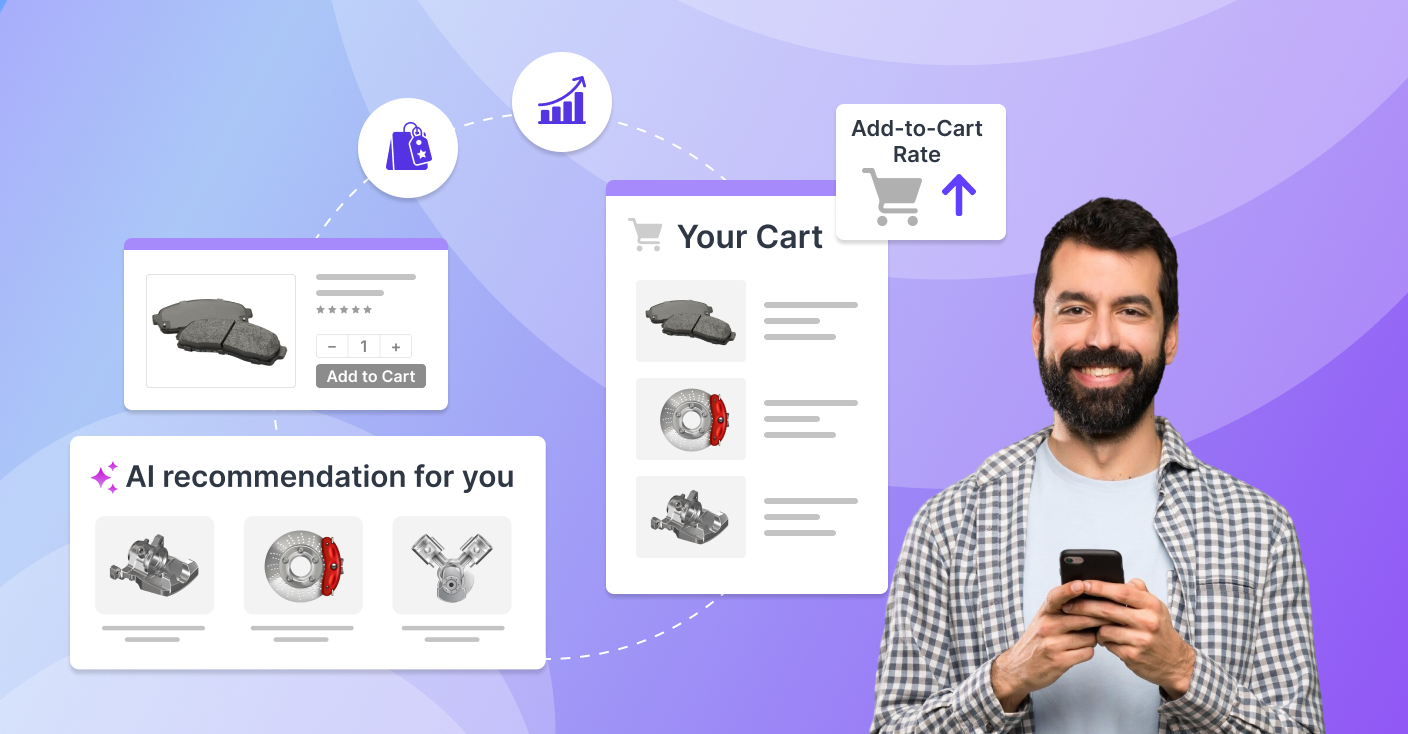
Table of Contents
Growing an online auto parts store isn’t just about attracting more traffic; it’s about generating more value from every customer who visits.
As competition increases and customer acquisition becomes more expensive, improving Average Order Value (AOV) has become one of the most effective ways for UK automotive retailers to drive profitable growth.
However, today’s shoppers expect more than a product catalogue. They want relevant recommendations to quickly find compatible parts, premium alternatives, and complementary products.
AI product recommendations help retailers personalize every shopping journey, making it easier for customers to discover the right products while increasing basket value and revenue.
In this blog, we’ll explore how AI-powered search and product recommendation increase AOV, the strategies leading automotive retailers use to improve customer experiences, and how your business can implement them to drive sustainable growth.
Why Are Many Auto Parts Stores Missing Opportunities to Increase AOV?
Most automotive retailers invest heavily in SEO, paid advertising, and promotions to attract customers.
However, more traffic doesn’t always translate into more revenue. If shoppers purchase only one item, acquisition costs remain high while profitability suffers.
The real opportunity is increasing the value of every order. For example, a customer buying brake discs may also need brake pads, brake fluid, or fitting kits.
Without intelligent recommendations, these additional purchases are often missed because traditional merchandising relies on fixed product rules instead of customer intent.
Most auto parts retailers don’t lose revenue because they lack products; they lose revenue because customers struggle to find the right products quickly.
Every additional search, filter, or compatibility check creates friction that can reduce basket value or lead to cart abandonment.
| Traditional Recommendations |
AI Product Recommendations |
| Same products shown to every visitor |
Recommendations tailored to each shopper |
|
Manual product associations |
Learns from browsing and purchasing behaviour |
|
Static cross-sell rules |
Real-time personalisation |
|
Limited upselling opportunities |
Intelligent product discovery |
|
One-size-fits-all merchandising |
Vehicle and customer-specific recommendations |
AI isn’t replacing merchandising; it’s making it more relevant. By understanding customer intent instead of relying on predefined rules, retailers can recommend products customers are more likely to purchase.

How AI Product Recommendations Improve the Buying Journey
One of the biggest advantages of AI is its ability to understand customer intent as shoppers move through your website.
Instead of waiting until checkout to suggest additional products, AI continuously analyses behaviour throughout the buying journey and surfaces recommendations where they add the most value.
For automotive retailers, this means customers can discover compatible parts, premium alternatives, and essential accessories without interrupting their purchase journey.
AI recommendations can help customers:
- Find compatible replacement parts for their vehicle.
- Discover premium alternatives that better match their requirements.
- Add complementary products such as installation kits or maintenance accessories.
- Explore products frequently purchased together by similar customers.
- Receive personalised recommendations based on previous purchases and browsing behaviour.
This creates a better shopping experience while naturally encouraging customers to purchase more within a single transaction.
Why Static Product Recommendations No Longer Meet Customer Expectations
Many automotive eCommerce stores still rely on manually configured product recommendations. While this approach may work for smaller catalogues, it becomes increasingly difficult to manage as inventories grow and buying journeys become more complex.
Today’s shoppers expect faster, more relevant product discovery. According to the 2025 Coveo Commerce Relevance Report, 72% of shoppers abandon eCommerce sites when they can’t quickly find relevant products, while 62% are more likely to purchase when generative AI is available.
These findings highlight a clear shift in customer expectations—from generic merchandising to intelligent, personalised shopping experiences.
For auto parts retailers, where product compatibility and buying confidence directly influence purchasing decisions, static recommendations often fall short. AI-powered recommendations help bridge this gap by surfacing compatible parts, complementary products, and relevant alternatives at the right stage of the buying journey.
Key Takeaways
- Increase revenue without relying solely on acquiring more traffic.
- Recommend compatible parts based on customer behaviour and vehicle fitment.
- Improve product discovery through AI-powered personalisation.
- Increase basket size with intelligent cross-selling and upselling.
- Build shopping experiences that encourage repeat purchases and long-term customer loyalty.
Five AI Recommendation Strategies That Increase Average Order Value
Every automotive retailer wants customers to spend more per transaction, but pushing more products isn’t the answer.
Modern shoppers expect recommendations that simplify their buying journey, not sales tactics that interrupt it. AI changes the way recommendations work by understanding customer intent and delivering suggestions that are relevant, timely, and helpful.
Instead of relying on predefined merchandising rules, AI continuously learns from customer interactions, browsing behaviour, purchase history, and product relationships.
Every recommendation becomes smarter with every purchase, allowing retailers to create personalised experiences that naturally encourage higher-value orders.
1. Recommend Compatible Products with Confidence
Finding the correct automotive part can be challenging, especially when customers are shopping for different vehicle makes, models, and production years. Even a small compatibility issue can result in abandoned carts, product returns, and lost customer trust.
AI recommendation engines remove much of this uncertainty by analysing vehicle fitment data alongside customer behaviour. Rather than showing hundreds of products, AI recommends the most relevant components based on the customer’s vehicle and shopping intent.
For example, when a customer searches for brake discs for a 2022 BMW 3 Series, AI can automatically recommend:
- Compatible brake pads
- Wear sensors
- Brake fluid
- Fitting kits
- Performance upgrades
Instead of forcing customers to search for each product individually, AI helps them complete their purchase in one journey, increasing both customer confidence and basket value.
2. Turn Cross-Selling into Helpful Buying Guidance
Traditional cross-selling often relies on fixed product relationships that rarely change over time. AI takes a different approach by identifying products that customers with similar buying behaviour frequently purchase together.
Rather than promoting random accessories, AI recommends products that genuinely support the customer’s purchase.
| Customer Adds |
AI Can Recommend |
|
Engine Oil |
Oil Filter, Funnel Kit, Engine Flush |
|
Brake Pads |
Brake Cleaner, Brake Fluid, Installation Kit |
|
Car Battery |
Battery Charger, Terminal Protectors |
|
Wiper Blades |
Screen Wash, Glass Cleaner |
|
Alloy Wheels |
Wheel Locks, Tyre Pressure Sensors |
Because these recommendations solve a problem rather than create one, customers perceive them as valuable guidance rather than promotional messaging.
3. Use AI to Deliver Smarter Upselling
Upselling isn’t about persuading customers to spend more. It’s about helping them make a better buying decision.
For automotive retailers, this could mean recommending a premium battery with a longer warranty, higher-performance brake pads for demanding driving conditions, or an upgraded service kit that offers better long-term value.
AI evaluates customer intent alongside historical purchasing patterns to determine which premium products are most relevant for each shopper.
Instead of interrupting the buying journey with aggressive promotions, retailers can present better alternatives when customers are actively comparing products.
Traditional Upselling vs AI Upselling
|
Traditional Approach |
AI-Powered Approach |
| Same premium product for everyone | Recommendations based on customer intent |
|
Manual merchandising |
Real-time behavioural analysis |
|
Limited personalisation |
Vehicle-specific recommendations |
|
Generic offers |
Context-aware upgrades |
The result is a shopping experience that feels more like expert advice than a sales pitch.
4. Improve Product Discovery Across Large Catalogues
One of the biggest challenges for UK automotive retailers is managing extensive product catalogues. With thousands of SKUs across multiple manufacturers, categories, and vehicle types, customers often struggle to find products they didn’t know they needed.
AI improves product discovery by analysing browsing patterns in real time and surfacing products that match each customer’s interests.
Instead of relying solely on category navigation or keyword searches, AI helps shoppers discover:
- Complementary maintenance products
- Seasonal accessories
- Higher-value alternatives
- Newly launched products
- Frequently purchased combinations
This creates a more engaging shopping experience while exposing customers to products that might otherwise remain hidden within the catalogue.
5. Personalize Every Stage of the Customer Journey
Many retailers think product recommendations only belong on product pages. In reality, AI can influence purchasing decisions throughout the customer journey.
| Customer Journey Stage | AI Recommendation Opportunity |
|
Homepage |
Personalised featured products |
|
Category Pages |
Relevant product suggestions |
|
Product Pages |
Compatible accessories and alternatives |
|
Cart |
Complementary products and bundles |
|
Checkout |
Last-minute add-ons |
|
Post-Purchase |
Maintenance reminders and replacement parts |
This consistent personalisation keeps customers engaged while creating multiple opportunities to increase Average Order Value without disrupting their shopping experience.
Why UK Automotive Retailers Are Investing in AI
The UK automotive aftermarket is becoming increasingly digital, but customer expectations continue to evolve faster than many commerce platforms.
Retailers are now expected to deliver:
- Personalised product recommendations
- Accurate vehicle compatibility
- Intelligent product discovery
- Faster search experiences
- Seamless omnichannel shopping journeys
Meeting these expectations manually becomes increasingly difficult as product catalogues grow.
AI helps retailers scale personalisation across thousands of products without constantly updating merchandising rules, allowing teams to focus on business growth instead of manual catalogue management.
Common Mistakes Retailers Make When Implementing AI Recommendations
Investing in AI doesn’t automatically increase Average Order Value. The results depend on how recommendations are implemented and how well they align with the customer journey.
Many retailers introduce AI as a standalone feature instead of making it part of their overall commerce strategy.
Some of the most common mistakes include:
|
Mistake |
Business Impact |
| Showing the same recommendations to every customer | Lower engagement and missed personalisation opportunities |
|
Ignoring vehicle compatibility |
Higher returns and reduced customer trust |
|
Recommending products only at checkout |
Fewer opportunities to increase basket value |
|
Focusing only on upselling |
Customers perceive recommendations as promotional rather than helpful |
|
Not measuring recommendation performance |
Limited visibility into AOV and conversion improvements |
The most successful automotive retailers treat AI as an ongoing optimisation strategy. They continuously refine recommendation models, monitor customer behaviour, and test different placements across the buying journey to improve engagement and revenue.
How Can You Measure the Success of AI Product Recommendations?
Introducing AI recommendations is only the first step. Measuring the right performance indicators helps retailers understand whether personalisation is delivering measurable business value.
Instead of tracking clicks alone, focus on metrics that directly influence profitability.
Key KPIs to Monitor:
- Average Order Value (AOV)
- Conversion Rate Optimisation services
- Revenue Per Visitor (RPV)
- Recommendation Click-Through Rate
- Attach Rate (additional products purchased)
- Repeat Purchase Rate
- Customer Lifetime Value (CLV)
- Return Rate for Compatible Products
Monitoring these KPIs helps identify where AI is creating the greatest commercial impact and where further optimisation is needed.
Why Choose Magneto IT Solutions for AI-Powered Automotive eCommerce?
Implementing AI product recommendations isn’t simply about adding another technology to your storefront.
Success depends on understanding customer behaviour, integrating the right commerce platform, and creating recommendation strategies that support long-term business goals.
At Magneto IT Solutions, we help automotive retailers build intelligent commerce experiences that improve product discovery, increase Average Order Value, and strengthen customer loyalty.
Our team helps businesses:
- Implement AI-powered product recommendations
- Build intelligent cross-selling and upselling strategies
- Improve vehicle compatibility experiences
- Personalize customer journeys across every touchpoint
- Integrate AI with Shopify Plus, Adobe Commerce, BigCommerce, Salesforce Commerce Cloud, and composable commerce platforms
- Optimize commerce performance using real customer insights
Whether you’re modernizing an existing automotive store or launching a new digital commerce experience, we help you implement AI where it delivers measurable business outcomes, not unnecessary complexity.
Let’s Wrap Things Up
Every customer interaction is an opportunity to increase Average Order Value. AI-powered product recommendations help auto parts retailers deliver relevant shopping experiences, improve product discovery, and turn more purchases into higher-value orders.
Ready to Increase AOV?
At Magneto IT Solutions, we help automotive retailers implement AI-powered commerce solutions that increase conversions, boost basket value, and create personalised shopping experiences.
Book a free strategy session to discover how AI recommendations for auto parts stores can help your business grow.
FAQs
 How do AI product recommendations increase AOV in auto parts stores?
AI recommends compatible parts, premium alternatives, and complementary products based on customer intent, helping increase basket value and Average Order Value (AOV).
What products can AI recommend?
AI recommends compatible replacement parts, maintenance kits, accessories, service bundles, and premium alternatives based on customer behavior and vehicle data.
Can AI reduce cart abandonment?
Yes. By helping shoppers find the right products faster, AI reduces purchase uncertainty and encourages more customers to complete their orders.
Which eCommerce platforms support AI recommendations?
Platforms like Shopify Plus, Adobe Commerce, BigCommerce, Salesforce Commerce Cloud, and composable commerce solution support AI-powered recommendations.
How can Magneto IT Solutions help?
Magneto IT Solutions helps automotive retailers implement AI-powered product recommendations that improve product discovery, increase AOV, and create personalised shopping experiences.
Can AI recommendations increase sales without increasing website traffic?
Yes. AI recommendations can help boost revenue by suggesting more products to add to each basket, more cross-sells and upsells, and more relevant products that are shown on the website.
How does AI personalisation improve the auto parts shopping experience?
AI personalisation can look at customer behaviour, vehicle data, browsing history and purchase intent to bring up more relevant products, enabling consumers to quickly find a product that suits their needs.
Where should auto parts retailers display AI product recommendations?
Recommendations can be displayed across the homepage, category pages, product pages, search results, shopping carts, checkout and post-purchase journeys, depending on customer intent.
What is the difference between AI recommendations and traditional product recommendations?
Traditional recommendations are usually based on manually set rules, whereas AI recommendations can interpret real-time customer behavior, product relationships, and purchasing patterns to provide more individualized recommendations.