How Generative Engine Optimisation is Revolutionising SEO in the UK
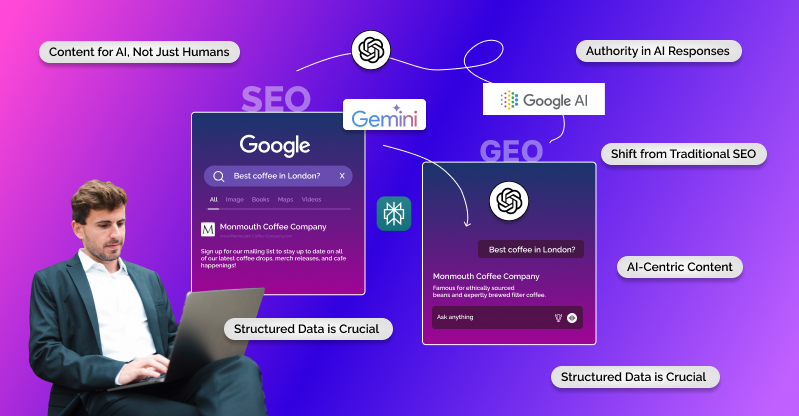
Table of Contents
The way people search for products, platforms, and services in the UK has fundamentally shifted. Google’s AI Overviews launched in the UK on 15 August 2024, and since then, search engines have increasingly replaced traditional blue links with ai generated answers. Bing Copilot, Perplexity, ChatGPT Search, and Gemini now compete for the same queries that once drove organic traffic to eCommerce sites.
Generative engine optimisation – commonly abbreviated as GEO – is the practice of optimising content, data, and brand signals so that ai search tools can understand, trust, and cite your brand in their ai responses. Unlike traditional seo, which targets rankings on search engine result pages, geo generative engine optimisation focuses on earning mentions and citations inside ai generated summaries. Generative Engine Optimisation is reshaping SEO practices toward being cited in ai generated answers, and for UK retailers, manufacturers, and distributors selling online, this shift demands immediate attention.
At Magneto IT Solutions, we apply GEO specifically to B2B and B2C eCommerce platforms – Magento, Shopify Plus, and headless architectures – rather than generic content marketing. This article answers four critical questions for UK eCommerce leaders:
- What is generative engine optimisation and how does it differ from search engine optimisation?
- How do generative search engines decide which brands to cite?
- What practical steps can uk businesses take to earn ai visibility?
- How do you measure geo success in a market where clicks are declining?
What Is Generative Engine Optimisation (GEO)?
GEO optimises your website content, structured data, and brand presence so ai platforms – ChatGPT, Gemini, Claude, Perplexity, Copilot – can surface you in their ai generated responses. GEO focuses on content being cited in ai generated answers, not just appearing in traditional rankings. It extends engine optimisation into an ai driven search landscape where answer engine optimisation and entity alignment matter more than isolated keywords.
GEO interacts with semantic search, entity recognition, and E-E-A-T signals that generative ai systems depend on. Geo ensures content is cited in ai answers by aligning depth, authority, and structure with how ai models retrieve information.
Key distinctions:
- SEO targets ranking position on search engine result pages
- GEO targets citation and mention within ai generated outputs
- AEO (answer engine optimisation) focuses on direct answers in featured snippets and voice results
- GEO encompasses AEO while extending to generative search platforms, ai summaries, and conversational ai tools
How Generative Engines and AI Search Actually Work
Large language models like GPT-4.1, Claude 3.5, and Gemini 1.5 do not simply match keywords. They vectorise content into high-dimensional embeddings, retrieve semantically relevant passages, and synthesise ai generated responses that blend multiple sources.
The pipeline follows a consistent pattern: a user asks a question, the generative engine retrieves candidate sources using hybrid methods (lexical matching plus vector embeddings), the model composes an answer, and it selects which brands to mention or link. Some ai tools crawl the web in real time (Perplexity, ChatGPT with browsing), while others rely on indexed content (Google AI Overviews via Gemini).
These ai systems reward:
- Clarity and structure in content layout
- Topical authority built through depth, not volume
- Internal consistency across product pages, knowledge bases, and integration documentation
- Freshness and regular updates, particularly for evolving topics
SEO vs GEO: What’s Changing for UK Brands
SEO focuses on ranking while GEO focuses on ai visibility – and for UK eCommerce brands, this distinction now carries commercial weight. Ai driven search will prioritise contextually relevant content over traditional rankings.
Four key shifts define the transition:
- From clicks to answers: users get direct answers from ai summaries without visiting a website
- From keywords to entities: ai systems interpret brand identity, platform capabilities, and topical relationships rather than keyword density
- From pages to topic clusters: generative search engines reward interconnected content ecosystems over standalone pages
- From SERP position to AI mention share: brand visibility depends on being cited by ai engines, not just ranking in position one
GEO does not replace seo. It builds on solid seo foundations – speed, Core Web Vitals, mobile-first design, crawlability – that UK sites still require. Both seo and GEO must work together; without technical seo, ai tools cannot crawl or index content reliably.
Why GEO Matters Right Now in the UK Market
Google’s AI Overviews reached the UK in August 2024, and AI Mode launched in July 2025. Approximately 69.5% of UK Google searches in early 2026 resulted in zero clicks – users getting their answer directly on the search page. Generative search reduces clicks to websites, changing user behaviour fundamentally. Ai search reduces clicks to websites, increasing the need for GEO across every sector.
AI-generated search experiences are often the final destination for users seeking information. UK procurement teams now ask ai tools for platform advice – “Magento vs Shopify Plus for UK VAT and B2B” – and ai driven platforms deliver recommendations without requiring a single website visit. This traffic tends to be smaller in volume but significantly higher in intent: people search with specific implementation, integration, and replatforming questions.
Why UK CMOs and eCommerce directors should prioritise GEO now:
- Early mover brand visibility in ai responses compounds over time
- Ai-referred leads show higher qualification rates
- The CMA has mandated publisher opt-out and attribution controls, making GEO part of regulatory readiness
- Competitors not investing in GEO will lose digital visibility as search behaviour shifts permanently
- Geo matters because the window for establishing topical authority in ai platforms is narrowing
How GEO Is Transforming Traditional SEO Tactics
Core SEO activities are being reframed for an ai powered search world. Keyword research now emphasises natural language, long-tail questions, and intent clusters. Long-tail keyword rankings indicate successful GEO initiatives because they align with how people phrase queries in conversational ai tools.
On-page SEO must evolve: answer-first introductions, clear subheadings, concise definitions, and structured FAQs that ai tools can reuse. Backlinks remain useful as authority signals, but content quality, citations, and entity coherence increasingly dominate for ai powered search.
What remains critical: technical seo, site speed, crawlability, mobile optimisation. What needs updating: content format, schema adoption, entity definition. What is losing impact: relying solely on keyword density and link volume.
Core Pillars of Generative Engine Optimisation
GEO requires content to be contextually relevant and structured. Geo focuses on context optimisation and structured data as foundational principles. Five pillars underpin every effective geo strategy:
- Clarity and completeness – answer user queries fully within well structured content blocks
- Semantic and structured content – organise pages around entities, relationships, and topics, not isolated keywords
- Authority and proof – embed real data, case studies, and expert perspectives
- Technical discoverability – ensure schema markup, crawlability, and indexation support ai readiness
- Consistent brand narrative – align messaging across your eCommerce ecosystem, from product pages to integration documentation
Optimising Content So AI Tools Can Cite Your Brand
GEO content must be clear, relevant, and authoritative. Content with statistical data and expert quotes is more visible in ai generated responses. When creating content for ai citation, break pages into self-contained sections that each answer a specific question.
Effective content patterns for ai citation:
- Answer-led introductions that define key terms in the first paragraph
- FAQ blocks mapping to real user queries
- Step-by-step implementation guides (e.g. migration checklists)
- Platform comparison content (“how to choose between Shopify Plus and Adobe Commerce in 2025”)
- Glossaries defining industry terms consistently
- Integration playbooks for PIM, CRM, and ERP connectors
- Data-backed case studies with conversion metrics and performance outcomes

Structured Data, Schema, and Semantic Signals for GEO
Structured data helps ai models understand your content better. GEO integrates structured data for better ai content understanding across product catalogues, guides, and service pages.
Key schema types for UK eCommerce GEO:
- FAQ schema on category pages and buying guides
- HowTo schema on implementation and migration content
- Product schema across SKUs with consistent attributes
- Organisation schema establishing entity identity
- Article schema on thought leadership and technical documentation
- Breadcrumb schema clarifying site hierarchy for ai systems interpret site structure
Apply schema consistently across thousands of SKUs or B2B product lines using product information management systems that feed structured, machine-readable data to generative search platforms.
Building Authority and Trust for AI-Driven Search
Ai systems prefer consistent information across reputable sources for higher trust and authority. Authority recognition comes from citations by ai systems, making earned media and third-party validation critical.
UK businesses must maintain consistent business information across trusted directories due to ai cross-referencing. Digital PR and brand mentions significantly influence ai search visibility and citations.
Authority-building tactics for eCommerce brands:
- Publish in-depth case studies about UK commerce builds and replatforming projects
- Contribute thought leadership to recognised UK tech and retail publications
- Embed real performance data (conversion uplift, page-speed improvements, revenue growth)
- Cite credible sources – gov.uk, ONS, industry bodies – so ai powered platforms see content as trustworthy
- Maintain author bios with verifiable expertise credentials
Answer Engine Optimisation (AEO) and Conversational Content
Answer engine optimisation overlaps with GEO: both aim to produce content that ai systems can use as a direct answer. GEO integrates structured data and conversational content to maximise citation probability.
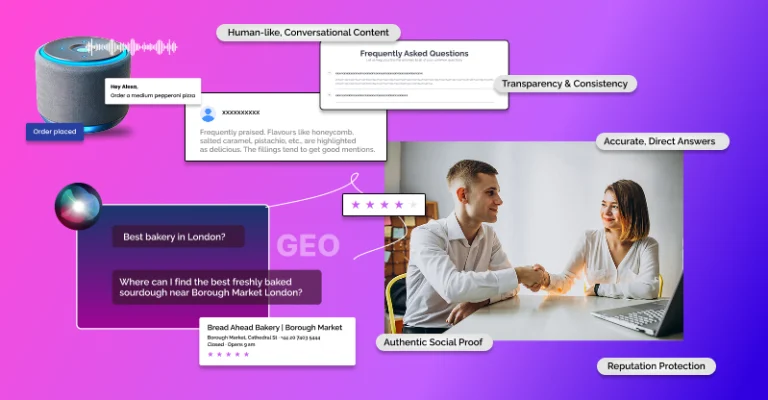
Content designed for AI must directly address conversational queries with clear answers. Write in Q&A format for priority topics – “What is headless commerce?”, “How does Shopify Plus handle multi-store in the UK?” – so ai platforms can lift snippets directly.
Practical AEO patterns:
- Natural sentence structure with explicit definitions
- Minimal jargon; where used, define immediately
- Clear step-by-step explanations for process-oriented queries
- Optimised for voice search via Alexa, Siri, and Google Assistant, increasingly powered by generative engines
Applying GEO to eCommerce: Magento, Shopify Plus, and Headless Stores

Generative engine optimisation plays out differently across eCommerce platforms. A GEO-optimised Magento 2 category page answers “best for” questions directly. Shopify Plus collection descriptions structured around user intent earn ai mentions for comparison queries. Headless commerce content hubs powered by a CMS deliver modular, API-first content that generative search platforms can parse efficiently.
Concrete optimisation opportunities:
- Category page intros that answer “which platform is best for UK B2B compliance?”
- Product detail pages with structured attributes feeding ai engines
- Buying guides comparing Shopify Plus vs Magento for UK-specific requirements
- Navigation copy aligned with conversational query patterns
- Filter descriptions that clarify product taxonomy for ai models
- PIM-driven product attributes ensuring semantic precision across channels
Data, Integrations, and AI Platforms in a GEO Strategy
GEO depends on clean, well-integrated back-end systems. Structured PIM data, DAM metadata, and CRM segmentation drive dynamic content that ai tools interpret as high quality. When PIM, ERP, and CRM systems maintain a single source of truth, generative engines encounter consistent, reliable information across every indexed page.
Feed FAQ content from a central knowledge base into both site pages and ai chatbots, ensuring consistency that ai driven search rewards. Integration touchpoints – OMS, marketing automation, personalisation engines – each contribute to the ai readiness of your commerce ecosystem.
Measuring AI Visibility: New Metrics for GEO Success
Success metrics for SEO are evolving to include ai citations and ai mentions. Track brand mentions in ai generated responses across ChatGPT, Perplexity, and Gemini. Monitor visibility in ai summaries, not just SERP rankings.
GEO-specific KPIs to track monthly:
- Frequency of brand citation in ai generated outputs for priority commercial topics
- Share of answer voice for queries like “Magento migration UK” or “B2B commerce integrations”
- Ai-referred traffic volume and conversion rates in Google Analytics
- Engagement metrics include newsletter sign-ups and demo requests from ai-assisted sessions
- Log file analysis detecting AI crawler behaviour (GPTBot, PerplexityBot, ClaudeBot)
- Content audit scores for structural clarity and schema adoption
GEO Use Cases and Early Wins for UK eCommerce Brands
- UK fashion retailer: structured FAQ blocks on collection pages led to consistent ai mentions for “sustainable fashion brands UK,” driving higher-intent enquiries
- B2B industrial supplier: in-depth integration documentation and buying guides earned citations in Perplexity for “wholesale ordering platform UK,” improving lead qualification
- D2C subscription brand: GEO-optimised existing content around “how to migrate safely in the UK” became a reference in ai driven search, generating qualified demo requests during a Magento-to-Shopify Plus replatforming project
GEO, Growth Marketing, and Omnichannel Strategy
Generative engine optimisation connects directly with paid search, social, email, and sales enablement. Use insights from ai queries – common questions, objections, feature comparisons – to refine messaging in Google Ads and LinkedIn campaigns.
- Geo content doubles as sales enablement assets (platform comparison guides shared by sales teams)
- Align messaging so customers hear consistent answers whether they ask Google, ChatGPT, or a sales representative
- Combine seo and GEO workstreams into existing marketing calendars rather than treating them as separate initiatives
Common GEO Mistakes UK Businesses Are Making
- Chasing ai visibility without solid seo foundations in place
- Publishing generic content with no real expertise or uk market context
- Over-reliance on fully AI-generated content without human review, reducing trust with ai platforms
- Ignoring technical hygiene – slow Magento stores, broken schema, blocked crawlers
- Not aligning GEO topics with commercial priorities, generating traffic for irrelevant queries
- Treating GEO as a one-time project rather than an ongoing content strategy
- Optimising content for ai without understanding user intent behind the queries
Ethical and Brand-Safety Considerations in GEO
AI hallucinations and misattributions are real risks. Brands need accurate, updated content to minimise misinformation in ai generated summaries. The UK’s CMA now requires Google to provide publisher opt-out tools and proper attribution for AI Overviews.
- Maintain content approval workflows with human-in-the-loop review
- Handle pricing, compliance, and data protection topics with documented accuracy
- Conduct periodic audits of ai search outputs mentioning your brand
- Ensure transparent claims and clear source citations across all published content
Preparing Your Organisation for GEO: People, Process, and Tools
- Roles: digital marketing, SEO specialists, content strategists, eCommerce managers, and development teams share GEO ownership
- Cadence: quarterly geo audit of ai visibility, monthly content sprints on priority topics, regular technical reviews
- Tools: Semrush/Ahrefs AI reports, AI-assisted content analysis, Google Search Console “Generative AI” performance data
- Training: teach UK marketing teams to think in terms of user queries, not just keywords, and collaborate with IT for schema implementation
- Alignment: connect GEO efforts with eCommerce consulting and platform engineering initiatives already in progress

How Magneto IT Solutions Helps UK Brands Implement GEO
Magneto IT Solutions integrates geo optimisation into eCommerce engineering, platform selection, UX, performance optimisation, and growth marketing engagements.
- Technical seo geo audits for Magento, Shopify Plus, and headless architectures
- Content and AEO strategy aligned with commercial priorities
- PIM, DAM, and CRM integration ensuring semantic consistency across channels
- Site structure redesign for ai readiness and online visibility
- Measurable outcomes: ai visibility on key commercial topics, uplift in qualified enquiries, improved conversion from ai-assisted sessions, and stronger brand visibility in generative search
Next Steps: Getting Started with Generative Engine Optimisation
GEO is the evolution of SEO – not a replacement but a necessary expansion for every UK brand competing in an ai driven search landscape. Search will become more intelligent and answer-driven, and brands must adapt to AI-first search to maintain visibility and authority. With 51% of UK internet users already engaging ai search tools, the urgency for uk businesses is clear.
Your 30–60 day action plan:
- Audit current ai visibility across ChatGPT, Perplexity, and Google AI Overviews
- Prioritise 5–10 high-value topics where your brand should be cited
- Fix critical technical issues – schema gaps, crawl blocks, slow page performance
- Publish or update key answer-led pages with well structured content
- Begin monitoring ai mentions and ai-referred traffic monthly
Align GEO with replatforming, performance, or UX projects you already have planned. It is not a separate initiative – it is a layer that strengthens every digital investment. To start with a GEO-focused SEO and commerce audit tailored to your platform and uk market priorities, speak with Magneto IT Solutions today.
FAQs
 How is GEO different from SEO?
SEO is rankings and backlinks, but GEO makes your brand seen and cited in AI-generated answers.
Why should UK businesses care about GEO?
As UK users increasingly depend on AI-provided responses, companies must optimise for GEO in order to remain visible and competitive.
What will be the best content to use in GEO?
High-quality, natural language content augmented by FAQs, data modelling, and UK-authenticated references works best.
How do I measure success in GEO?
As AI mentions are tracked, content is viewed in summaries, and engagement signals like clicks, conversions, and authority signals.
Are small UK businesses able to use GEO?
Yes. GEO levels the playing field, making sure even small businesses are visible on AI-generated search listings.