SEO vs. GEO vs. AEO: The Ultimate 2026 Guide to Ranking on Everything
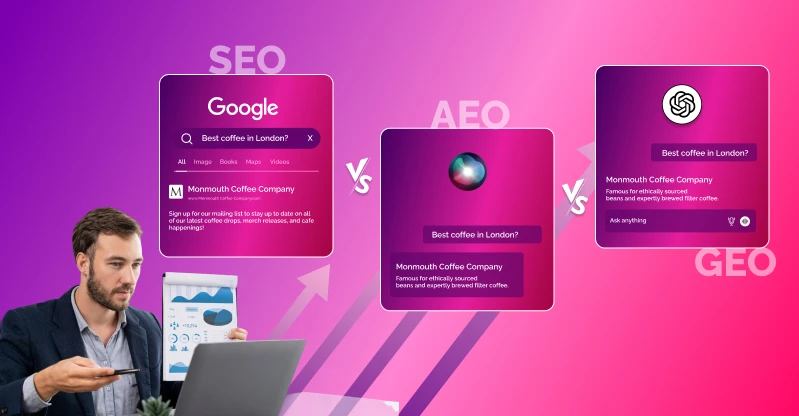
Table of Contents
Search is evolving faster than ever. While traditional search engine optimization (SEO) remains essential, the rise of artificial intelligence (AI) is fundamentally changing how people discover information online. Instead of clicking through a list of blue links, users increasingly receive direct answers from AI-powered search experiences such as Google AI Overviews, ChatGPT, Perplexity AI, Microsoft Copilot, and Gemini.
This shift has introduced two new optimization strategies alongside traditional SEO: Generative Engine Optimization (GEO) and Answer Engine Optimization (AEO).
SEO helps your website rank in conventional search engine results pages (SERPs). GEO focuses on increasing your visibility in AI-generated summaries and recommendations, while AEO ensures your content is structured to become the direct answer that AI assistants provide to users. For businesses investing in AEO Services, this means creating content that is concise, authoritative, and easy for answer engines to extract and present. Similarly, brands looking for answer engine optimization services need a strategy that goes beyond keywords and focuses on clarity, structure, and trust.
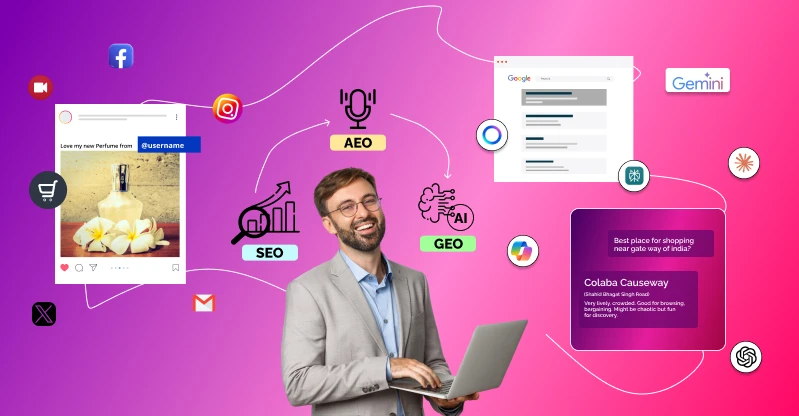
Rather than replacing SEO, GEO and AEO build upon its foundation. Businesses that combine all three approaches are better positioned to reach customers across every stage of their search journey whether they search on Google, ask ChatGPT for recommendations, compare products in Perplexity AI, or use voice assistants for quick answers. This is especially important for companies offering AI SEO Services, where the goal is to improve visibility across both traditional search and AI-driven discovery channels.
In this guide, you’ll learn:
- What SEO, GEO, and AEO are and how do they differ.?
- Why all three strategies are essential for modern digital marketing.
- How AI search engines evaluate and cite content.
- Best practices for optimizing content for both traditional and AI-powered search.
- How to future-proof your website for the next generation of search experiences.
Whether your goal is to generate more organic traffic, increase brand visibility in AI search, or become a trusted source cited by answer engines, understanding the relationship between SEO, GEO, and AEO is the key to long-term digital success.

SEO vs GEO vs AEO: What is SEO?
Search Engine Optimization (SEO) is the practice of improving a website’s visibility in organic search results. It involves optimizing your website so search engines like Google and Bing can better understand, index, and rank your content for relevant user queries.
Although AI-powered search experiences are transforming how information is presented, traditional search engines continue to process billions of searches every day. Users still rely on Google to research products, compare services, find local businesses, and make purchasing decisions. Strong SEO remains the foundation of every successful digital marketing strategy, including modern AI SEO Services that combine classic ranking tactics with AI-era visibility goals.
Modern SEO extends far beyond keyword optimization. Search engines evaluate hundreds of ranking signals to determine whether your content deserves to appear for a particular search query.
The Growing Importance of E-E-A-T
Google increasingly evaluates content using the principles of Experience, Expertise, Authoritativeness, and Trustworthiness (E-E-A-T) to improve visibility in traditional blue links as well as newer search experiences.
Websites that clearly demonstrate first-hand experience, industry expertise, credible authorship, trustworthy information, and strong authority signals are more likely to perform well in both traditional search and AI-powered search experiences. It involves optimizing your website so search engine crawlers can discover, crawl, and index your web pages.
Ways to strengthen E-E-A-T include:
- Publishing original research and insights.
- Citing reputable sources.
- Showcasing author credentials.
- Including case studies and customer success stories.
- Keeping content accurate and up to date.
- Maintaining transparent business information.
These trust signals not only influence traditional rankings but also increase the likelihood of your content being referenced by AI-powered search engines.
Why SEO Still Matters?
Despite the rapid adoption of AI search, SEO remains the foundation of online visibility.
Traditional search continues to dominate transactional, navigational, and local searches, including queries such as:
- Best Shopify development company
- Magento development services
- eCommerce SEO agency
- Digital marketing company near me
- Enterprise website development services
These high-intent searches often lead directly to conversions, making SEO indispensable for businesses seeking qualified traffic.
Additionally, AI systems frequently rely on content that already performs well in traditional search. Websites with strong technical SEO, authoritative content, and established trust signals are more likely to be selected as sources for AI-generated summaries and responses.
Instead of viewing SEO as outdated, businesses should recognize it as the foundation upon which successful GEO and AEO strategies are built.
What is Generative Engine Optimization (GEO)?
Generative Engine Optimization (GEO) is optimization for generative search engines powered by AI, like Google SGE, Perplexity, and You.com. It reflects how generative AI tools are changing search behavior and how large language models assemble answers from multiple sources.
Conventional search engines return a list of ranked links, but generative engines combine multiple sources into one answer. Your mission in GEO is to have your content included in that AI-generated summary, as search engines increasingly reward content relevance, not just keyword usage. In practice, generative AI favors sources it can interpret clearly, trust, and cite with confidence.
Key GEO Elements
- Semantic Content: GEO optimizes for generative AI experiences powered by large language models. These tools synthesize multiple sources instead of only returning ranked links, so AI engines seek context and meaning rather than keywords. For instance, a site that describes “how AI software improves Shopify stores in New York” must use clear content structure to connect ideas like analytics, automation, customer experience, and revenue growth.
- Structured Data: Schema markup and metadata inform AI about your site. Including product schema, FAQs, and reviews increase your chances of being referenced.
- Long-Tail Optimization: Users pose natural questions to generative machines such as, “What is the best CRM for small businesses in the USA?” GEO targets intent-based queries written in a conversational tone and aligned with how engines interpret searches through natural language processing.
- Sources of Trust: Generative machines will indeed consider credibility. Content referred with references, case studies, and expert remarks will be picked up.
How Does GEO Differ from Traditional SEO?
Traditional SEO focuses on improving rankings in search results by optimizing keywords, backlinks, and technical performance.
GEO expands this approach by helping AI models understand:
- What your content is about through semantic content, as generative systems use natural language processing to interpret meaning and relationships.
- Whether your information is trustworthy.
- How your expertise relates to a topic.
- Whether your content directly answers user intent through long-tail optimization, where a conversational tone helps GEO align with how people phrase prompts and questions.
- Whether your page deserves to be cited alongside other authoritative sources, supported by structured data and clear content structure that improves how AI engines interpret and cite information.
Core Elements of GEO
Semantic Content
Modern AI systems understand topics, relationships, and context, not just keywords.
For example, a page discussing Shopify development should naturally include related concepts such as eCommerce, customer experience, conversion optimization, headless commerce, payment gateways, APIs, and scalability.
This semantic depth helps AI understand the full context of your content.
Entity Optimization
Search engines increasingly organize information around entities, people, organizations, products, technologies, and locations.
Clearly defining your business, services, products, authors, and industry expertise helps AI establish stronger relationships between your brand and relevant topics.
Structured Data
Schema markup provides machine-readable information about your content.
Helpful schema types include:
- Article
- Organization
- Person
- FAQ
- Breadcrumb
- Product
- Review
Structured data helps search engines and AI systems interpret your content more accurately.
Original Insights
AI systems favor content that contributes unique value rather than repeating information available elsewhere.
Adding original statistics, expert opinions, proprietary frameworks, case studies, industry observations, or practical examples increases the likelihood of your content being cited. That also applies when creating content designed to give search engines and AI models clear, useful context they can interpret and surface.
Schema markup provides machine-readable information, and a logical site structure helps search engines and AI systems understand page hierarchy and relationships.
Authority and Trust
AI-generated responses are more likely to cite and reuse content built on original insights, and they prioritize information from credible and trustworthy sources.
Businesses can strengthen authority by:
- Publishing expert-written content that positions the brand as a reliable source.
- Improving the likelihood of having content featured in AI-generated answers and summaries.
- Updating content regularly.
- Demonstrating real-world experience.
- Building a strong backlink profile.
Why Does GEO Matters?
As AI-generated search experiences become more prominent, visibility is no longer limited to traditional rankings.
GEO helps businesses:
- Increase visibility in AI-generated summaries.
- Build authority across multiple AI platforms.
- Reach users earlier in their research journey.
- Improve brand recognition even without a direct website click.
- Future-proof their content strategy for AI-first search.
Companies that invest in GEO Service today position themselves to benefit as AI-powered search continues to reshape how people discover information online.
What is AEO (Answer Engine Optimization)?
Answer Engine Optimization (AEO) is the process of structuring content so search engines, AI assistants, and voice-enabled platforms can quickly identify and deliver direct answers to user questions.
While SEO focuses on ranking pages and GEO focuses on being cited in AI-generated summaries, AEO is about becoming the answer itself. This is especially important for brands offering answer engine optimization(AEO) services, because the goal is to create content that answer engines can easily extract, summarize, and present in response to conversational queries.
AEO is increasingly important because users now ask search engines and AI tools complete questions instead of typing short keywords. For example, instead of searching for “best CRM software,” a user may ask, “What is the best CRM software for small businesses with a limited budget?” Answer engines are designed to respond to these natural-language queries with concise, relevant, and trustworthy information.
How AEO Differs from SEO and GEO?
SEO aims to improve rankings in search results.
GEO aims to increase visibility in AI-generated summaries.
AEO aims to provide the exact answer that AI systems, voice assistants, and featured snippets can surface immediately.
This makes AEO especially valuable for:
- Voice search
- Featured snippets
- People also ask results
- AI assistants like ChatGPT and Copilot
- Smart speakers and mobile assistants
- FAQ-driven content
Core Elements of AEO
Question-Based Content
AEO works best when content is organized around the questions users actually ask.
Examples include:
- What is SEO?
- How does GEO work?
- What is the difference between SEO and AEO?
- Which strategy is best for eCommerce brands?
Clear question-based headings make it easier for answer engines to identify relevant sections.
Concise, Direct Answers
Answer engines prefer content that gets to the point quickly.
The best AEO content usually includes:
- A short definition or summary at the beginning.
- A clear explanation in plain language.
- Supporting details below the answer.
- Lists, tables, and examples where appropriate.
Structured Formatting
Formatting plays a major role in AEO.
Helpful content structures include:
- FAQs
- Bullet points
- Numbered steps
- Comparison tables
- Definition blocks
- How-to sections
These formats make it easier for AI systems to extract and present information accurately.
Schema Markup
Structured data helps answer engines understand the purpose of your content.
Useful schema types for AEO include:
- FAQ Page
- HowTo
- Article
- Organization
- Product
- LocalBusiness
Trust and Authority
Answer engines are more likely to surface content from credible sources.
To improve trust, businesses should:
- Publish expert-authored content.
- Include citations and references.
- Keep content updated.
- Use clear brand and author information.
- Demonstrate real-world experience.
Why AEO Matters?
AEO is essential because users increasingly expect immediate answers rather than long lists of links.
It helps businesses:
- Appear in featured snippets.
- Improve visibility in voice search.
- Increase chances of being cited by AI assistants.
- Capture zero-click search opportunities.
- Deliver faster answers to high-intent users.
For companies investing in AI SEO Services, AEO is a critical part of the strategy because it bridges the gap between traditional search visibility and AI-driven answer delivery.
SEO vs GEO vs AEO: Key Differences
Although SEO, GEO, and AEO are closely related, each serves a different purpose in the modern search ecosystem.
| Comparison Point | SEO | AEO |
GEO |
| Full form | Search Engine Optimization | Answer Engine Optimization | Generative Engine Optimization |
| Simple meaning | Helps a webpage rank higher in search results | Helps content appear as a direct answer | Helps content get mentioned in AI-generated answers |
| Main goal | Bring more visitors from search engines | Give users a quick and accurate answer | Increase brand visibility in AI platforms |
| Where it works | Google, Bing and other search engines | Featured snippets, voice search and answer boxes | ChatGPT, Google AI Overviews, Gemini, Copilot and Perplexity |
| Content focus | Keywords, search intent and useful information | Clear questions and direct answers | Trusted, well-structured and easy-to-cite information |
| Best content format | Blog posts, landing pages and product pages | FAQs, definitions and how-to steps | Research, expert insights, statistics and original information |
| Role of keywords | Very important for matching search queries | Helpful, especially in question-based headings | Useful, but meaning, context and topic coverage matter more |
| Writing style | Helpful, detailed and keyword-focused | Simple, direct and concise | Clear, factual, complete and supported by evidence |
| How success is measured | Rankings, organic traffic, clicks and conversions | Featured snippets, answer visibility and voice-search mentions | AI citations, brand mentions, referral traffic and visibility in AI responses |
| Simple example | Ranking a blog for “best CRM software” | Answering “What is CRM software?” in a short paragraph | Getting your CRM brand recommended in an AI-generated comparison |
| Best for | Attracting users who want to explore websites | Reaching users who want an immediate answer | Reaching users who use AI tools to research and make decisions |
How Do They Work Together?
SEO, GEO, and AEO should not be treated as separate silos. Instead, they should work together as part of one unified content strategy.
- SEO helps your content rank.
- GEO helps your content get cited.
- AEO helps your content get answered.
A strong page can do all three at once if it is technically sound, semantically rich, well-structured, and written with user intent in mind.
For example, a company offering eCommerce SEO Services can create a product category guide that ranks in Google, gets cited in AI-generated shopping recommendations, and appears in answer boxes for questions like “What is the best way to optimize an online store for search?”
Why Do Businesses Need SEO, GEO, and AEO Together?
The future of search is not about choosing one strategy over another. It is about building visibility across multiple discovery channels.
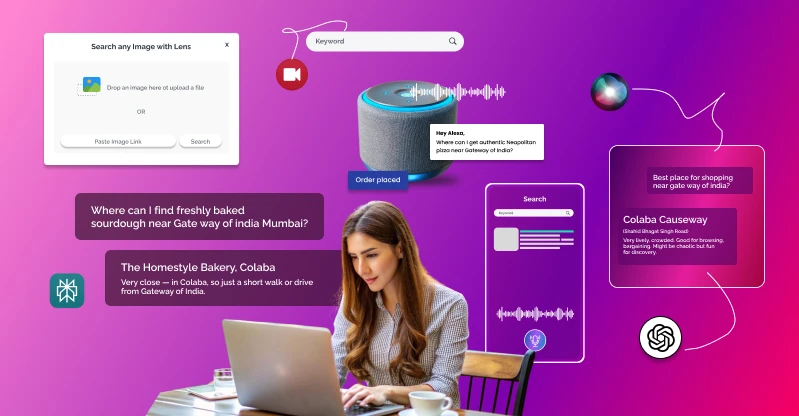
Users may:
- Search Google for a service provider.
- Ask ChatGPT for a recommendation.
- Use Perplexity to compare options.
- Ask a voice assistant for a quick answer.
- Read an AI-generated summary before clicking a result.
If your content is optimized only for traditional SEO, you may miss visibility in AI-generated experiences. If you focus only on AEO, you may lose broader organic traffic. If you ignore GEO, your brand may not appear in the summaries and citations that increasingly influence user decisions.
That is why modern businesses need a balanced strategy that combines SEO, GEO, and AEO. If you need AEO Services, also known as answer engine optimization services, we can help improve how your brand appears in answer engines.
If you need AI SEO Services, we can optimize your content for both search engines and AI-driven discovery. If you need eCommerce SEO Services, we can help your store attract more qualified traffic and conversions. The goal is the same: make your content discoverable, understandable, and trustworthy across every search environment.
Companies that adapt early will have a major advantage as AI continues to reshape how people search, compare, and buy online.

Future-Proof Your Search Strategy with SEO, AEO, and GEO
Search is evolving beyond traditional rankings, making SEO, AEO, and GEO essential for long-term digital visibility. By combining these strategies, your business can rank in search results, answer customer questions, and appear in AI-generated recommendations.
As AI-powered search platforms like Google AI Overviews, ChatGPT, Perplexity AI, Microsoft Copilot, and Gemini continue to evolve, combining SEO, GEO, and AEO strategies is essential for improving both traditional search rankings and AI visibility.
Magneto IT Solutions can help you build a future-ready search strategy that reaches customers across both search engines and AI platforms. Contact us today to turn the future of search into your next growth opportunity.
FAQs
 What is the difference between SEO, GEO, and AEO?
SEO helps your website rank higher in traditional search results. GEO focuses on making your content visible and cited in AI-generated answers. AEO ensures your content provides direct answers that AI assistants use.
Do I still need SEO if I use GEO and AEO?
Yes, SEO is the foundation. It helps your website get found and trusted, supporting both GEO and AEO strategies
How long does it take to see results from SEO, GEO, or AEO?
Results can vary. Some changes show effects in a few weeks, but building strong visibility usually takes several months of consistent effor
Are keywords important for AI search optimization?
Keywords are still useful, but AI also values clear, relevant, and well-structured content that directly answers questions.
Can I optimize existing content for SEO, GEO, and AEO?
Absolutely. Updating your content with clear answers, good structure, and trustworthy information can improve its performance across all three areas.gs, expanding topic coverage, including credible sources, and making the page easier to understand.
What are AI citations, and why are they important?
AI citations are references or links used by AI platforms to show where information came from. They can increase brand visibility, build trust, and send interested users to your website.
Are keywords still important for AEO and GEO?
Yes, but keywords are no longer enough on their own. Search intent, context, topic depth, natural language, and content quality are also important for AI-focused optimization.
Can existing content be optimized for SEO, AEO, and GEO?
Yes. Existing content can be improved by updating facts, adding clear answers, strengthening headings, expanding topic coverage, including credible sources, and making the page easier to understand.
How long does SEO, AEO, or GEO take to show results?
Results depend on the website’s authority, competition, content quality, and technical health. Some improvements may appear within weeks, while stronger and more consistent visibility often requires several months of ongoing work.