Why PIM, ERP, and CRM Are Essential for eCommerce Replatforming Success
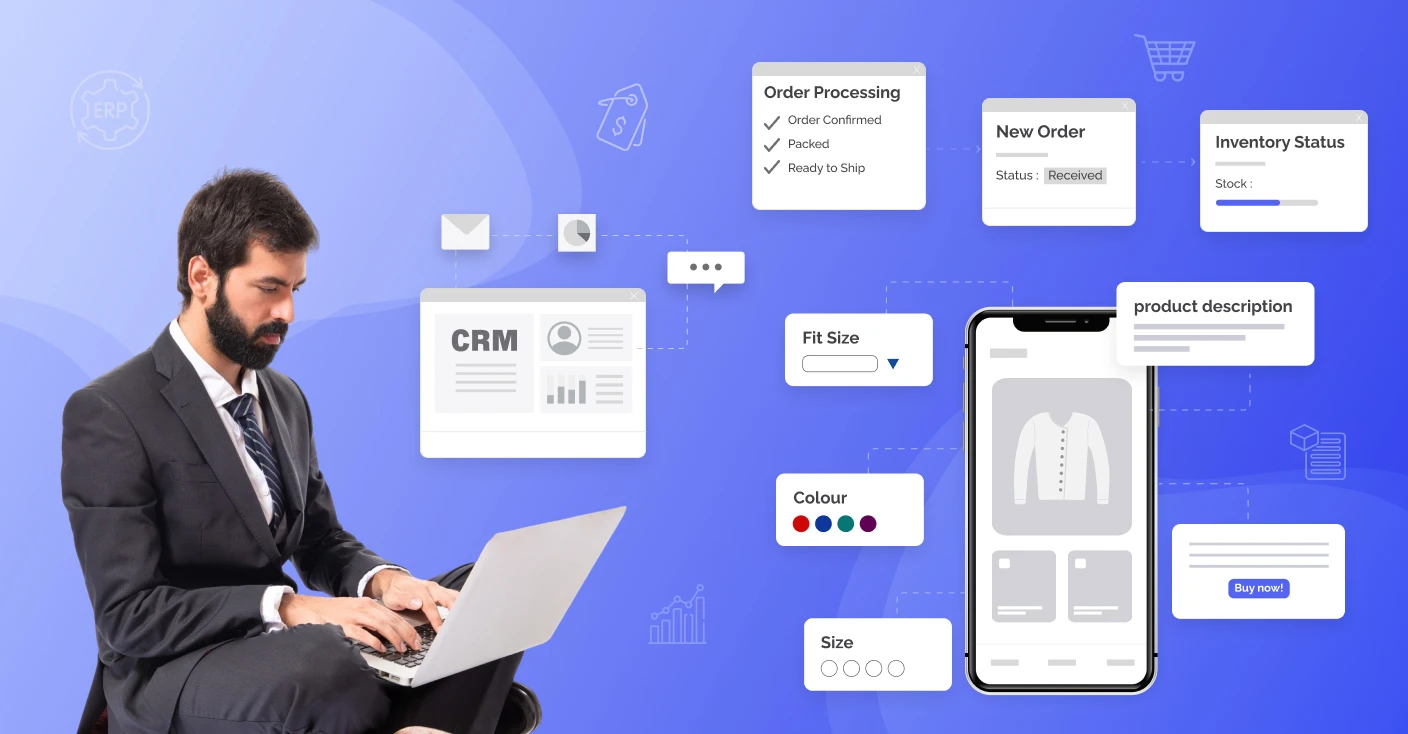
Table of Contents
In most cases, eCommerce replatforming is not merely an exercise of moving from one eCommerce platform to another.
Rather, it is an opportunity for B2C, D2C, B2B brands, and other growing eCommerce businesses to embark on an opportunity for the development of scalable eCommerce systems that can support the increasing needs of the organization.
As the organization grows globally, the need for the commerce infrastructure of the organization also increases. In this context, eCommerce systems such as Product Information Management (PIM), Enterprise Resource Planning (ERP), and Customer Relationship Management (CRM) play an integral role.
In most cases, the organization realizes that the eCommerce platform that was developed was not sufficient enough to support the increasing needs of the organization.
For instance, over time, an organization understands that the eCommerce platforms that it has developed over the years have not been able to keep pace with the increasing product offerings, changing needs of customers, and the intricacies involved in the integration of these platforms with the other enterprise guide.
However, the process of replatforming the eCommerce platform does not address the underlying business issues that necessitated the need for the replatforming process in the first place.
Instead, the answer to the underlying business issues that necessitated the need for the replatforming process in the first place can be addressed by the integration of the key enterprise applications such as PIM, ERP, and CRM with the replatformed eCommerce platform.
At Magneto IT Solutions, we have worked with numerous global brands who have undergone complex digital commerce transformation.
We have learned that the key for the successful implementation of the replatforming process lies with the integration of the commerce platforms with the key enterprise systems.
Understanding eCommerce Replatforming
In the context of eCommerce businesses, the necessity for replatforming arises when the current platform is unable to cater to the increasing business needs of the organization. This may also include the expansion of the eCommerce business to new markets, the launch of new products/services, the implementation of omnichannel sales strategies, etc.
Replatforming enables companies to shift their business to new-age commerce platforms that offer much-needed flexibility, scalability, and API-based integrations. It is not simply the migration of data from one platform to another; it is the integration of product, business, and customer data across the entire commerce ecosystem.
This can not only create inefficiencies in the replatforming process but also after the new platform is launched. We specialize in replatforming services that enable the creation of an ecosystem where product information, operational systems, and customer data can function seamlessly.

Product Information Management as the Backbone of Product Data
One of the most challenging aspects of eCommerce replatforming involves managing vast amounts of product information. In eCommerce businesses, thousands of products have numerous product attributes, images, and price structures.
If businesses do not have a proper mechanism to manage all this information, it may lead to inconsistencies in product information across different channels. This may not only cause business issues but may also have a detrimental effect on customer experience.
The Product Information Management (PIM) systems act as the core of product information management in the contemporary digital commerce ecosystem.
PIM systems allow businesses to manage product information such as product attributes, digital assets, as well as product descriptions, thus providing a single source of truth in different sales channels, marketplaces, and storefronts.
We can help businesses effectively manage all product information through effective product information management services during eCommerce replatforming projects.
ERP Systems Enable Operational Alignment
ERP systems play a critical role in aligning digital commerce operations with internal business processes. With the integration of ERP systems into eCommerce platforms, it is possible to conduct business operations in a synchronized manner, as it can synchronize the entire business operation in real time.
In the scenario of re-platforming the eCommerce website, the inclusion of ERP systems can facilitate the flow of operation data between the eCommerce platform and the business process.
It ensures that the business does not experience difficulties in areas like inventory management, order fulfillment, and operational performance.
Real-time communication and interaction between the eCommerce platform and the inventory and order management systems is made possible by an integrated ERP system, which improves operational efficiency.
CRM Systems Power Customer Engagement
Customer expectations are no longer the same as in the past in today’s modern eCommerce world, and today’s customers are accustomed to a personalized experience, offers, and consistency in the digital world.
Customer Relationship Management (CRM) systems allow companies to combine customer data, purchasing patterns, and engagement in a single place.
When combined with today’s advanced commerce systems, CRM systems allow companies to provide personalized shopping experiences, marketing, and data-driven customer engagement strategies.
Today, brands are utilizing custom CRM development services to enable a system that can meet the business needs.
With the help of expert CRM consulting services, we can enable a company to implement a CRM system that can be effectively integrated with eCommerce systems.
The Importance of System Integration in Replatforming
One of the most common challenges that businesses face during their eCommerce transformation journey is the existence of isolated systems.
The implication is that for businesses where integration between PIM, ERP, and CRM systems is absent, data silos may occur, which could prove harmful to the smooth running of the business.
The foundation of a scalable digital commerce ecosystem is integration. When PIM, ERP, CRM, and commerce systems are integrated as a system of systems rather than a collection of isolated systems, businesses can overcome data silos and gain operational visibility.
Integration is at the heart of any replatforming project we undertake for businesses. This is where we ensure that the enterprise systems of the businesses are connected with the new-age eCommerce platforms, which can provide scalable and robust ecosystems for businesses.
Key Considerations When Integrating Systems During Replatforming
System integration during eCommerce replatforming requires careful planning. Another important aspect that needs to be considered by the business is the integration infrastructure, i.e., whether API, middleware, or integration platforms are required for smooth integration.
Another important aspect that needs to be considered by the business is the scalability of the system, as the infrastructure of the eCommerce business may increase in the future, and the infrastructure of the system should be able to handle such situations without any problems.
Another important aspect that needs to be considered by the business is the data governance, i.e., how the business can effectively manage the data related to products, business, and customers.
By following the above strategies, the business can overcome the problems that are faced in the process of system integration.
How We Support eCommerce Replatforming
At Magneto IT Solutions, we take a strategic approach to replatforming and view it as a part of a larger commerce transformation rather than a simple replatforming project.
Our teams work with enterprise leaders to assess existing technology stacks, build scalable commerce architectures, and integrate key enterprise systems such as PIM, ERP, and CRM into modern digital commerce platforms.
By integrating PIM systems, ERP systems, CRM systems, and eCommerce systems, it would be possible to help businesses build a digital commerce ecosystem that can be used to support business growth.
Conclusion
eCommerce replatforming is a great opportunity for businesses to improve their technology infrastructure and build scalable commerce ecosystems that are geared towards growth.
The integration of PIM, ERP, and CRM systems with modern eCommerce systems can help businesses function better, provide exact insights about products, and give a personalized experience to their customers.
Our eCommerce experts can help businesses partner to create a unified commerce ecosystem that meets their high standards of excellence.
FAQs
 What is eCommerce replatforming?
eCommerce replatforming is a process of moving your online store from one platform to another for boosting performance. This is not a simple movement of platforms, it’s about fixing the gaps in your existing operations by choosing a reliable system.
Why is PIM important in eCommerce replatforming?
PIM is ideal for centralized product information uniform across the channels to ensure better consistency.
How does ERP integration benefit eCommerce businesses?
ERP integration can benefit eCommerce businesses by providing a link between their eCommerce sites and their operating systems, such as inventory, order processing, finance, and supply chain, to provide real-time visibility.
What is the role of CRM in eCommerce transformation?
The role of CRM is significant, to manage their relationship with users and provide a personalized experience.
Why should businesses integrate PIM, ERP, and CRM while undergoing the replatforming process?
The businesses should integrate PIM, ERP, and CRM during the replatforming process so that these systems can be sync with each other to provide an efficient experience for the customers.


