Winning AI Search Answers with AEO-Driven Ecommerce Content
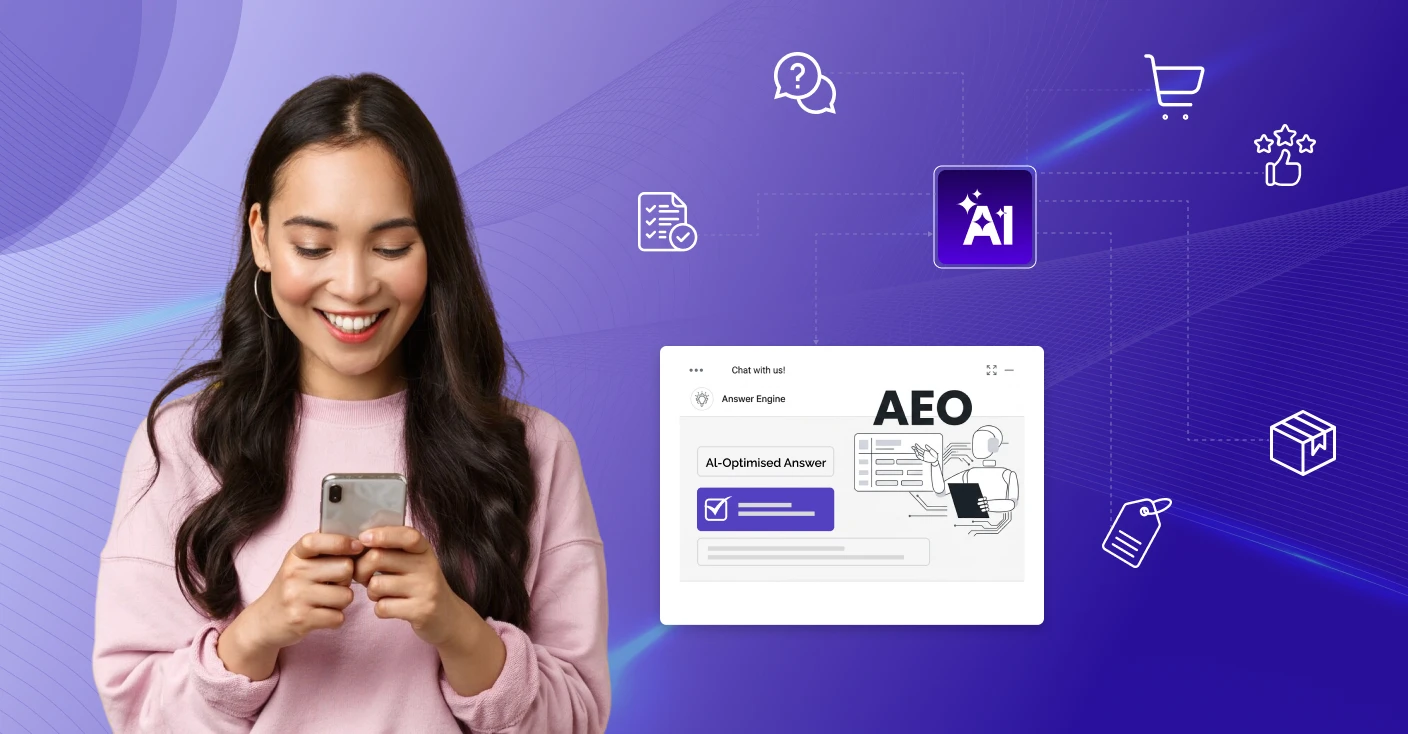
Table of Contents
With the evaluation of AI, buyers’ search behavior has changed dramatically. Specifically for the eCommerce search behavior this shifting is changed from keyword-driven discovery to more conversational.
Buyers now ask for complete questions and expect to receive direct answers without having to navigate through multiple sites. AI-powered search engines are increasingly more focused on intent, clarity, and trust when offering responses to consumers’ searches.
This has transformed the way ecommerce branches reach their customers. Answer Engine Optimization can help brands adapt by structuring all the content, which can be understood by AI.
In an increasingly AI-driven search market, brands that optimize for answers rather than rankings have an edge in the customer journey, increasing credibility and conversion potential.
In this article we will explore how AEO in eCommerce changing content format to win over the AI search answers for better visibility and outcome.
What Is Answer Engine Optimization?
Answer Engine Optimization is a process that help create digital content in a way that can be extracted and presented by AI-powered platforms as direct answers to user queries.
Unlike traditional SEO, which only rely on ranking and clicks, AEO work for clarity, intent, and explanations. For online stores, Answer Engine Optimization services helps AI-powered platforms extract accurate explanations about products, differences, and purchases.
This way, online stores can be featured inside AI-generated answers, which can drive user decisions before visiting a website. It differs from traditional SEO as it emphasizes meaning and usability instead of keyword usage.
How AI Search Engines Understand Content
Intent-Based Query Processing
The goal of using AI in search engines is not so much to match keywords as it is to understand the purpose behind the query. A search engine examines the intent of a user’s query to determine whether it is about insights, comparisons, or transactions, taking into account limitations like price, usage, and urgency.
Ecommerce content that explicitly addresses these signals performs better. Describing who the product is intended for, what the product does, and when the product should be selected can help the AI engines better map the content. This intent clarity can help the AI system confidently extract information from the content for users who need to know.
Context and Semantic Relevance
Semantic relevance enables AI systems to understand meaning beyond literal words. In this regard, AI does not focus on the number of keywords, but rather the relationship between ideas in the topic.
eCommerce businesses achieve semantic clarity in their content by providing an explanation of the product in terms of its practical context, such as the product’s relation to the users’ lifestyles, challenges, or industry standards.
The use of similar terms helps in the strengthening of the relationship between the topics, while the logical progression of the content enhances its semantic meaning. The contextual alignment of the content, if high, is likely to be referenced in the AI-generated content.
Importance of Content Structure
Content structure directly influences how AI engines extract and interpret information. Clear headings define topic boundaries, while focused paragraphs reduce confusion. Each section should communicate one idea to prevent misinterpretation. Logical sequencing helps AI systems follow explanations accurately. For ecommerce, strong structure ensures product specifications, policies, and comparisons are properly understood. Well-organized pages improve extraction accuracy and reduce summarization errors.
Get a clean and proper structure for boosting the AI confidence when selecting content for user-facing answers. It will eventually help to boost the visibility and trustworthiness in conversational search experiences.
Why SEO Alone Is No Longer Enough
Traditional SEO focuses on rankings and traffic, but AI search increasingly delivers zero-click experiences. Users often receive complete answers without visiting websites. In this environment, being included within AI responses is more valuable than ranking alone.
It also exhibits greater intent, which makes early visibility essential. By combining SEO fundamentals with AEO tactics allows brands to reach a wider audience and impact consumer choices at an earlier stage of the process, which enhances long-term discoverability.
Content Formats That Perform Best for AEO
Educational Blog Content
Blog content related to education is essential for AI systems to recognize authority and content depth for a particular topic. This content provides detailed descriptions of topics, trends, and purchasing considerations for a particular product. When creating blog content for ecommerce websites, educational content answers customer research questions that are often asked before making a purchase. Describing a product’s functionality, its importance, and when to use a product are all essential for improving content extractability. This is because well-structured educational content provides AI systems with detailed content to summarize correctly, making blog content one of the best forms of content for achieving visibility.
FAQ Pages
FAQ pages align perfectly with AI answer formats. Each question-answer pair is a reflection of a typical conversational search, making extraction a very easy process.
Ecommerce-based FAQs can be referenced by AI-system for various topics including shipping, returns, sizes, compatibility, and usage. With well-written FAQs can be helpful for the end-users to eliminate ambiguity and increase accuracy.
Updated FAQs are often a reflection of relevance, which is essential for AI systems to increase visibility, making them a key component of any successful Answer Engine Optimization strategy.
Optimized Product Pages
Product pages can be considered critical AEO assets for online store brands. Giving detailed descriptions includes key features, benefits, specifications, and usage of the product will help the AI system understand the value of the product. By avoiding ambiguous promotional content will help improve the overall interpretability of the AI.
Giving the context of the target audience of the product along with how it can solve their problems will help boost the relevance of the answer. Optimizing the product pages will help ensure that the AI answer that accurately represents the product will help build trust.
Comparison and Buyer Guides
Comparison pages and buyer guides support decision-oriented queries commonly handled by AI search. These formats explain differences between products and outline selection criteria clearly.
Having honest, balanced comparisons can build credibility with users and AI systems alike. Buyer will guide AI to understand evaluation factors such as performance, pricing, and suitability.
Structuring Ecommerce Content for AI Answers
Writing for Questions
Writing for questions means framing content around how users naturally ask things. Headings should reflect real customer queries rather than keyword phrases. This alignment improves matching with conversational AI searches. Ecommerce brands benefit by anticipating common questions about products, policies, and usage. Clear question-based headings guide AI engines toward relevant sections quickly. When content mirrors user language, AI systems extract answers more accurately. Writing for questions increases relevance and improves answer performance across AI-driven platforms.
Paragraph-Level Clarity
Paragraph-level clarity ensures each paragraph communicates one idea. Mixing multiple concepts increases extraction errors. AI engines perform best when information is concise and focused. Clear topic sentences help identify intent, while supporting sentences add context. For ecommerce content, this clarity improves interpretation of features, benefits, and policies. Focused paragraphs reduce misrepresentation risks and improve summarization accuracy.
Clear paragraph structure strengthens AI confidence and improves answer quality across conversational search results.
Consistency Across Pages
Ensuring content consistency can help create trust with AI systems. As due to the inconsistencies between product pages, blogs, and FAQs can create trust issues. AI systems can verify information by cross-checking sources to maintain uniform content form.
Online sites need to ensure that specifications, prices, and logic, as well as policies, remain consistent. Consistent terms and phrases help create stronger trust signals. Consistency of content helps boost the confidence of AI systems when picking the best answer. Uniformity across pages helps maintain authority over the long term, increasing the chances of repeated inclusion in the responses.
Role of Schema and Structured Data
Why Schema Matters
Schema markup helps AI engines understand content context and relationships. It provides structured signals about page purpose, entities, and data types. For ecommerce, schema clarifies product details, FAQs, and reviews. While schema does not replace strong content, it enhances clarity. Proper implementation improves extractability and reduces ambiguity. Schema acts as a supporting layer that strengthens AI interpretation, making it easier for systems to confidently surface content within answers.
Key Schema Types for Ecommerce
Product schema, FAQ schema, and review schema are most valuable for ecommerce AEO. Product schema defines attributes like price, availability, and specifications. FAQ schema highlights question-answer pairs. Review schema communicates user sentiment and ratings. These schema types help AI engines identify relevant information quickly. Accurate schema improves content comprehension and increases answer eligibility. When aligned with high-quality content, schema enhances AI visibility and trust.
Schema as a Supporting Signal
Schema enhances clarity but cannot fix poor content. AI engines prioritize meaning and intent before structured data. Schema works best when paired with clear, accurate writing. It reinforces context and improves extraction efficiency. Ecommerce brands should view schema as an amplifier rather than a replacement. Properly implemented schema supports long-term AEO performance by strengthening AI confidence in content interpretation.
Trust Signals That Influence AI Answers
Accuracy and Transparency
AI always prioritize accurate, transparent content, by creating clear and in-depth product descriptions, honest pricing, and visible policies brands can build trust.
Misleading or vague data can reduce credibility. Brands must ensure factual consistency. Transparency to boost AI confidence when selecting answers. With the help of reliable insights the customer trust can be improved and accuracy remains a foundational requirement for long-term AEO success.
User Reviews and Feedback
User-generated reviews provide authenticity and credibility. AI engines analyze reviews to assess real-world product performance. Structured, genuine feedback strengthens trust signals. Reviews also provide contextual insights that AI systems can summarize. Ecommerce brands benefit by presenting reviews clearly. Authentic user feedback increases AI confidence and improves answer reliability.
Long-Term Authority Building
Consistently answering user questions builds topical authority. AI engines recognize brands that provide reliable information over time. Publishing accurate, helpful content strengthens long-term trust. Authority increases repeated inclusion in AI answers. Long-term consistency matters more than short-term optimization. Authority-building is essential for sustained AEO visibility.

Measuring AEO Performance
Visibility Beyond Rankings
AEO success extends beyond SERP rankings. Visibility includes AI mentions and answer inclusion. Ecommerce brands must track AI citations and references. Traditional metrics alone are insufficient. Measuring AI visibility helps evaluate AEO impact. Monitoring brand presence in AI answers provides actionable insights.
AI Referral Traffic
AI referral traffic reveals engagement quality. Users arriving from AI platforms often show higher intent. Tracking AI referrals helps identify content effectiveness. Ecommerce brands should analyze behavior patterns. AI traffic insights guide optimization strategies. Understanding AI-driven visits improves conversion planning.
Conversion Quality
AI-driven users typically convert at higher rates. These users arrive with clear intent. Measuring conversion quality reveals AEO value. Ecommerce brands should track purchase behavior and engagement. High-quality conversions validate AEO investment. Conversion analysis supports long-term strategy refinement.
The Future of Ecommerce Search
Intent-First Discovery
Ecommerce search is shifting toward intent-first discovery. AI engines focus on understanding needs rather than matching keywords. Brands that answer intent clearly gain visibility. Intent-driven discovery favors helpful, structured content. Ecommerce brands must adapt to remain competitive. Answer-focused strategies define future search success.
AEO as an Ongoing Strategy
AEO is not a one-time effort. AI models evolve continuously. Ecommerce brands must update content regularly. Ongoing optimization ensures relevance. AEO requires monitoring, refinement, and consistency. Long-term commitment delivers sustainable results.
SEO and AEO Together
SEO and AEO work together. SEO builds technical foundations. AEO enhances AI visibility. Combined strategies ensure comprehensive discoverability. Ecommerce brands benefit from both approaches. Integrated optimization maximizes reach and influence.
Conclusion
With the role of search becoming ever more significant in the way people discover products through the aid of AI, brands need to think beyond SEO to reap the benefits of AEO.
For example, when responding to questions, search engine AI prioritizes clarity, intent, and trust. This implies that internet businesses might benefit from AEO early on if they organize their data to meet these standards.
Educational blogs, optimized product information, answers to frequently asked questions, and buying guides are all significant features of effective AEO strategies. Clarity, semantic relevance, and messaging all play a significant role in aiding the AI in providing accurate answers to queries.
FAQs
 What is AEO in ecommerce?
AEO optimizes ecommerce content so AI search engines present it directly as answers to customer questions.
How does AEO differ from SEO?
SEO targets rankings, while AEO targets inclusion within AI-generated conversational responses.
Why is AEO important for ecommerce brands?
AI search influences purchase decisions before users visit websites, making answer visibility critical.
Which content formats support AEO best?
Educational blogs, FAQs, product pages, comparison content, and buyer guides perform best.
Does AEO replace traditional SEO?
No, AEO complements SEO by focusing on AI-driven answer visibility.
Is schema required for AEO success?
Schema helps AI understanding but cannot replace clear, structured content.
How do you measure AEO performance?
By tracking AI mentions, referrals, engagement quality, and conversions.
Is AEO a long-term strategy?
Yes, AEO requires continuous optimization as AI search technology evolves.


