Adobe Commerce Cloud as a Service (ACCS) for Scalable and Future-Ready Commerce
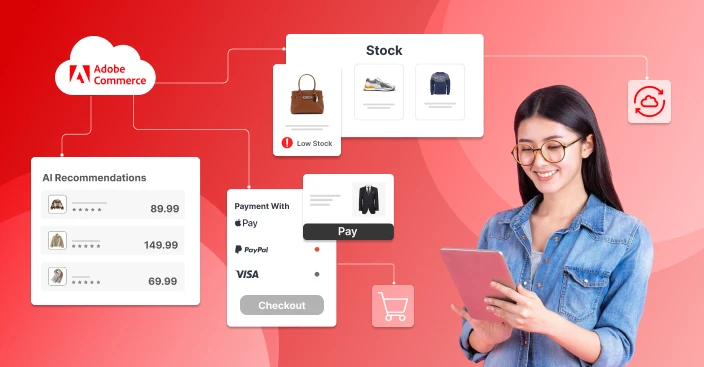
Table of Contents
Enterprise commerce has reached a point where managing the platform can be as demanding as growing the business itself. Infrastructure overhead, upgrade cycles, and performance bottlenecks often slow down innovation and limit scalability.
At the same time, organizations are under increasing pressure to deliver faster, more personalized experiences across channels.
Adobe Commerce as a Cloud Service (ACCS) emerges as a response to this challenge, offering a model that reduces operational complexity while enabling continuous innovation.
In this blog, we’ll break down how ACCS works and why it is becoming a key enabler for scaling modern, enterprise-grade commerce.
What is Adobe Commerce as a Cloud Service?
Adobe Commerce as a Cloud Service is Adobe’s fully managed, SaaS-based commerce platform designed to remove operational complexity, while empowering businesses with Adobe Commerce Development Services for long-term scalability and innovation. Instead of worrying about infrastructure, patching, or scaling during peak demand, businesses can rely on Adobe to handle it all.
What makes this model powerful is that it doesn’t take away flexibility. The Adobe Commerce platform supports both traditional and headless architectures, combining the robustness of Adobe Commerce with a composable, API-first architecture and giving enterprises the ability to innovate faster without being tied down by backend constraints. It is also built for both B2B and B2C commerce.
In simpler terms, it allows businesses to focus on what truly drives revenue, experience, speed, and continuous improvement.

Why This Shift Matters More Than Ever
The commerce landscape has changed dramatically. Customers expect a seamless user experience that is fast and personalized across every touchpoint. At the same time, businesses are scaling aggressively, handling larger catalogs, entering new markets, and managing unpredictable traffic spikes.
And here’s the reality: even small inefficiencies can impact revenue.
According to Adobe, the average eCommerce conversion rate globally is around 2.5%–3.6%, meaning the majority of traffic doesn’t convert. That’s why performance, speed, and experience are no longer technical concerns, they are business-critical levers.
ACCS is designed to address exactly this gap and help brands build a competitive edge. Adobe Commerce supports over 500,000 online stores globally.
From Managing Infrastructure to Driving Growth
One of the most noticeable changes with ACCS is how it transforms internal teams.
Instead of spending time on upgrades, server management, or performance fixes, teams can focus on improving customer journeys and launching new initiatives faster to drive business growth.
This shift is especially valuable for enterprise businesses where delays in deployment or performance issues directly affect revenue and customer retention.
With ACCS, scaling is no longer something you prepare for, it’s something that happens automatically.
Performance Optimization That Directly Impacts Conversions
Speed has become one of the most important factors in digital commerce success. A faster storefront doesn’t just improve user experience, it directly impacts conversion rates, SEO rankings, and revenue. Advanced caching techniques can also improve loading times significantly and support optimal performance.
Adobe highlights that with modern cloud-native architecture and edge delivery, businesses can significantly improve performance and conversions. In fact, Adobe Commerce capabilities have shown the potential to increase conversion rates by up to 8% through improved storefront experiences and optimization tools. Regular performance monitoring helps identify ongoing optimization opportunities and sustain those gains over time.
That kind of improvement, even at scale, can translate into substantial revenue growth for enterprise businesses.
Built for Composable, Future-Ready Commerce
What makes ACCS particularly relevant today is its composable foundation.
Modern enterprises are no longer relying on a single platform to do everything. They are building ecosystems, and often use adobe commerce integration to connect Adobe Commerce with ERP and CRM systems as part of a composable stack, alongside specialized third party tools for search, payments, personalization, analytics, custom payment methods, and Adobe Experience Manager Services to deliver seamless digital experiences. This also makes room for third party integrations with payment gateways and inventory management systems, helping teams keep operations connected and consistent.
ACCS supports this approach seamlessly. Its API-first and headless capabilities allow businesses to experiment, integrate, and evolve without disrupting the core system.
This flexibility helps brands build future proof solutions as technology and customer expectations evolve.
Continuous Innovation Without Disruption
One of the biggest frustrations with traditional commerce platforms is the upgrade cycle. It often slows down innovation and introduces risk.
ACCS eliminates this challenge with a version less model. Updates happen continuously in the background, applying the latest patches to help protect against vulnerabilities and following industry best practices to keep the platform up to date with the latest features and fixes without disruption.
This allows organizations to move faster, test more, and innovate without waiting for large release cycles.
Is ACCS the Right Fit for Your Business?
Adobe Commerce as a Cloud Service is particularly suited for scaling enterprises and complex projects with demanding operational needs.
If your business is expanding into new markets, managing a large product catalog, or struggling with platform maintenance, ACCS offers a stronger path to efficient ecommerce experiences, while its migration services help preserve security and access to newer features during transitions. Adobe Commerce also supports seamless moves from WooCommerce or an existing store with data integrity and near-zero disruption.
It’s not just about reducing effort, it’s about unlocking the ability to grow without friction. Implementation timelines vary, but adobe commerce development services, as part of broader adobe commerce development solutions, often take 12 to 16 weeks on average for a structured rollout.

How We Help You Unlock Its Full Potential
At Magneto IT Solutions, we see ACCS not just as a platform upgrade but as a strategic opportunity for transformation.
With deep expertise in Adobe Commerce and enterprise ecosystems, plus the technical expertise needed for complex Adobe Commerce projects, we help businesses move beyond implementation and truly leverage its open-source flexibility, native B2B functionality, and enterprise-grade capabilities for growth. Our certified Adobe Commerce developers and other certified developers support delivery of tailored solutions for enterprise brands.
From designing composable architectures to executing seamless migrations and building high-performance storefronts, our focus is always on aligning technology with business outcomes, with custom development adding value when standard functionality does not meet unique business requirements. We also handle custom module development and module development for complex integrations or unique requirements.
Adobe Commerce also supports custom theme and extension development, with custom themes enhancing user experience and brand identity.
We have completed over 500 launches across Adobe Commerce projects.
Because ultimately, the goal is not just to adopt a new platform, but to build a commerce experience that drives measurable impact.
Conclusion
Adobe Commerce as a Cloud Service represents a clear shift toward simpler, faster, and more scalable ecommerce solutions.
It removes the operational burden that has traditionally limited innovation and replaces it with a model built for continuous growth and business growth.
For organizations looking to make this transition meaningful, the right strategy and execution are key. Connect with our experts offering Adobe Commerce Development Services In New York to explore how ACCS can be tailored to your business goals.
FAQs
 What makes Adobe Commerce as a Cloud Service different from traditional Adobe Commerce?
It is a fully managed SaaS platform where Adobe handles infrastructure, updates, and scalability, unlike traditional models that require active management.
How does ACCS improve performance?
It uses cloud-native architecture and edge delivery to improve speed, directly impacting conversions and the customer experience.
Is ACCS suitable for enterprise businesses?
Yes, it is designed to handle complex operations, large catalogs, and global scaling requirements.
Does it support composable commerce?
Yes, ACCS is built on a headless, API-first architecture, making it ideal for composable strategies.
Can businesses migrate from existing Adobe Commerce setups?
Yes, migration can be done in phases or as a full transition, depending on unique business needs.