How AI Agents Help Automotive Businesses Streamline B2B Commerce
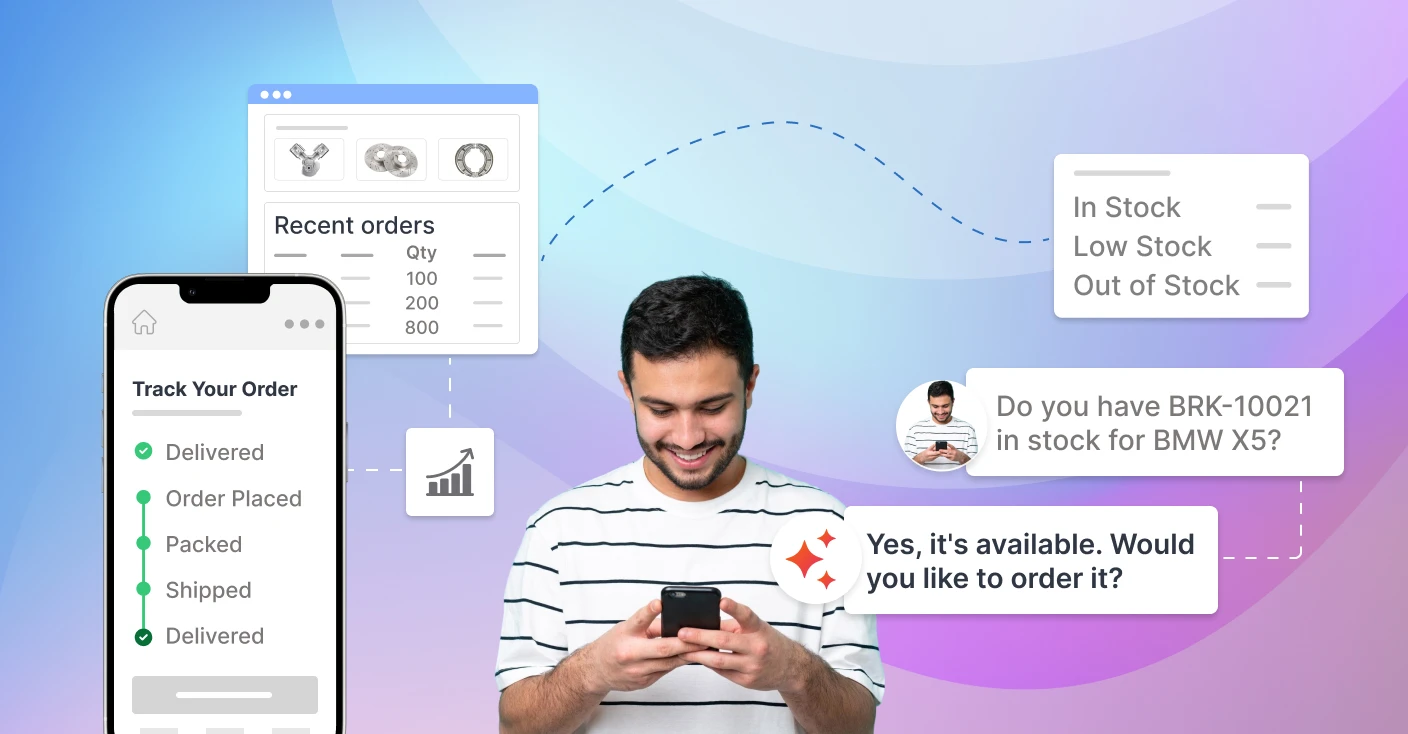
Table of Contents
The automotive industry is undergoing a major digital transformation. Manufacturers, distributors, wholesalers, and aftermarket parts suppliers are increasingly investing in e-commerce to meet evolving buyer expectations and streamline operations.
However, managing thousands of SKUs, complex pricing structures, supplier networks, inventory fluctuations, and customer service requests remains a challenge for many businesses.
This is where AI agents are changing the game.
Unlike traditional automation tools that follow predefined rules, AI agents can analyze data, make decisions, execute tasks, and continuously optimize outcomes with minimal human intervention.
For B2B automotive businesses, this means faster operations, smarter decision-making, and more personalized customer experiences.
As automotive companies accelerate their digital commerce initiatives, AI agents are becoming a critical driver of growth and operational efficiency.
What Are AI Agents?
AI agents are intelligent software systems designed to perform tasks autonomously. They can gather information, interpret customer behavior, make recommendations, automate workflows, and interact with multiple business systems simultaneously.
In automotive ecommerce, AI agents function as digital assistants that help businesses optimize inventory, pricing, customer support, procurement, and sales processes.
Rather than relying solely on manual intervention, AI agents continuously monitor data and execute actions aligned with business objectives.
Why Automotive Businesses Need AI-Powered Commerce
Automotive businesses face unique ecommerce challenges:
- Massive product catalogs
- VIN-based compatibility requirements
- Dynamic inventory levels
- Multiple supplier relationships
- Customer-specific pricing agreements
- Lengthy purchasing cycles
- Increasing customer expectations
Traditional ecommerce systems often struggle to manage these complexities efficiently. AI agents help businesses automate decision-making while delivering superior customer experiences at scale.
According to a 2025 McKinsey Global Survey on AI, 88% of organizations report using AI in at least one business function, up from 78% the previous year, underscoring the rapid acceleration of AI adoption across industries.

Traditional eCommerce vs AI-Agent Powered Automotive Commerce
Understanding the differences between traditional ecommerce and AI-agent powered commerce helps businesses identify opportunities to improve efficiency, customer experiences, and long-term growth.
| Capability | Traditional Ecommerce | AI-Agent Powered Commerce |
| Product Search | Keyword-based | Context-aware and predictive |
| Inventory Management | Manual monitoring | Automated forecasting and replenishment |
| Customer Support | Human-dependent | 24/7 AI-assisted support |
| Pricing Updates | Periodic manual changes | Real-time optimization |
| Product Recommendations | Rule-based suggestions | AI-driven personalization |
| Decision Making | Reactive | Predictive and proactive |
Key Applications of AI Agents in B2B Automotive Commerce
AI agents are helping automotive businesses improve efficiency, personalize buyer experiences, and drive better commerce outcomes. Below are some of the key use cases.
1. Intelligent Product Discovery
Finding the right automotive part can be challenging due to complex catalogs, technical specifications, and compatibility requirements. According to Gartner, B2B buyers spend only 17% of their purchasing journey interacting with suppliers, making digital product discovery more important than ever.
AI agents analyze:
- Vehicle specifications
- Search behavior
- Purchase history
- Product compatibility data
- Industry trends
This allows customers to quickly identify the most relevant products without manually searching through extensive catalogs.
Benefits include:
- Improved search accuracy
- Faster product discovery
- Reduced customer frustration
- Higher conversion rates
Businesses investing in the development of an online automotive store can leverage AI-powered search capabilities to improve customer satisfaction and drive revenue growth.
2. Automated Inventory Optimization
Inventory management remains one of the most critical operational challenges in automotive commerce.
AI agents continuously monitor:
- Inventory levels
- Sales velocity
- Seasonal demand fluctuations
- Supplier performance
- Market demand trends
Using predictive analytics, AI agents can recommend reorder quantities, identify slow-moving inventory, and prevent stockouts before they affect customer satisfaction.
The result is improved inventory turnover and reduced carrying costs.
3. Personalized B2B Customer Experiences
Modern B2B buyers expect experiences similar to those offered by leading B2C brands.
AI personalization agents can personalize:
- Product recommendations
- Promotions
- Catalog visibility
- Contract pricing
- Customer-specific offers
The impact can be significant. For automotive businesses serving repair shops, dealerships, distributors, and fleet operators, personalization can drive stronger customer loyalty and increased lifetime value.
4. AI-Powered Customer Support
Customer service teams often spend hours handling repetitive inquiries regarding:
- Product compatibility
- Order tracking
- Warranty details
- Returns and exchanges
- Shipping updates
AI agents provide instant support 24/7, helping customers find answers faster while reducing pressure on support teams.
This improves response times and enables service representatives to focus on more complex customer interactions.
Many automotive website development companies are now integrating conversational AI into ecommerce platforms to enhance customer engagement.
5. Smart Pricing Optimization
Pricing in automotive commerce is rarely static.
It is influenced by:
- Supplier costs
- Inventory availability
- Market demand
- Customer agreements
- Competitive pricing
AI pricing agents continuously evaluate these factors and recommend pricing strategies that maximize profitability while maintaining competitiveness.
This allows businesses to react to market changes in real time rather than relying on periodic manual updates.
6. Predictive Sales Forecasting
Accurate forecasting is essential for inventory planning and business growth.
AI demand forecasting analyze:
- Historical sales patterns
- Customer buying behavior
- Seasonal demand
- Economic indicators
- Market trends
These insights help automotive businesses make better decisions around purchasing, inventory allocation, and operational planning.
7. Automated Procurement Workflows
Procurement processes are often resource-intensive and prone to delays.
AI agents can automate:
- Reorder triggers
- Purchase order generation
- Supplier evaluation
- Vendor recommendations
- Procurement tracking
This reduces manual workloads while ensuring products remain available when customers need them.
Business Impact of AI Agents in Automotive Commerce
AI agents create measurable impact across every function of automotive commerce. The table below highlights how they improve key business areas through intelligent automation and data-driven decision-making.
| Business Area | AI Agent Contribution |
| Sales Growth | Personalized recommendations and smarter upselling |
| Inventory Management | Demand forecasting and stock optimization |
| Customer Experience | Faster support and product discovery |
| Procurement | Automated supplier and reorder management |
| Operations | Reduced manual workload |
| Profitability | Dynamic pricing and margin optimization |
Benefits of Implementing AI Agents
From increased revenue to operational efficiency, AI agents help automotive businesses overcome everyday challenges while creating opportunities for sustainable growth.
1. Increased Revenue
Personalized recommendations, intelligent pricing, and improved customer experiences contribute directly to higher conversion rates and increased sales.
2. Improved Operational Efficiency
Automation reduces manual effort across inventory management, procurement, customer support, and order processing.
3. Faster Decision-Making
Real-time insights enable businesses to respond quickly to changing market conditions.
4. Better Customer Experiences
Customers receive relevant recommendations, instant support, and seamless purchasing journeys.
5. Scalable Growth
AI agents help businesses manage increasing transaction volumes without a proportional increase in operational costs.
Building an AI-Ready Automotive Commerce Platform
To maximize the value of AI agents, businesses need a strong digital foundation.
Key requirements include:
- Modern ecommerce architecture
- Centralized product information
- ERP integration
- CRM integration
- Real-time inventory visibility
- API-first connectivity
- Scalable cloud infrastructure
Working with an experienced automotive ecommerce solutions provider helps ensure these systems are properly integrated and optimized for AI-driven operations.

Expert Perspective: Why Data Quality Matters
Many organizations rush to implement AI without first addressing their underlying data challenges.
The success of AI agents depends heavily on:
- Accurate product information
- Clean customer data
- Connected business systems
- Reliable inventory data
Businesses that establish a unified data foundation across ecommerce, ERP, CRM, and supply chain systems are far more likely to achieve measurable ROI from AI investments.
This is why leading automotive ecommerce integration services projects prioritize data readiness before deploying advanced AI capabilities.
The Future of Agentic AI in Automotive Commerce
The next generation of automotive commerce will be increasingly autonomous.
AI agents will evolve from assisting business users to independently managing critical processes such as:
- Inventory replenishment
- Dynamic pricing adjustments
- Customer engagement campaigns
- Procurement workflows
- Demand forecasting
- Order orchestration
Businesses that adopt AI-powered commerce today will be better positioned to improve operational efficiency, enhance customer experiences, and maintain a competitive advantage in an increasingly digital marketplace.
How Magneto IT Solutions Powers AI-Driven Automotive Commerce
The team at Magneto IT Solutions helps businesses build future-ready automotive eCommerce ecosystems with AI-driven capabilities that support long-term growth.
- Develop AI-ready automotive ecommerce platforms tailored to your business.
- Integrate ERP, CRM, PIM, inventory, and other enterprise systems seamlessly.
- Implement AI-powered search, personalization, pricing, and automation.
- Optimize performance, scalability, and customer experiences with ongoing support
Key Takeaways
AI agents are redefining how automotive businesses operate online.
From intelligent product discovery and predictive inventory management to automated customer service and pricing optimization, these technologies help organizations become more efficient, responsive, and customer-centric.
As competition intensifies and buyer expectations continue to rise, investing in AI-powered automotive ecommerce solutions is no longer optional; it is becoming a strategic necessity.
Whether you’re a manufacturer, distributor, wholesaler, or aftermarket parts supplier, now is the time to evaluate how AI agents can strengthen your digital commerce strategy and accelerate growth.
Ready to Accelerate Your Automotive Ecommerce Growth?
Get in touch with our experts and discover how AI can power your next stage of automotive commerce success.


