How AI-Powered Pimcore Is Transforming eCommerce Data Management
Table of Contents
As with the data-driven economy that’s popular today, eCommerce companies are faced with the challenge of coping with the increasing need to manage and deliver high amounts of product data across multiple channels.
As digital commerce expands, product information has to stay clean, complete, and channel-ready at every touchpoint. Consumers expect seamless, coherent, and tailored experiences whether they shop on a website, mobile app, or marketplace, and manual or traditional product data management cannot keep up with that volume and complexity. AI-driven PIM gives businesses a practical advantage: it improves efficiency, supports compliance and governance, reduces data errors, and accelerates time-to-market for new products.
This introduction explores how AI-powered PIM transforms ecommerce data management through smart data cleansing, automated product categorization, dynamic content enrichment, predictive analytics, and stronger data governance. You will see how these capabilities help improve customer experience, speed up product launches, create operational efficiency, and build a stronger competitive position as AI-driven PIM continues to evolve.
A pimcore development company helps businesses implement AI-powered Product Information Management (PIM) solutions that automate, enrich, and scale ecommerce product data across websites, mobile apps, marketplaces, and other sales channels. For ecommerce brands, retailers, manufacturers, distributors, and large digital businesses managing complex product catalogs, that means better data accuracy, faster operations, and more consistent customer experiences.
The New eCommerce Data Management Role for AI
Classic PIM systems were created to merge and make product data available at affordable prices. But with rising SKUs, constant revisions, and multi-channel requirements, consistency of the data across channels became tougher. With more business and information complexity, the Pimcore platform provides a highly flexible open-source data management foundation built on PHP and Symfony.

Artificial Intelligence reverses these limitations by presenting PIM systems with smart data identification, automation, and predicted data. With the adoption of artificial intelligence, pimcore development supports enterprise use cases across digital experience management, master data management, and digital transformation through PIM, DAM, MDM, and DXP capabilities. Such compatibility renders companies smarter, faster, and more efficient in their decision-making, and over 25,500 websites use Pimcore for data management.
Smart Data Cleansing and Validity
Machine learning models detect and correct errors, duplicates, or blank product data, improving data accuracy while managing product data at scale. AI fills missing dimensions or material characteristics using context data or trend history. Pimcore implementations also require capabilities in data migration, including data cleansing and mapping.
AI cleansing makes product data accurate and marketplace and brand compliant, with minimal human interference but maximum precision in data. In practice, data accuracy depends on strong data modeling and automated data validation to support long-term data quality management.
Auto Product Categorization and Tagging
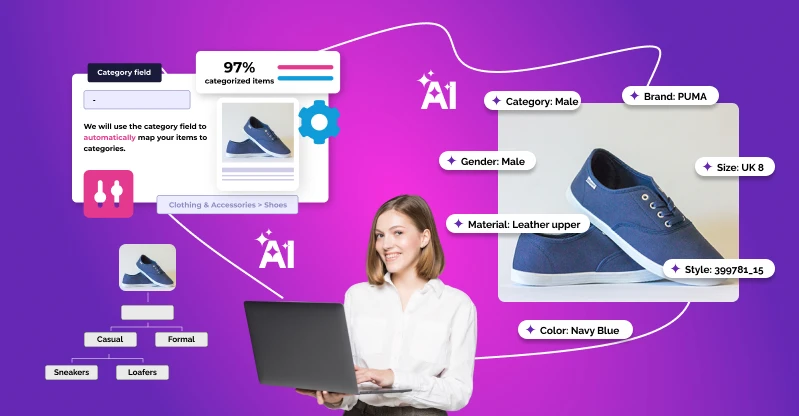
AI in PIM technology employs NLP and machine learning to categorize products automatically. This eliminates man-hours of labor in favor of teams and tags each product up correctly with the correct attributes, ensuring they’re discoverable and enhancing SEO performance.
The outcome is accelerated onboarding and enhanced discoverability through digital channels.
Dynamic Content Enrichment
Artificial intelligence improves product data quality with highly customizable, SEO-enriched product descriptions optimized to the interests of the audience, including automated content generation as part of AI-based enrichment.
Content and tone may be readily translated to several markets or consumer groups, technical for B2B, lifestyle-oriented for B2C, or geo for in-market buyers.
These types of automated enrichment drive higher interest and conversion by optimizing product content for future relevance and engagement, while also supporting marketing efforts and stronger customer engagement.
Predictive Analytics for Product Insights
Artificial intelligence product information management solution turns customer data into valuable insights on product performance. Predictive analysis determines best sellers, predicts customer demand, and supports decisions with customer insights tied to customer preferences.
Sales and customer satisfaction extension occur due to data-driven strategic decision-making.
AI-Driven PIM Facilitating Time-to-Market Acceleration
Quicker is better in eCommerce. Companies that are able to bring new products to the market quicker and update data in real-time have a massive competitive edge, and pimcore development services help accelerate launches at scale to drive business growth. AI in PIM solutions automate and expedite product launch cycles with end-to-end workflows without disruption. The underlying architecture must support scalability for growing product catalogs and high traffic volumes.
Streamlined Onboarding Workflows
AI supports import, mapping, and real-time validation from other sources like suppliers, supplier data, ERP systems, or spreadsheets. AI automatically infers attribute relationships, and workflow automation supports faster onboarding, freeing configuration time and improving operational efficiency as products get to digital shelves more quickly.
Real-Time Channel Syndication
By consolidating AI with PIM, brands can easily manage their product data from web stores, marketplaces, and CMS into a harmonized, unified structure. This is particularly valuable for businesses investing in Magento ecommerce development, as Pimcore can help syndicate product data across platforms such as Magento and Shopify. Ensure better product information updates to be replicated on all channels at once, guaranteeing consistency and preventing delays caused by manual publishing. SSI Group integrated Shopify with Pimcore for online retail.
Improved Cross-Team Collaboration
AI in PIM is that one, unified source of truth that everyone has access to across teams, marketing, ops, sales, and IT. Automated role-based workflows and notifications minimize duplicate effort, approval cycles, and collaborate much better.
This unified, single framework not just simplifies but also drives data consistency across teams.
Building a Better Customer Experience with AI-driven PIM
Consumers these days do not demand plain accurate information, they demand interactive, informative, and personalized experience. AI in PIM alone can provide them such advanced digital experience, and Pimcore supports this as an experience management platform for richer customer-facing experiences in the digital world.
Pimcore also integrates digital asset management as a core feature, using DAM to organize product images and videos for easy access.
Hyper-Personalized Product Experience
With purchase history, location data, and behavior, AI dynamically personalizes content as per user intent, using AI for tailored solutions based on user context. For example, it can change tone, accentuate unique benefits, or show local images, with experiences that customers feel are personalized and context-sensitive for stronger customer engagement.
Intelligent Search and Discovery
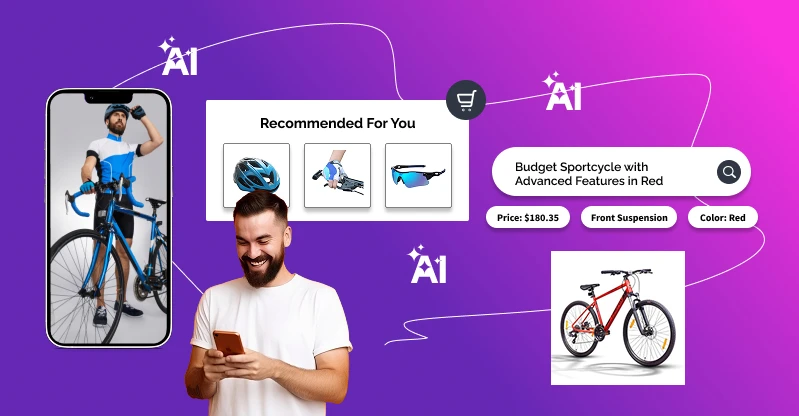
Semantic search with AI-powered search keeps context, intent, and proximal words to allow customers to locate what they seek, even attempting with incorrect or misspelled words. It helps to deliver better search results, boost customer satisfaction, and cut down cart abandonment.
Single Brand Experience Across Channels
AI delivers product information and digital assets to all touch points, from advertisements and web listings to catalogs offline. Pimcore DAM organizes product images and videos for easy access across channels, which helps protect brand reputation. Consistency protects the brand, and AI-based localization pulls out fine differences in terms of cultural and language nuances.
Data Governance and Compliance Redefined
With eCommerce going global, governance for master data and unstructured data becomes more challenging. AI in PIM makes automatic checks for compliance with regulations and for global standards as easy as pie.
AI helps annotate such compliance fields omitted like safety warnings or certification or determine region-based labeling requirements. It keeps the product information up to date to avoid legal trouble for brands and allows consumers’ trust to be maintained. Stronger governance controls also support better data integrity across channels.
The AI-Driven Competitive Advantage of Product Information Management
In the age of aggressive digital competition today, excellent product data management is the difference between making and breaking a company. AI product information management solutions transform product data into a business growth driver, an innovation catalyst, and a business excellence driver that can also drive digital transformation and free teams to focus on broader strategic initiatives.
Automation That Grows with Your Business
AI performs the usual tasks such as categorization, tagging, and verification of data with ease as businesses grow. With a few hundred, thousands, or millions of SKUs, AI provides speed with precision without added human capital.
Unrivaled Data Precision and Consistency
AI automatically verifies and corrects data errors through data quality management, producing accurate and consistent product data across all channels. That is what gives consumer confidence, supports data accuracy and trusted product information, minimizes returns, and maximizes marketplace positions.
More Compelling Customer Experience with Insights
By analyzing customer interaction and taste, AI is tailoring product content by segment, for more engagement, higher conversion rates, and making every touch count.
Smaller Time-to-Market and More Agility
Product lifecycles are shortened by AI-powered autonomous onboarding and update cycles, which also drastically shorten launch horizons. These days, businesses are setting the pace instead of racing to stay ahead of emerging trends.
Intelligent Decision Making through Predictive Analytics
AI in PIM provides prescriptive recommendations for selling activity, and AI solutions can suggest improvements in pricing, inventory, and campaign decisions so businesses can optimize the return on price, stock, and advertising spend. Smart prescriptive predictiveness ensures informed decisions are evidence-driven and aligned with business needs.
Frictionless Multichannel and Cross-Border Business
AI wipes out localization, translation, and compliance verification, enabling brands to expand globally without interruption. It provides each territory and channel with precisely individualized, compliant information.
Enhanced Brand Identity and Trust
AI delivers the same voice, tone, and level of content at every customer touch point, for building trust and long-term dependence on integrity.
Reduced Operating Cost and Improved ROI
Manual processing is minimized with automation, delivering cost effective solutions alongside time and cost savings. With lower time to market as well as improved conversion rates, the ROI of AI in PIM excels through software development efficiency.
Future-Proof Flexibility and Scalability
AI in PIM software is adaptive. With the emergence of new channels, technology, or formats, AI can be retrained to support new models for data to keep businesses technologically agile and ahead of the curve.
Innovation-Driven Differentiation
Firms can use AI to drive value differentiation by way of intelligent automation, content creation, predictive personalization, and integrating AI into content and process intelligence to innovate and leapfrog competitors, helping drive business growth in saturated markets.
AI-driven product information management consulting not only organizes data, it helps firms make quicker decisions, make better strategies, and provide improved customer experiences. It closes the tech-experience gap, gets brands contemporary and forward-looking.
Emerging Trends: The Future of AI- Driven PIM Systems
The convergence of PIM and AI continues to advance, with a still brighter future on the horizon.
A few of the future trends include:
- AI-driven automated content generation for product content, images, and even videos in an optimized state.
- Voice and Image Recognition, where AI visually recognizes products and auto-populates data fields.
- Augmented Reality (AR) Data Mapping to connect 3D models with asset data in real-world locations.
- IoT Integration, where products supply updates of PIM information based on usage or performance.
- These trends are empowering businesses to strengthen their digital presence.
Such integrations will keep improving the accuracy, customization, and scalability of the data for making AI-driven PIM the backbone of digital commerce ecosystems.

Conclusion
AI-driven Product Information Management is now reality and not science fiction anymore but the new normal for digital commerce. Choosing a pimcore development company is critical for project success, long-term scalability, and getting the right solution for your business.
It makes it possible for organizations to shift from human effort-based processing of data to intelligent, automatic, and customer-centric processes. Companies should also verify a partner’s experience with the specific core modules they need.
By adopting AI in PIM, businesses can seek to be more accurate, quicker to market, and more engaging and coherent product experiences.
In an expanding eCommerce economy, an investment in professional product information management services is a step towards digital excellence, business efficiency, and future competitiveness. Official partner status reflects an agency’s project history and product knowledge, with tiers such as Silver, Gold, Platinum, and Global Solution Partner. The official Pimcore partner directory can be filtered by region, industry, and technologies.
The future belongs to those businesses that can turn their product data into smart data, and AI-driven PIM is the solution to achieve this. Technical expertise in PHP and Symfony is crucial when evaluating a pimcore developer for complex implementations. Effective post-launch support should include SLAs, performance monitoring, and feature enhancements. Consult with our PIM experts for a free consultation to know more about the implementation.
FAQs
 Which AI capability do we deploy in PIM solutions?
Machine learning, NLP, and predictive analytics capabilities are deployed to support automated enrichment, classification, and validation of data.
In what way do AI in PIM solutions shorten time-to-market?
Product onboarding, enrichment, and data distribution are processed automatically by AI in PIM, supporting quicker and flawless product launches.
Can ERP, marketplaces, and CMS be integrated with PIM?
ERP, marketplaces, and CMS systems can be integrated with PIM in a way to support real-time synchronizations in channels.
What kind of organizations will derive maximum value from AI in PIM?
Retailers, manufacturers, distributors, and large eCommerce players with multiple, complex product catalogs will derive maximum value.
What is the return on investment that the deployment of AI-based PIM can yield?
Greater efficiency, less manpower cost, quick implementations, and better conversions.