How ChatGPT Shopping Works for Shopify Merchants?
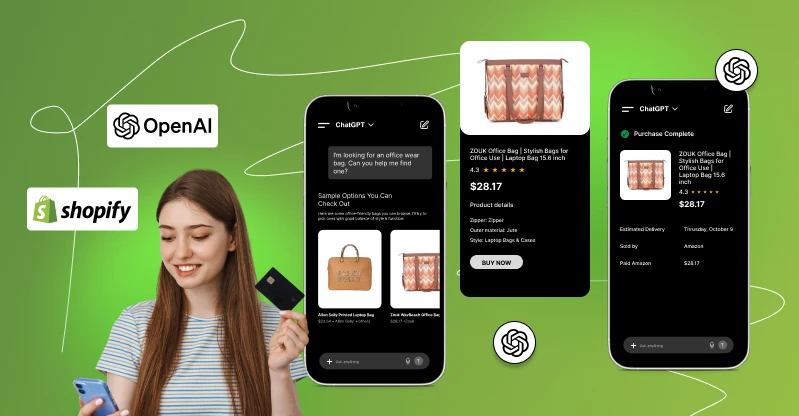
Table of Contents
Shopping is moving beyond search boxes, category pages and marketplace filters. A customer can now describe what they need in a conversation, compare suitable products and continue toward a purchase without beginning the journey on a conventional storefront.
For Shopify merchants, this change creates a new discovery channel rather than a replacement for their existing store. The opportunity is to make product information understandable, current and commercially useful wherever AI-assisted shopping happens. This guide explains how Shopify’s connection with ChatGPT works, what has changed since the original announcement and how merchants can prepare.
Key Takeaways
- Shopify merchants can make products discoverable across supported AI shopping channels through Shopify’s centrally managed infrastructure.
- Product accuracy, availability, variants and imagery influence whether AI systems can understand and present an item appropriately.
- Merchants remain responsible for product quality, fulfilment, policies and the customer experience.
- AI visibility is connected to product-data readiness, but it is not a guaranteed replacement for SEO, advertising or storefront optimisation.
- Success should be measured through qualified discovery, attributed sessions, assisted conversions, completed orders and customer value.

What Is the Shopify OpenAI Integration?
The Shopify OpenAI integration connects Shopify’s commerce infrastructure with shopping experiences in ChatGPT. It enables eligible products to appear when a user asks for recommendations, comparisons or help finding something that matches specific requirements.
Shopify supplies structured information such as product names, descriptions, images, prices, variants and availability. ChatGPT can use that information during product discovery, while Shopify continues supporting the merchant’s catalogue, checkout, order management and fulfillment workflows.
This model is an example of agentic commerce, where an AI system does more than answer a question. It interprets a shopper’s need, evaluates available products and helps move the customer toward a transaction while keeping the merchant connected to the commercial journey.
What Has Changed Since the Original Announcement?
The first Shopify and OpenAI announcement in September 2025 focused on allowing merchants to sell through ChatGPT conversations. At that stage, much of the discussion centred on a limited rollout, direct conversational purchasing and the future expansion of the experience.
By March 2026, Shopify described a broader model built around Agentic Storefronts. According to Shopify’s current announcement, millions of merchants can reach shoppers across ChatGPT, Microsoft Copilot, Google AI Mode and Gemini through systems managed from Shopify Admin.
Shopify also states that products can be made available in supported AI channels without merchants maintaining separate integrations or channel-specific apps. Inventory and pricing remain synchronised, while orders can carry referral attribution into Shopify Admin. On supported ChatGPT experiences, mobile shoppers may continue through an in-app browser, while desktop journeys can open the merchant’s store.
The practical change is important: merchants should no longer view the opportunity as a one-time partnership announcement. It is becoming an operating model for distributing products across AI-led discovery environments.
How Does ChatGPT Shopping Work with Shopify?
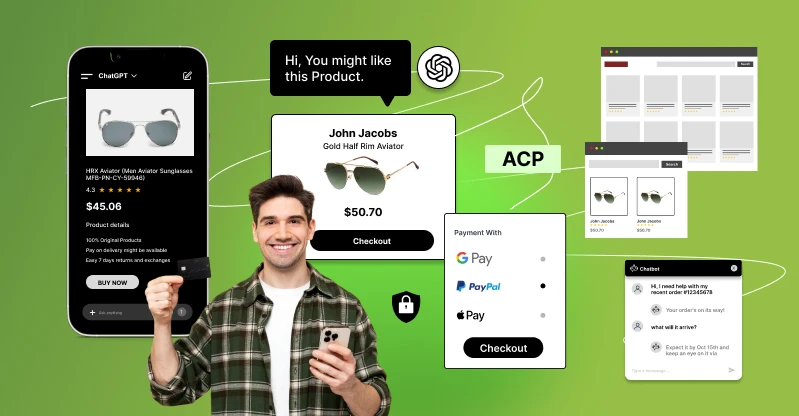
The customer journey can be understood in five stages.
1. A Shopper Describes a Need
The journey begins with natural language. Instead of entering a short product keyword, a user may describe an occasion, budget, preferred material, size, use case or concern. The request can become more specific as the conversation continues.
2. Relevant Products Are Identified
ChatGPT evaluates available product information and the context supplied by the shopper. Clear attributes and complete variant data help distinguish between products that might otherwise appear similar.
3. Products Are Presented for Evaluation
Suitable options may be shown with information such as the title, image, price, seller and relevant characteristics. The shopper can refine the request, compare alternatives or ask follow-up questions before deciding what to view or buy.
4. The Shopper Continues Toward Checkout
The exact path can vary by device, market and supported experience. The customer may continue through an embedded browser or visit the merchant’s storefront, where the applicable checkout, payment methods, policies and brand experience remain available.
5. The Merchant Manages the Order
Orders continue to flow into Shopify’s operating environment for processing and fulfillment. Shopify says merchants remain the merchant of record and retain ownership of their customer relationships and data, subject to the applicable channel experience and consent.
What Are the Benefits for Shopify Merchants?
Discovery at the Moment of Intent
AI conversations often reveal more context than a traditional keyword. A shopper might explain who the product is for, the problem it must solve and the constraints affecting the decision. Products that accurately match those requirements can become visible during a highly relevant research moment.
A Shorter Route from Research to Purchase
Conventional shopping frequently moves between search results, articles, category pages and individual product pages. Conversational discovery can reduce some of that movement by helping customers narrow their choices before they reach checkout.
Access to Multiple AI Channels
Shopify’s broader approach is not limited to one assistant. Central management gives merchants a way to prepare for several AI-led environments without treating each one as an entirely separate commerce operation.
Better Attribution and Operational Continuity
Referral attribution can help merchants identify traffic and orders associated with ChatGPT. Products, pricing and inventory remain connected to Shopify, reducing the risk of AI channels becoming disconnected catalogues that teams must update manually.
Continued Merchant Control
The merchant still owns core responsibilities such as pricing, fulfilment, returns, customer support and policy compliance. The AI channel can influence discovery, but it does not remove the need for a trustworthy store and reliable post-purchase experience.

Does Integration Affect SEO?
The integration does not automatically improve conventional Google rankings. Organic search and AI shopping use some overlapping foundations, including accessible pages, accurate product information, strong content and clear entity signals, but they are not the same distribution system.
For traditional search, merchants still need crawlable product pages, useful category content, technical stability, descriptive metadata, internal linking and structured data. For AI shopping, machine-readable product records, current availability and complete attributes become especially important.
The strongest strategy is not to choose between SEO and AI visibility. Merchants should create one dependable product-information foundation that can serve storefront visitors, search engines, shopping feeds and AI channels without contradictory details.
What Product Data Does AI Shopping Need?
An AI system cannot confidently recommend a product it cannot understand. Generic titles, missing attributes, inconsistent variants and outdated availability reduce the quality of matching, even when the product itself is suitable.
OpenAI’s product feed specification describes structured records for product and variant information. Relevant fields include stable identifiers, titles, descriptions, canonical URLs, media, price, availability, seller information and variant details. Required and optional fields have different roles, but richer accurate information can improve relevance and user trust.
For businesses managing large or complex catalogues, product information management solutions can establish consistent attributes, naming rules, variant relationships and approval workflows. This creates a reliable source from which Shopify, storefronts, feeds and emerging shopping channels can receive aligned information.
How Can Shopify Merchants Prepare?
Audit the Catalogue
Review titles, descriptions, variants, availability, pricing, images and canonical URLs. Remove vague promotional language where it replaces useful product facts. Make sure every variation is connected to the correct parent product and purchasing option.
Describe Products Around Customer Decisions
Include the information people use when comparing options: dimensions, materials, compatibility, use cases, care requirements, restrictions and differentiating features. Do not create unsupported claims merely to sound more persuasive.
Strengthen Product Imagery
Use clear primary images and relevant supporting views. Visual information should help shoppers understand scale, details, colour, fit or functionality. File names and alternative text should remain descriptive and accurate.
Keep Commercial Information Current
AI-assisted discovery loses value when a recommended product is unavailable or differently priced at checkout. Inventory, price and promotion updates should flow consistently from the system responsible for those records.
Improve the Storefront Experience
AI can introduce a qualified visitor, but the store must still earn the purchase. Speed, mobile usability, trust signals, policies, checkout and customer support remain decisive once the customer enters the merchant experience.
Merchants that need to align catalogue architecture, integrations and storefront performance can use professional Shopify development services to address the complete journey rather than treating ChatGPT visibility as an isolated feed exercise.
Do Merchants Need to Build a Separate Integration?
Shopify says eligible merchants receive access to supported AI channels through its Agentic Storefronts infrastructure without separate apps or individual integrations. Availability and exact behaviour may still vary by market, account, product category and channel.
Custom development may be needed when a business has external catalogue systems, unusual pricing rules, complex product configurations or data-quality problems. The requirement is usually not to create a new ChatGPT storefront from zero, but to ensure that the existing commerce architecture can supply dependable information.
An AI search implementation may also be valuable inside the merchant’s own storefront. It can improve natural-language product discovery after a visitor arrives, giving customers a consistent way to search using needs and use cases rather than exact catalogue terminology.
How Is This Different from an On-Site AI Chatbot?
ChatGPT shopping helps customers discover products while they are using an external AI environment. An on-site assistant operates within the merchant’s own experience and can be designed around the catalogue, policies, account functions and service workflows.
An ecommerce AI chatbot can answer product questions, explain delivery policies, help customers compare options and guide them through the store. It complements external discovery by supporting the shopper after arrival, but it should use verified data and offer access to human support when needed.
How Should Performance Be Measured?
Do not evaluate the channel only through impressions or referral sessions. A product may appear frequently but attract poorly matched visitors, while another may receive fewer appearances and generate stronger purchase intent.
Monitor these measures:
- ChatGPT-attributed sessions and orders
- Product-level clicks from AI channels
- Conversion rate by referral source
- Assisted conversions
- Revenue and profit per referred session
- New versus returning customers
- Product availability after referral
- Checkout completion rate
- Returns and customer-service contacts
Compare results with other discovery channels, but account for differences in intent and scale. Early performance should guide catalogue improvements and testing rather than justify broad conclusions from limited data.
Common Mistakes to Avoid
- Treating the original 2025 announcement as the current product experience
- Expecting every Shopify product to receive equal visibility
- Publishing incomplete titles and descriptions
- Allowing prices or availability to become inconsistent
- Confusing AI shopping visibility with guaranteed SEO rankings
- Optimising for AI systems while neglecting the customer
- Measuring sessions without connecting them to commercial outcomes
- Assuming AI discovery can compensate for weak fulfilment or support
Final Thoughts
Shopify’s connection with ChatGPT marks a shift from ecommerce being destination-led to becoming more distributed. Products can now be discovered while customers are describing needs, evaluating options and asking follow-up questions in AI environments.
The businesses best prepared for this change will not be those adding the most AI terminology to their websites. They will be the ones with accurate catalogues, distinctive product information, reliable integrations and customer experiences that remain trustworthy after the recommendation.
Magneto IT Solutions helps Shopify merchants strengthen product data, commerce architecture, AI-led discovery and conversion journeys. If your catalogue is difficult to distribute across search, storefront and AI channels, start with a readiness assessment that identifies the data and experience gaps limiting visibility.
With ongoing innovation in AI, this alliance brings ever-more integrated and intuitive digital commerce. For a better understanding, book your free consultation with our Shopify experts and grow your business with AI excellence.
FAQs
 What is the Shopify OpenAI integration?
It connects Shopify product and commerce infrastructure with supported ChatGPT shopping experiences, allowing eligible products to appear during conversational discovery and helping shoppers continue toward purchase.
Can Shopify merchants sell through ChatGPT?
Eligible Shopify merchants can make products available through supported ChatGPT experiences. The exact discovery and checkout journey can vary by device, market, category and current platform availability.
Do merchants need a separate ChatGPT app?
Shopify states that supported AI channels are managed through its infrastructure without separate channel-specific apps. Complex external systems or custom commerce rules may still require technical preparation.
How can products become more visible in AI shopping?
Maintain accurate titles, descriptions, attributes, variants, images, prices and availability. Product information should clearly explain who the item suits, how it differs and when it is useful.
Will ChatGPT shopping replace ecommerce SEO?
No. AI shopping adds another discovery route, while organic search continues to depend on crawlability, useful content, technical quality, authority and a strong on-site customer experience.


