Adobe Summit 2026 Recap and Key Takeaways
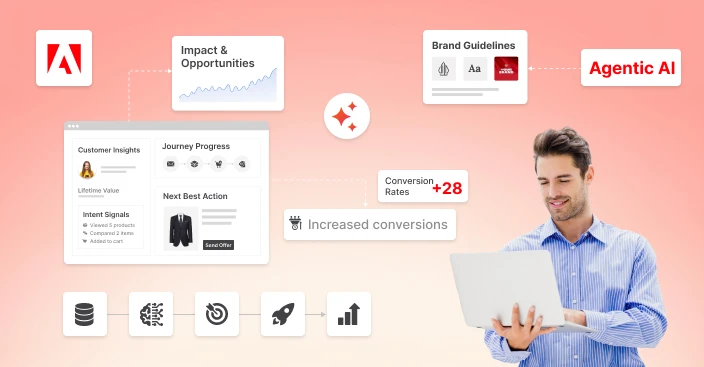
Table of Contents
With over 14,000 attendees gathering in Las Vegas, the Adobe Summit 2026 delivered one central message: the era of AI acting merely as an assistant waiting for instructions is officially over.
Today, AI understands business goals, develops strategic plans, and executes workflows autonomously. Humans have transitioned from executors to strategists. For digital decision-makers, the key announcements at this year’s Adobe Summit were less about new software features and more about a fundamental repositioning: Agentic AI is now the operating system for modern business.
What is Agentic AI?
Agentic AI refers to artificial intelligence systems that move beyond simply generating responses to actively pursuing complex goals, developing strategic plans, and autonomously executing multi-step workflows across enterprise systems with minimal human intervention.
Our e-commerce architects at Magneto IT Solutions have been analyzing these announcements, and here is what we are advising our enterprise clients. Below is our comprehensive recap of the key announcements from the Adobe Summit 2026 and what the shift to Agentic AI means for your Customer Experience (CX) and commerce strategies.
Adobe CX Enterprise:
Adobe is moving beyond the traditional Experience Cloud. The new unified platform, Adobe CX Enterprise – customer experience orchestration, is designed to orchestrate entire customer journeys through AI agents.
During a standout keynote moment, Nvidia CEO Jensen Huang joined Adobe CEO Shantanu Narayen on stage. Huang succinctly described the new Adobe as a “marketing manufacturing system” capable of producing customer experiences on an industrial scale. His advice to leaders was clear: “You never want to be too early, but you definitely can’t afford to be late.”
The core of this system integrates three key areas:
1. Brand Visibility: Tools like the Adobe Experience Manager, the new LLM Optimizer, and a strategic integration with SEMrush.
2. Customer Engagement: The Adobe Experience Platform (AEP), which now processes over 1 trillion experiences per year as a contextual data layer.
3. Content Supply Chain: Adobe GenStudio, engineered to meet exploding content demands.

Generative Engine Optimization (GEO): Visibility in the Age of AI
Generative Engine Optimization (GEO) is the strategy of structuring brand data, product catalogs, and content so that LLMs (like ChatGPT, Perplexity, and Google AI Overviews) can seamlessly read, understand, and cite your brand as an authoritative recommendation in AI-generated answers.
AI platforms like ChatGPT, Google Gemini, and Perplexity are rapidly becoming the primary interface between customers and brands. Anil Chakravarthy, President of CXO Business at Adobe, shared a striking statistic from Adobe CX Analytics: AI traffic to US online stores increased by 269% year-over-year.
Even more impressive? Visitors from AI assistants convert 31% better and generate 254% more revenue per visit compared to traditional search traffic.
Despite this, Adobe’s internal surveys show that 80% of companies have critical gaps in their brand representation on AI platforms. As Loni Stark, VP of Strategy at Adobe, put it: “For decades, brands have managed content, but now they also need to manage context.”
To address this, Adobe launched the Adobe LLM Optimizer, a tool designed to analyze agentic traffic and optimize your brand’s presence within LLMs. This firmly establishes Generative Engine Optimization (GEO) as the successor to traditional SEO.
Adobe CX Enterprise Coworker & Agentic Content Supply Chain
To tie the ecosystem together, Adobe introduced the CX Enterprise Coworker. This always-on AI agent operates as a digital colleague. By natively integrating with leading LLMs from Anthropic, OpenAI, Google, and Microsoft, Adobe reduces “walled-garden” risks for enterprises. You set the goal, for example, “Increase cross-sell performance by 3%” and the Coworker autonomously develops a campaign, coordinates with your team, executes across channels, and measures results.
This automation is critical because the demand for content is projected to increase fivefold by 2027. Manual production can no longer keep pace.
With Adobe Creative Agent and GenStudio, a creative brief that historically took three weeks to process can now be generated in 7 minutes and finalized in 30. Through Brand Intelligence, the system automatically ensures all generated assets remain strictly on-brand by learning from past approvals and rejections rather than relying solely on static guidelines.
Adobe Commerce: The Agent-Ready Storefront
Commerce was a focal point of the Summit, proving that the “Agentic Era” is a concrete product reality. Adobe Commerce is evolving into an agent-based system, offering a fully managed cloud solution and a flexible optimization layer that can sit on top of existing e-commerce systems.
For B2B organizations, the most technically consequential announcement was the Commerce MCP Server, which gives developers secure, real-time access to catalog, cart, pricing, and order management capabilities for AI agents. Paired with new B2B Drop-in Capabilities for negotiable quotes and purchase orders, Adobe is laying the groundwork for complex AI-assisted RFQ workflows.
Two vital questions emerged for B2B and B2C brands:
Are your products AI-readable?
When a user asks ChatGPT for product recommendations, your catalog must be semantically enriched to be understood and recommended. This requires a robust data infrastructure; your Product Information Management (PIM) and Digital Asset Management (DAM) systems are now the foundation of your AI discoverability.
Can AI agents buy directly from your storefront?
Through the new Adobe Brand Concierge, customers can consult with a dialog-oriented AI and complete their purchases directly within the conversation without ever navigating to a traditional checkout page. DICK’S Sporting Goods demonstrated this live on stage, showing frictionless AI-to-AI purchasing is a reality today.

Actionable Takeaways for Digital Leaders
1. GEO is the New SEO: Optimizing for human search is no longer enough. Your product data and brand messaging must be agent-ready to capture high-converting AI traffic.
2. Brand Governance Must Scale Systemically: Relying on human review for every asset is a bottleneck. Systems like Adobe Brand Intelligence make brand consistency operationally scalable via machine learning.
3. Content Production Needs an Industrial Upgrade: With content demand skyrocketing, adopting an AI-powered content supply chain is the only viable way to scale without exhausting your teams.
4. Agentic Commerce is Here: Integrating AI into your storefront isn’t just about chatbots; it’s about enabling frictionless, conversation-driven checkouts, a growing priority for enterprises seeking Adobe Commerce Development Services In New York. and AI-to-AI purchasing.
Conclusion
Adobe Summit 2026 showed how fast things are changing. Your brand needs to be ready for how AI discovers, recommends, and brings your brand in front of customers.
What’s changing is visibility and control. AI is starting to decide what gets seen, what gets recommended, and what gets bought. That directly impacts how customers find and choose your brand.
Businesses that adapt early will stay visible and grow.
Are you ready for the Agentic Era?
The tools exist, the integrations are live, and early adopters are already pulling ahead. If you have questions about Adobe CX Enterprise, Agentic Commerce, or how to prepare your tech stack for the future, Magneto IT Solutions is here to help.
Schedule a non-binding consultation with our experts today.
FAQs
 What was the main theme of Adobe Summit 2026?
The central theme of Adobe Summit 2026 was the shift to Agentic AI. Adobe announced a transition from AI merely assisting humans to AI agents autonomously executing workflows, managing campaigns, and orchestrating customer journeys via the new Adobe CX Enterprise platform.
What is the Commerce MCP Server announced at Adobe Summit?
The Commerce MCP Server is a newly introduced technical foundation that provides secure, real-time access to Adobe Commerce capabilities (like catalog, cart, and pricing) directly to AI agents, enabling complex agentic procurement and B2B workflows.
How is Adobe addressing Generative Engine Optimization (GEO)?
Adobe introduced the LLM Optimizer to help brands analyze agentic traffic and optimize their content for Large Language Models. This tool allows companies to improve their visibility and contextual relevance within AI engines like ChatGPT and Perplexity.
What is an agent-ready commerce ecosystem?
An agent-ready ecosystem enables AI agents to interact with your commerce platform, accessing product data, pricing, and checkout processes, to support conversational commerce and even autonomous purchasing journeys.
How can Magneto IT Solutions help businesses adopt Agentic AI?
Magneto IT Solutions helps enterprises transition to AI-ready ecosystems by optimizing data structures, implementing scalable commerce solutions, enabling GEO strategies, and integrating AI-driven workflows that align with business goals.