Agentic Commerce in News: Google and OpenAI Redefine the Future of AI‑Driven Retail
Table of Contents
This week marks a decisive inflection point for AI‑driven marketing and ecommerce. With Google and OpenAI introducing new open protocols and agent‑powered shopping capabilities, the industry is moving beyond experimentation into large‑scale, production‑ready agentic commerce.
These announcements signal a structural shift in how consumers discover products, evaluate options, complete purchases and how brands orchestrate those journeys across channels.
The “storefront” now incorporates AI assistants, for delivering conversational interfaces, and autonomous agents that operate across platforms in addition to websites and applications. It has a big impact on online retailer executives, particularly for the CTOs and tech decision-makers.
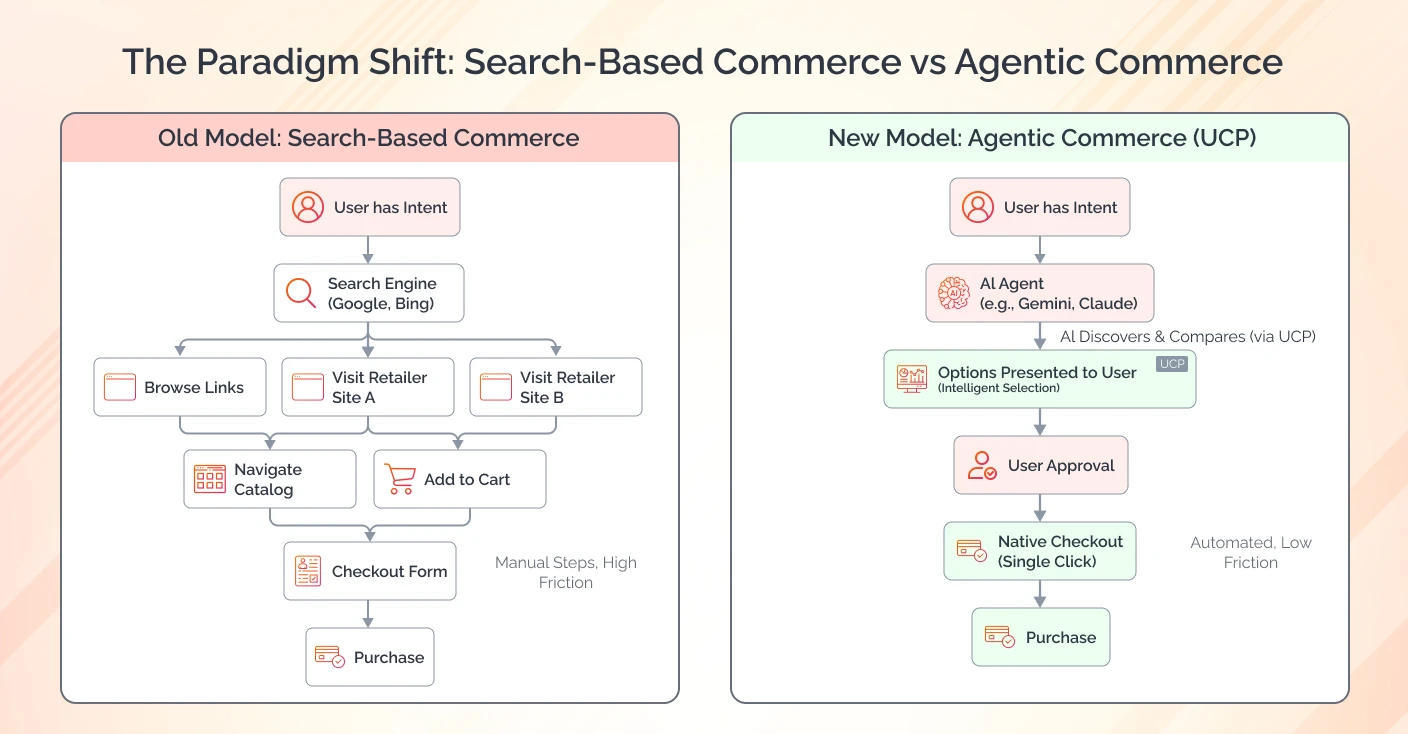
The structural shift from traditional “Search & Scroll” commerce to the streamlined “Agentic” workflow
In this article, we will break down the important developments and explain what they signify for ecommerce CEOs, marketing teams, and technical stakeholders involved in commerce design and data systems.
Google Introduces the Universal Commerce Protocol (UCP)
Google’s Universal Commerce Protocol (UCP) is designed to standardize how AI agents, retailers, and platforms collaborate across the full commerce lifecycle from discovery and decision‑making to checkout and post‑purchase support.
Developed in collaboration with major retail and platform partners, UCP is built as an open, interoperable standard that works alongside existing protocols such as Agent‑to‑Agent (A2A), Agent Payments Protocol (AP2), and the Model Context Protocol (MCP).
What UCP Enables
For ecommerce brands and agencies, UCP introduces several structural changes:
- Cross‑platform agent compatibility – a single integration can support multiple AI assistants and marketplaces.
- Conversational purchasing – customers can complete transactions directly within AI interfaces such as Google Search or Gemini.
- Consistent data exchange – product, inventory, pricing, and fulfilment data can be synchronized across channels.
- Reduced integration overhead – less dependency on bespoke, platform‑specific connectors.
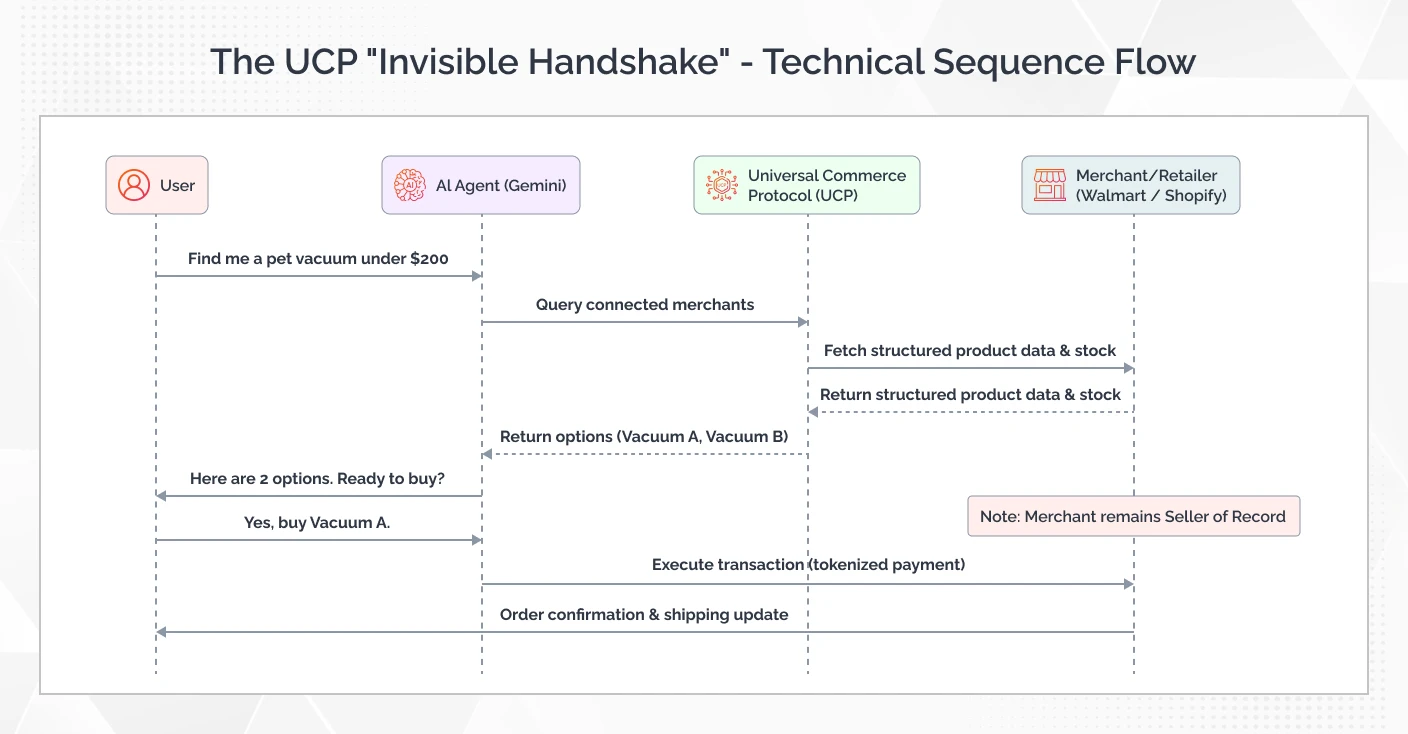
How UCP technically connects user intent to merchant fulfillment while keeping the retailer as the Merchant of Record.
From a technical standpoint, this transforms connections from UI-driven processes to API- and protocol-based interactions, while emphasizing the significance of clean data models and integration management.
Strategic Impact for Marketers and Agencies
UCP expands the concept of omnichannel marketing into what can be described as omni‑agent commerce, where discovery and transactions can occur in any AI‑mediated environment.
This requires organizations to:
- Rethink product feed architecture and structured data strategies.
- Prepare for new attribution models where AI agents mediate the customer journey.
- Develop capabilities in conversational experience design and agent training.
For technology teams, this also means determining if existing commerce platforms, PIM systems, and APIs are designed to be consumed by autonomous agents.
Brands that implement open standards early will be better positioned to capitalize on demand as AI interfaces become more popular shopping destinations.
Google’s Retail AI Vision: Gemini Enterprise and Agentic Customer Experience
At NRF 2026, Google outlined a broader strategy to position AI as the operational backbone of modern retail.
The company introduced Gemini Enterprise for Customer Experience, a platform designed to unify search, commerce, and customer service into a single, AI‑orchestrated system. Retailers can deploy agentic assistants across:
- Online storefronts
- Mobile applications
- In‑store kiosks
- Customer support channels
From Campaigns to Continuous Journeys
This marks a transition from campaign‑centric marketing to journey‑centric optimization.
AI agents can:
- Deliver real‑time, personalized product recommendations.
- Provide proactive customer support.
- Maintain context across channels and sessions.
- Drive higher lifetime value through consistent, adaptive engagement.
This raises the requirement for unified consumer data structures, real-time sync, and event-based commerce frameworks.
Implications for Agencies
Digital agencies will increasingly be evaluated on their ability to:
- Design and train brand‑aligned AI agents.
- Analyze conversational data at scale.
- Orchestrate cross‑channel experiences spanning digital and physical touchpoints.
Retail innovation is also extending into logistics, with AI‑driven fulfilment and last‑mile delivery further blurring the boundary between digital and physical commerce.
OpenAI and Stripe Launch Instant Checkout in ChatGPT
OpenAI, in partnership with Stripe, has introduced Instant Checkout within ChatGPT, powered by the open‑source Agentic Commerce Protocol (ACP).
Initially available to U.S. users and rolling out to a broad network of merchants, this capability transforms ChatGPT from a research assistant into a full‑fledged commerce channel.
Why This Matters
ChatGPT is already embedded in early‑stage buying behavior. With native checkout functionality:
- Product discovery, comparison, and purchase occur in a single conversational flow.
- AI agents handle intent matching, order routing, and payment orchestration.
- Merchants retain control over fulfilment and customer relationships.
For the CTOs, this demonstrates that AI interfaces are evolving into transactional endpoints, necessitating backend systems that can reliably enable agent-initiated orders.
Marketing and Data Strategy Considerations
For ecommerce teams and agencies, visibility in AI‑native environments depends less on advertising spend and more on:
- High‑quality structured product data.
- Clear semantic descriptions.
- Integration with open commerce protocols.
This shifts optimization priorities from traditional SEO alone to AI‑readiness ensuring products are understandable, accessible, and actionable by autonomous systems.
Strategically, the convergence of AI interfaces and payments infrastructure accelerates the move toward conversational commerce at scale.
Industry Perspective: What Tech Media Is Highlighting
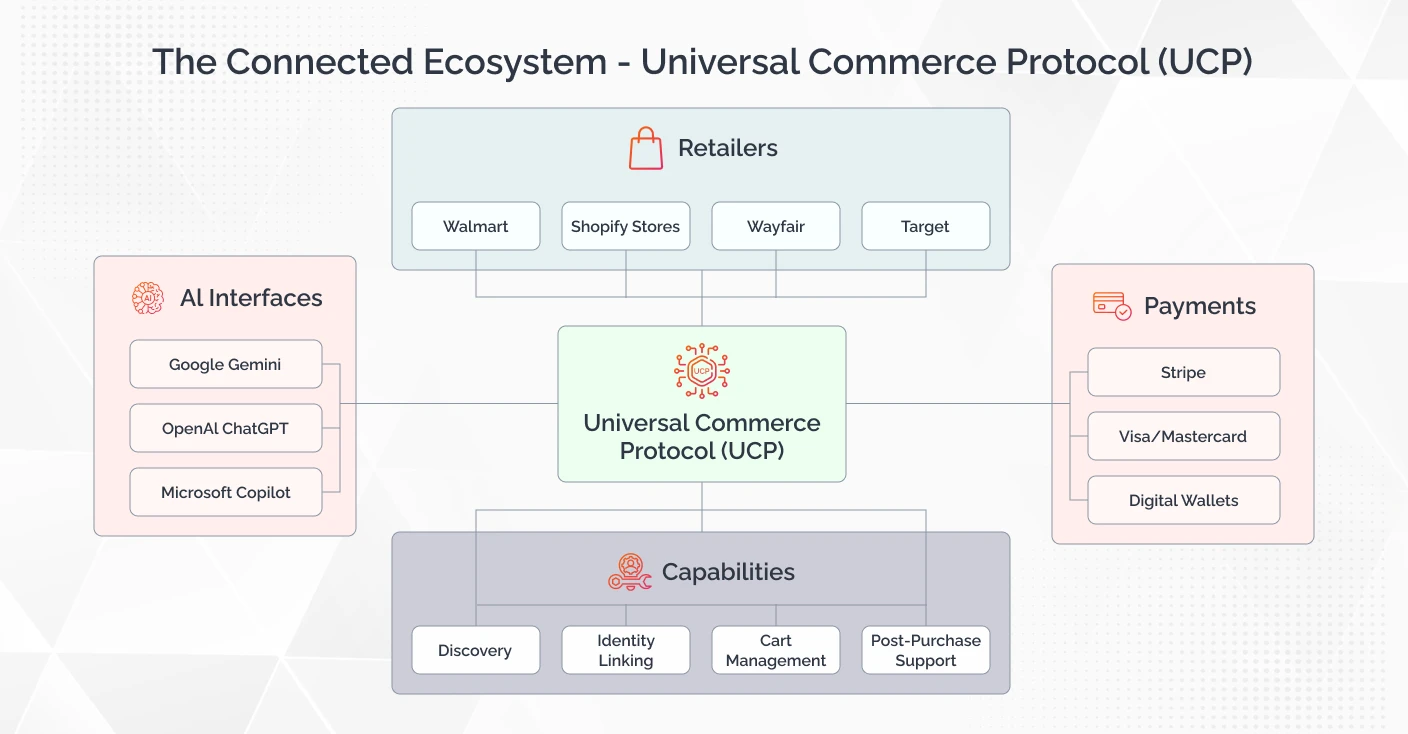
The unified ecosystem connects AI models, payments and retailers through open standards like UCP and ACP.
Industry analysts and technology publications describe UCP as a foundational layer for the next generation of digital commerce.
Key themes emerging from early coverage include:
- End‑to‑end agent participation across the shopping lifecycle.
- Interoperability between competing platforms and ecosystems.
- Rapid growth of startups focused on AI‑native product discovery and agent tooling.
The technical leaders can highlight the necessity of API-first commerce systems and structured data pipelines as foundational skills.
Investments in structured data pipelines, API‑first commerce platforms, and protocol compatibility are increasingly viewed as baseline requirements rather than experimental initiatives.
What This Means for Us
The introduction of UCP, Business Agent capabilities, and conversational ad formats signals a new operating model for performance marketing.
Near‑Term Marketing Shifts
Marketers should prepare for:
- Agent‑mediated discovery – AI systems acting as the first point of product evaluation.
- Real‑time personalization – offers and recommendations generated dynamically.
- Non‑linear journeys – customers moving fluidly between platforms without a single “funnel.”
Technology teams should plan for higher AI traffic, external calls to the system, and agent-driven relationships with core commerce systems.
Organizational Readiness Checklist
To remain competitive, marketing teams should:
- Audit product data for structure, completeness, and semantic clarity.
- Evaluate readiness for open protocol integrations (UCP, ACP).
- Build internal or partner capabilities in conversational UX design.
- Update measurement frameworks for AI‑assisted attribution.
Agencies that can integrate marketing strategy with data engineering and AI system design will occupy a critical advisory role in this transition.
Strategic Recommendations for the Agentic Commerce Era
Agentic commerce is no longer speculative, it is being deployed by the largest technology platforms in the world.
For marketing and ecommerce leaders, three priorities stand out:
1. Adopt Open Commerce Standards Early
Ensure commerce infrastructure supports emerging protocols to avoid platform lock‑in and maximize future channel reach.
2. Design for Conversational Experiences
Move beyond page‑centric UX to agent‑oriented customer journeys that prioritize dialogue, context, and continuity.
3. Invest in Skills and Partnerships
Develop expertise in:
- Structured data architecture
- Agent training and governance
- Conversational analytics
- Cross‑platform attribution
Early adopters will benefit from lower integration friction, faster experimentation, and stronger positioning in AI‑native discovery channels.
Key Takeaways
- Open commerce protocols are redefining how brands integrate with AI platforms.
- Product data quality is becoming a primary driver of visibility and conversion.
- Marketing strategies must evolve from channel‑centric to agent‑centric models.
- Agencies will need to blend marketing, data engineering, and AI system design expertise.
- Conversational checkout is accelerating the shift toward frictionless, AI‑mediated purchasing.

Conclusion
The coordinated moves by Google and OpenAI represent a structural re‑engineering of digital commerce.
As AI agents assume greater responsibility for discovery, decision‑making, and transactions, marketing and ecommerce teams must adapt their data, technology, and experience design strategies accordingly.
Organizations that embrace open standards and agent‑first journeys will be better positioned to compete in an environment where customer interactions are increasingly mediated by intelligent systems.
Need help preparing your commerce architecture and growth plan for AI-powered search and agentic commerce?
Connect with Magneto IT Solutions, we work as an AI-driven Digital Commerce and Growth Marketing Partner helping B2C, D2C, and B2B brands establish scalable, AI-ready ecosystems. We don’t just develop technology; we also design growth for an AI-first future.
FAQs
 Can AI-powered search change the SEO performance?
With the help of AI-powered search, brands can opt for organized data, logical clarity, and automated product information over keywords. It will help them to guarantee that their product, pricing, and inventory data for easily comprehended and consumed by AI systems on several platforms.
What kind of alignments is required for paid media strategies?
AI-powered tools can help to align the paid media in a better manner. By implementing context-aware targeting, with real time relevance the performance can be boosted with data-led integrations and campaigns.
How do brands optimize for AI product summaries and overviews?
Brands may improve AI-generated product summaries by ensuring uniform product taxonomy, correct characteristics, and well-managed data across commerce platforms, allowing AI to deliver clearer and more reliable information.
What is the importance of open protocols?
Open protocols are very crucial for delivering seamless interaction across AI platforms and commerce systems. Resulting in cutdown dependency on proprietary interfaces while boosting scalability, flexibility, and long-term stability.
How should agencies prepare?
To help companies stay competitive in an increasingly agent-driven commerce ecosystem, agencies must improve their expertise in structured data, conversational interactions, AI connections, and commerce architecture.