Smart DAM: How AI Accelerates Asset Tagging and Content Delivery
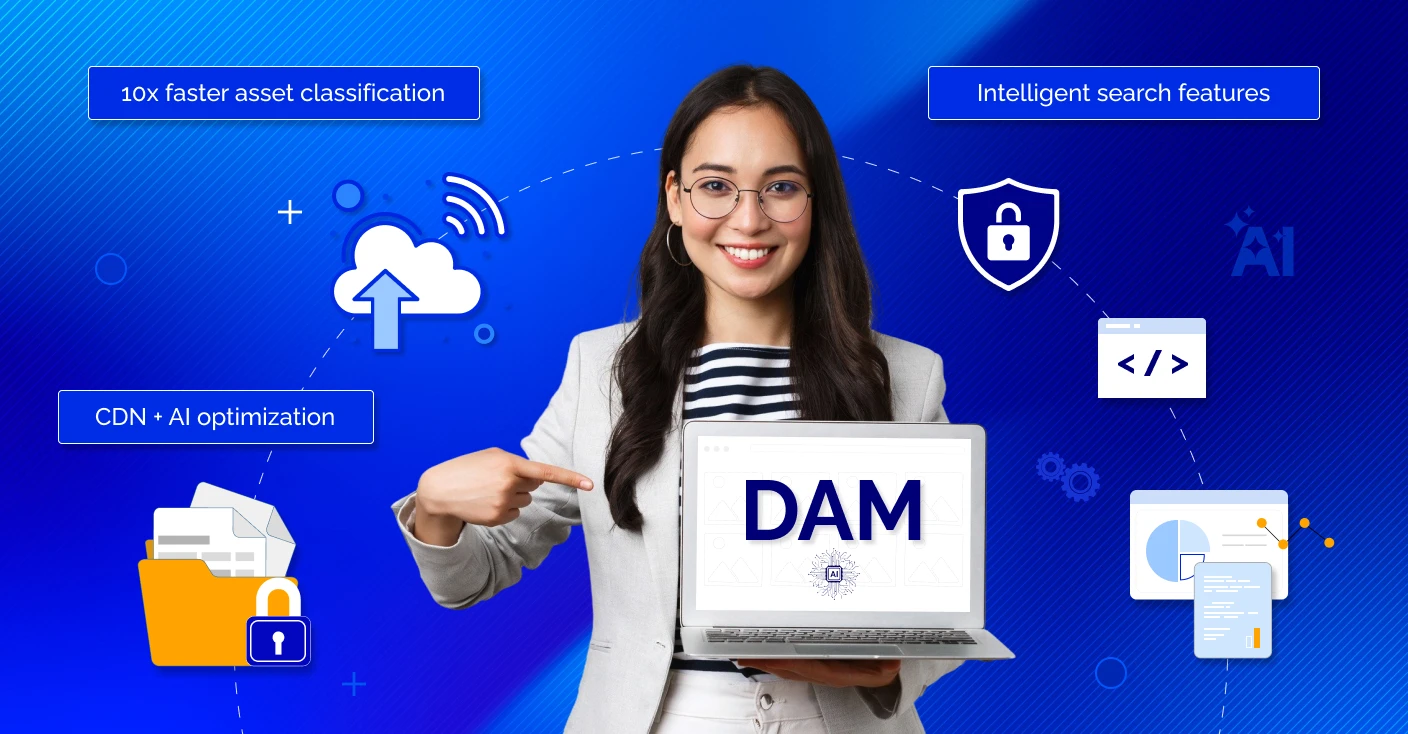
Table of Contents
Content is now considered the most valuable asset for modern businesses. It ranges from product pictures, product videos, marketing campaign creatives, and documentation, right up to brand guidelines. The more a business expands, either online, offline, or both, the more of this type of element is produced. The more this growth increases, the more important for this element to work accordingly.
Classic Digital Asset Management platforms were intended to manage and store digital assets, but are inadequate in terms of speed, volume, and personalization in today’s fast-paced world. Tagging, metadata terminology inconsistency, search speed, and content delivery speed become major roadblocks in terms of speed-to-market.
Smart DAM technology, fueled by artificial intelligence, solves these issues by offering innovative ways of asset marking, discovery, governance, and distribution. Smart DAM technology is based on artificial intelligence and brings intelligence and automation to the process of content operations.
In this blog, we shall discuss the functionality of Smart DAM, the use of AI in intelligent DAM systems, key features, use cases, advantages, and difficulties, and why the need for AI-based DAM has arisen to ensure scalable experiences.

What Is Smart DAM?
Smart DAM is a development of traditional Digital Asset Management that incorporates AI and machine learning algorithms. Unlike traditional systems that relied on manual entry and static metadata for their functions, Smart DAM systems use algorithms that can analyze assets to deduce their content and use potential.
At its core, Smart DAM aims to simplify the search, manage, and activate process for electronic assets. AI technology has enabled DAM solutions to evolve from simple storage solutions to smart systems that play an active role in the process of electronic asset creation, distribution, and performance enhancement.
Smart DAM, with the integration of intelligence into asset management, enables enterprises to minimize friction and maximize the value of their digital assets, promoting content velocity.
The Role of AI in Digital Asset Management
Artificial intelligence is what makes Smart DAM possible. It enables machines to handle large amounts of data that have no structure at a scale and speed that an individual or an automated process cannot tackle.
With the help of computer systems brands can analyze images and videos by detecting objects, colors, and logos. It recognizes patterns and objects through computer vision. Another feature of deep learning is natural language processing.
It allows machines to process unstructured chunks of data on a scale and speed which is not feasible for an individual or an automated process.
The computer system assists in image and video analysis by means of object recognition, color recognition, and logo recognition.
Key Capabilities for Smart DAM using AI
Intelligent Asset Tagging and Classification
Smart DAM provides the advantage of automated asset tagging. The AI, after the ingestion of assets, analyses them and creates metadata depending on the visual and text content of the assets. This makes it independent of manual tagging, which can be slow, inconsistent, and prone to errors.
Artificial intelligence integration ensures that the assets can be searched as soon as they are uploaded. With time, the system learns and gets better based on corrections and usage, ensuring that the results of the classification get more accurate.
Advanced Search and Discovery
Smart DAMs make a significant impact on asset discovery, as it goes beyond keyword search. Artificial intelligence search shows understanding capability, context, and connection based search. The search can be done by expressing it in words, phrases, or even images.
This capability saves time on searching for assets, as well as improves their reuse, to prevent the lockdown of valuable assets.
Context-Aware Content Organization
AI helps Smart DAM solutions analyze not only the content, but the usage of the content as well. Based on a campaign, channel, intent, or lifecycle stage, content can be categorized.
This context-driven organization facilitates and improves workflows and makes way for intelligent content activation related to marketing, commerce, and experience.
Faster Content Distribution Through All Channels
Smart DAM can be interfaced easily with content management systems, e-commerce platforms, marketing automation platforms, as well as digital experience management platforms. AI tools also help in taking decisions on asset selection, based on the channel, format, as well as target audience.
This means that the process of distributing content can be done faster, and there is no need for human coordination when working with Websites, Mobile Applications, Email Campaigns, or Social Media.
Governance, Compliance & Brand Control
The more content there is, the more difficult managing the governance process becomes. This is where the Smart DAM, through AI, can automatically apply brand and compliance guidelines. The system can identify resources as outdated or non-compliant and monitor usage rights.
In global companies, this functionality helps strike a balance between speed and control as local staff are able to work effectively without affecting brand integrity.
Smart DAM and Enterprise Content Operations
Smart DAM: Smart DAM has become the backbone of all enterprises as it integrates creation, management, and activation of content in a single operation. Marketing teams are able to execute their campaigns quickly, whereas creative teams spend less time on paperwork.
Content operations specialists have clearer visibility into asset usage, performance, and state. This allows an organization to have data-driven insights into content investment, reuse, and optimization.
In this way, Smart DAM reduces friction in content workflows, thus improving collaboration and efficiency.
Business Benefits of AI-Powered Smart DAM
Smart DAM’s influence, however, does not end there. When the system automatically tags content, the tag suggestions are related to the content the user searched for, and this feature cuts down the cost and time spent performing operations. Now, due to the increased speed provided by content velocity, the time-to-market process gets shortened, and as a result.
Optimal use of assets maximizes ROI on content investments, and benefiting from competencies builds brand trust and user experience. AI insights can also assist an organization when it comes to knowing which assets work best.
Taken together, these advantages place Smart DAM more as a strategic enabler than a supporting system for the digital growth of the company.
Key Enterprise Use Cases
Smart DAM offers support for numerous business applications. In the area of eCommerce, the software speeds up the updating and personalization of product content. In the field of marketing, the software simplifies the implementation and consistency of marketing campaigns.
The media and entertainment industry utilizes Smart DAM for large-scale content distribution and rights management. The B2B business industry also depends on it for managing technical documents, product images, and sales enablement content.
In all applications, Artificial Intelligence-driven DAM adjusts for complexity and ensures control and scalability.
Challenges and Implications of Implementation
Although the benefits of Smart DAM are obvious, sound fundamentals also play a crucial role in the success of its implementation. Data quality, metadata, and taxonomy have always been essential for achieving the best results of AI.
Integration with other existing systems, such as CMS, PIM, and marketing platforms, becomes a decisive factor in unlocking the end-to-end benefits. The other area that organizations need to focus upon is privacy, security, and ethical challenges, as in AI-based image recognition or user behavior analysis.
Change management is as important. Teams require this in order to adopt and trust these AI-driven workflows.
Best Practices When Scaling Smart DAM
The implementation of Smart DAM in business should be carried out with specific goals in mind, such as improving search times for assets or delivering content more quickly. This approach enables reaching Quick Wins.
It is important to build data foundations strongly and choose a DAM system that has robust AI capabilities and open integrations to ensure scalability. Continuous measurement and feedback enable the system to improve over time in line with business needs.
Smart DAM needs to be considered an endurance solution, rather than a project that has been completed.
The Future of Smart DAM
With the progression of AI technology, Smart DAM systems will also become more aggressive. There will be support of generative AI for asset development and modification, and more advanced analytics for content strategies.
Rather, the future of DAM software is one of not only managing but suggesting what content needs to be developed, reused, or retired. Which is a much smarter approach to content operations.

Conclusion
Smart DAM comprises an entirely new approach to digital content management for businesses. Organizations are able to overcome the restrictions of conventional DAM with the aid of AI, which helps in automating asset tagging and fast content delivery.
AI-Powered DAM assists in having faster workflows, effective governance, and easy discoverability and activation. Since content is driving the experience and differentiation in the digital space, it is not an option anymore, rather an imperative for any enterprise looking to compete and grow in this content-driven digital world and hence comes the concept of Smart DAM.
FAQs
 What is Smart DAM?
It is an Artificial Intelligence-enabled Digital Asset Management tool. It does automatic tagging, enhanced searching, and faster content distribution.
How AI enhances asset tagging?
Artificial intelligence employs computer systems and natural language processing to produce accurate and consistent metadata.
Can Smart DAM support omnichannel content delivery?
Yes, it does. It integrates with many platforms for the efficient delivery of the right assets.
Is Smart DAM good for large corporations?
Yes, it’s intended to scale for large asset libraries, global teams, and complex workflows.


